
The Windows of St. Martin’s
Pre-Raphaelite
A plan of St. Martin’s Church showing the location of main windows and features.
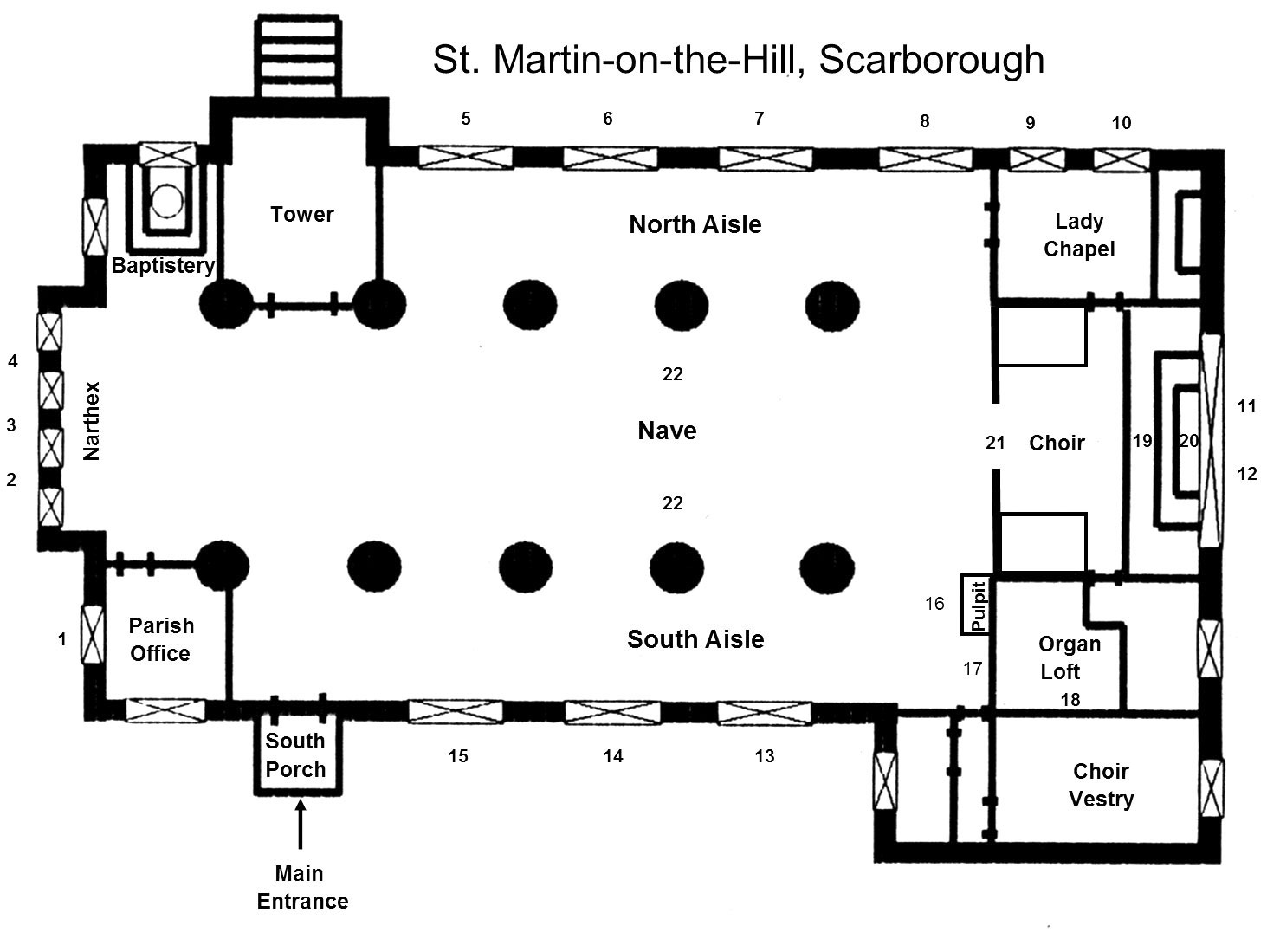
Key to the pre-Raphaelite windows, pulpit and organ screen:
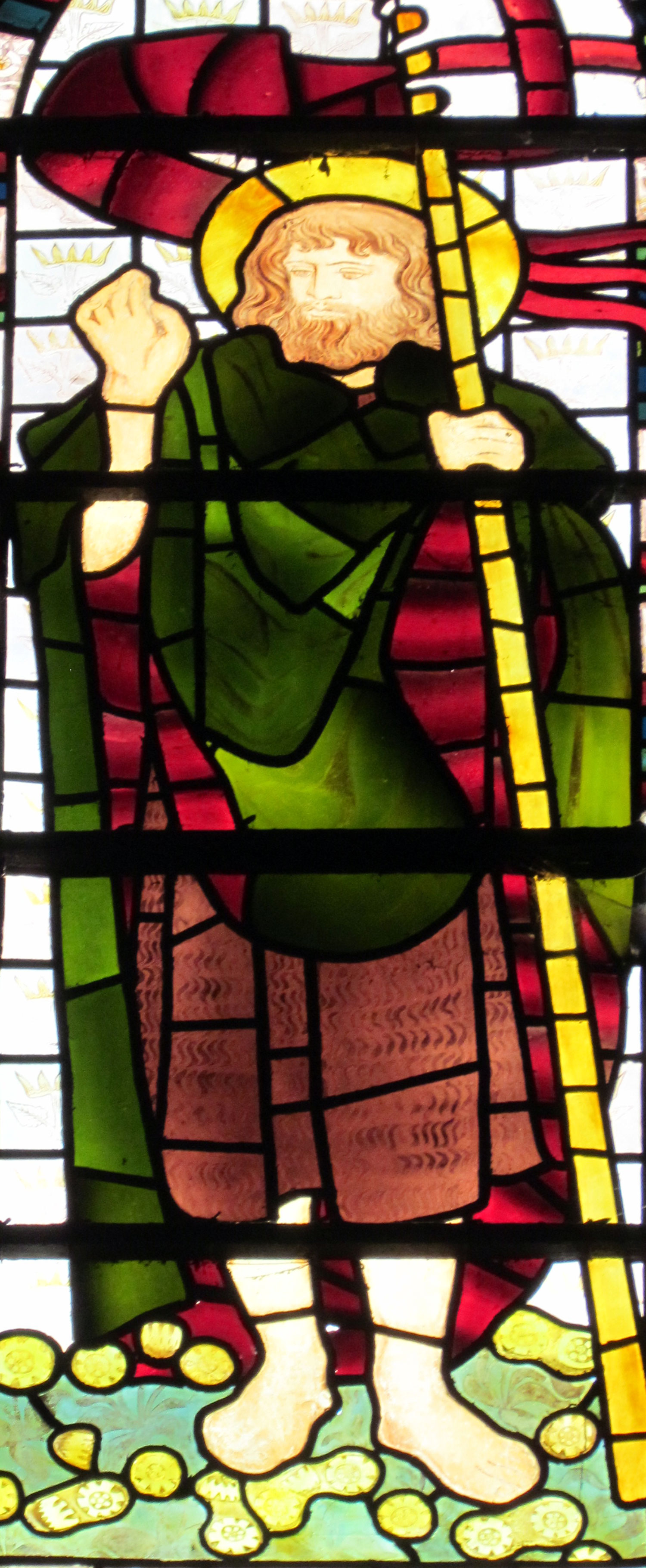
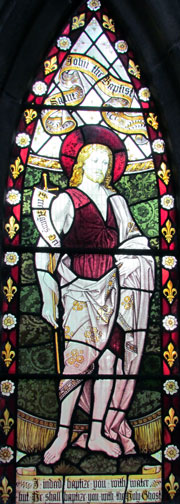
St John the Baptist by Morris & Co.
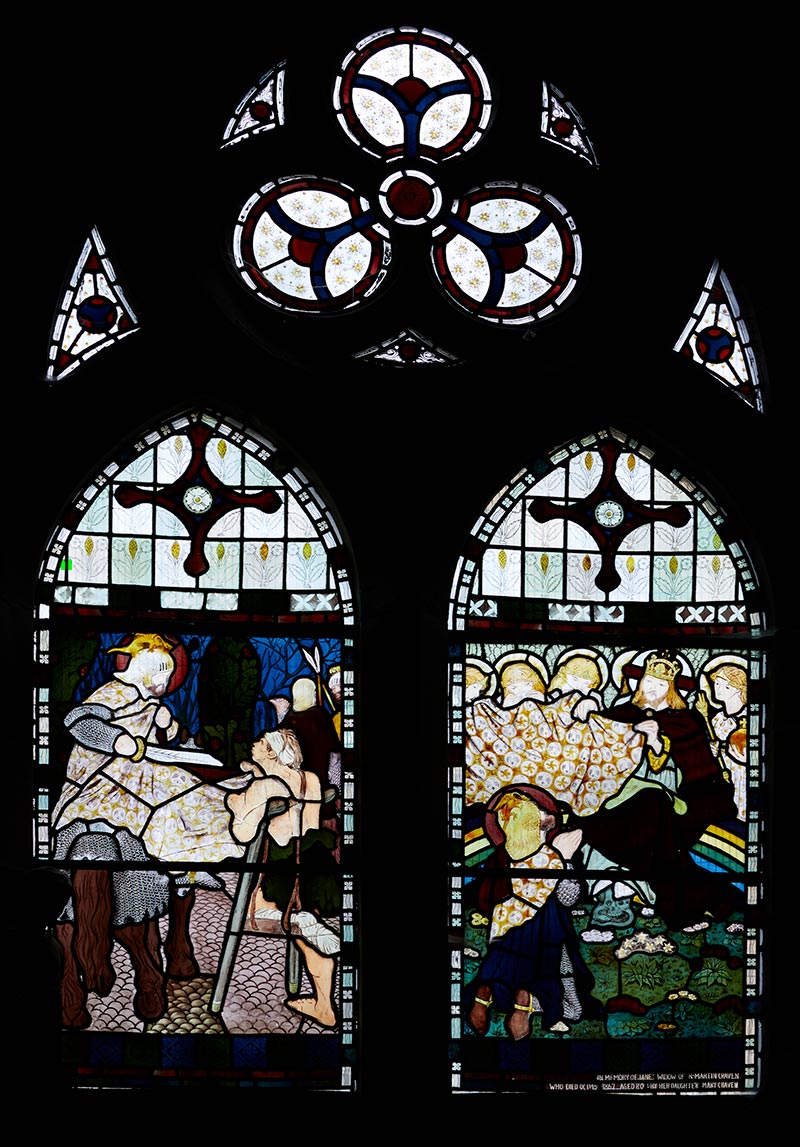
1 : The St. Martin Windows by Ford Madox Brown
This window is found on the west wall inside the parish office.
The Parish Office contains what is considered to be the finest window in the church. It is by Ford Maddox Brown and shows two episodes from the life of St. Martin.
On the left St. Martin divides his cloak with a beggar; note the two roman soldiers mocking Martin's actions and the detail of the beggar's injured leg.
On the right he sees the same cloak in heaven in the hands of Christ and supported by angels. We see Christ the King, a very catholic icon, with an angel holding his septre and orb. Christ's feet rest on a skull and a serpent symbolising his conquest of both death and the devil.
Note also that Christ sits on a rainbow with a foreground of painted flowers and grass. The angels hold the cloak in front of their faces.
The composition is artificial ( and in fact defies perspective) but is satisfying for all that. The colours are very fine.
The window was commissioned by Miss Mary Craven as a memorial to her mother, Jane, who died in 1862.
For more detail click the windows to enlarge.
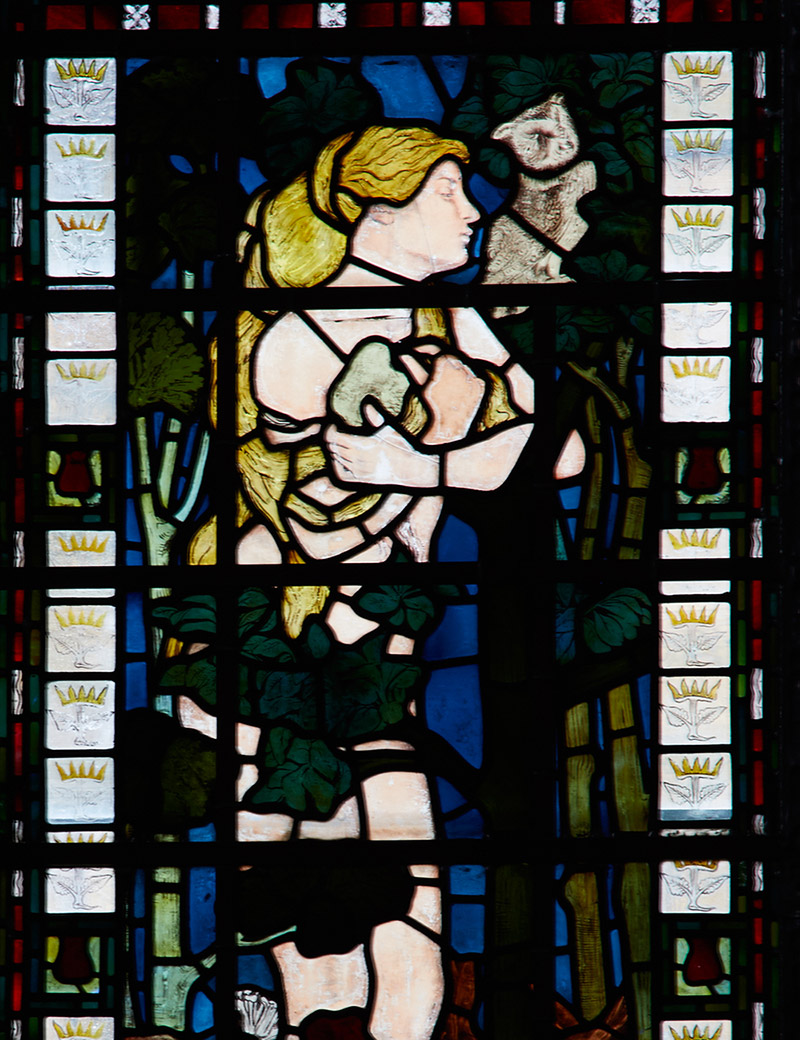
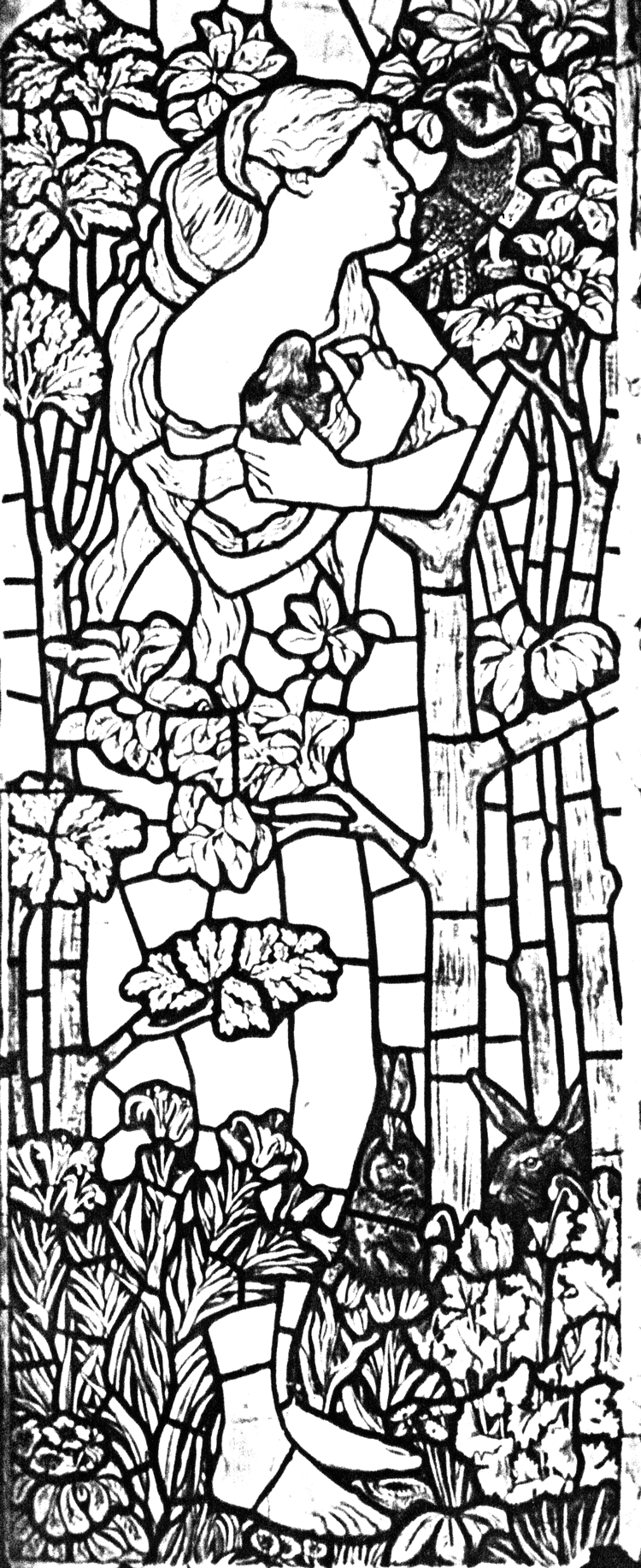
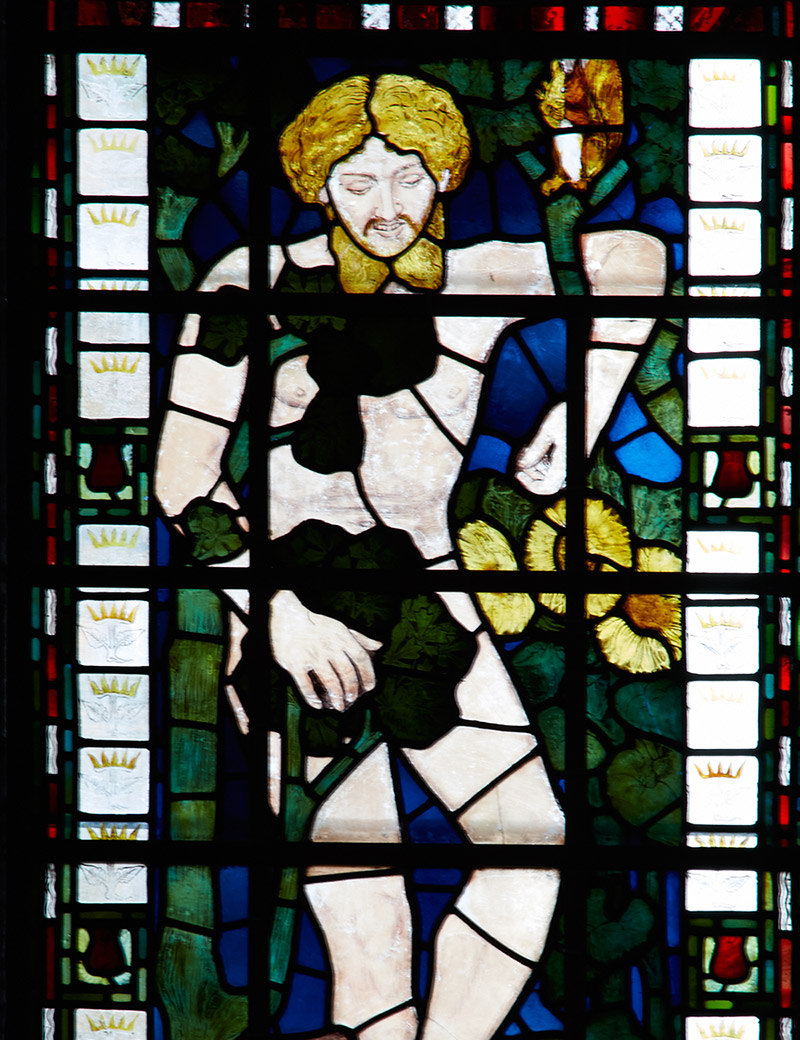
2 : West wall south lancet: Eve by Ford Madox Brown
The cartoons on this page show the artist and his second wife, Emma Hill, as Adam and Eve.
Brown himself described the two as being in attitudes of indolent repose. Adam is tickling a bear with his foot. This is both a pun and a symbol of the downfall of man. Adam is “bare” while the bear, as a wild animal, has symbolized cruelty and evil influence. In the Old Testament it is used to represent the Kingdom of Persia, which brought death and corruption into the world, and was finally destroyed by God (Daniel 7: 5).
Two bears are said to have appeared from the woods and eaten the children who mocked the prophet Elisha because of his baldness (II Kings 2: 24).
Bear cubs were believed to be born shapeless, their form being given to them by the mother bear. This legendary act became a symbol of Christianity, which reforms and regenerates heathen people. It is in this sense that a number of legends concerning the taming of a bear by a saint may be interpreted. Typical is the story of St. Euphemia, who, when thrown to the wild animals in the arena, was worshiped, rather than eaten, by the bear.
The red squirrel appearing eating an acorn on a branch above Adam's left arm is also symbolic of the devil, as the glowing colour of the squirrel’s fur were equated with the fires of hell. Also, the squirrel's lightning-fast turn of speed and destructive, tricky ways were considered further confirmation that this was indeed a creature of Satan.
Eve, however, cradles a bird thought to be a duck, and has an owl on her shoulder. The duck is generally thought to be a symbol of freedom. They can walk on the earth and swim in the sea as humans do but they also have the ability to soar into the sky. Birds are free to roam to earth and the sky. Many cultures believe that they are a symbol of eternal life; the link between heaven and earth. The fact that Eve cradles the duck may represent that link has just been lost. Furthermore, she may be cradling the duck because it is injured – a symbol of fateful or deep sadness caused by erring offspring.
The owl has a variety of meanings, but in this instance it is most likely to symbolize Satan, the Prince of Darkness, because the owl hides in darkness and fears the light. As Satan deceives humanity, so the owl is said to trick other birds, causing them to fall into the snares set by hunters.
Its most ancient gift, however, is that of wisdom, and, with this meaning, it is sometimes shown with St. Jerome.
In another sense, the owl is an attribute of Christ, who sacrificed Himself to save mankind, 'To give light to them that sit in darkness and in the shadow of death . . .' (Luke I: 79). This explains the presence of the owl in scenes of the Crucifixion.
The images portray Adam and Eve after the downfall of man as they are both clothed in leaves having become aware of their nakedness.
Both windows were donated by Miss Mary Craven at a cost of £100.
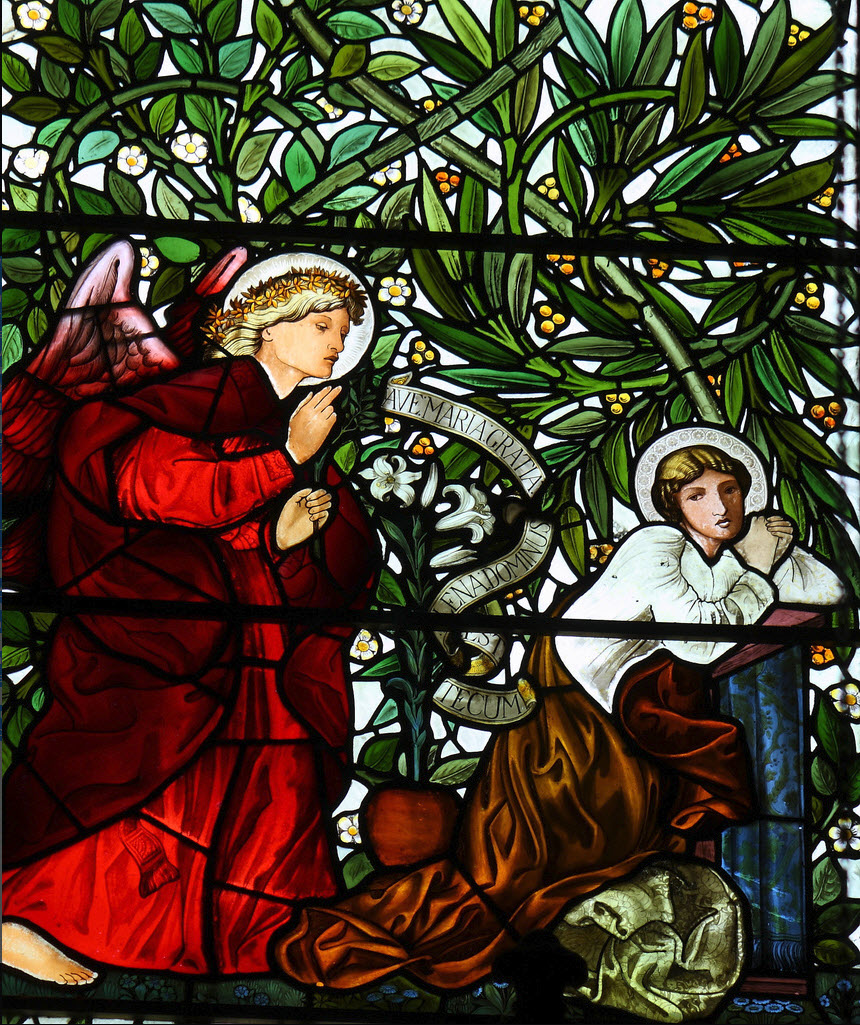
3 : West wall rose window centre: The Annunciation by Sir Edward Burne-Jones
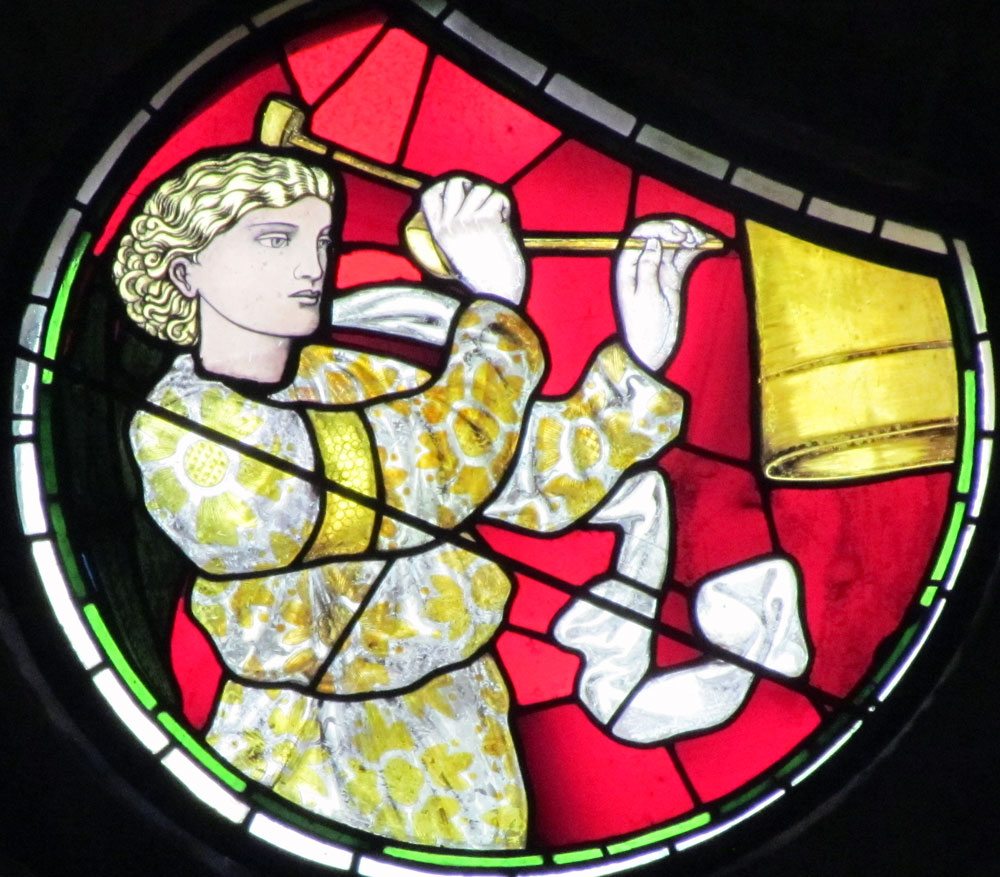
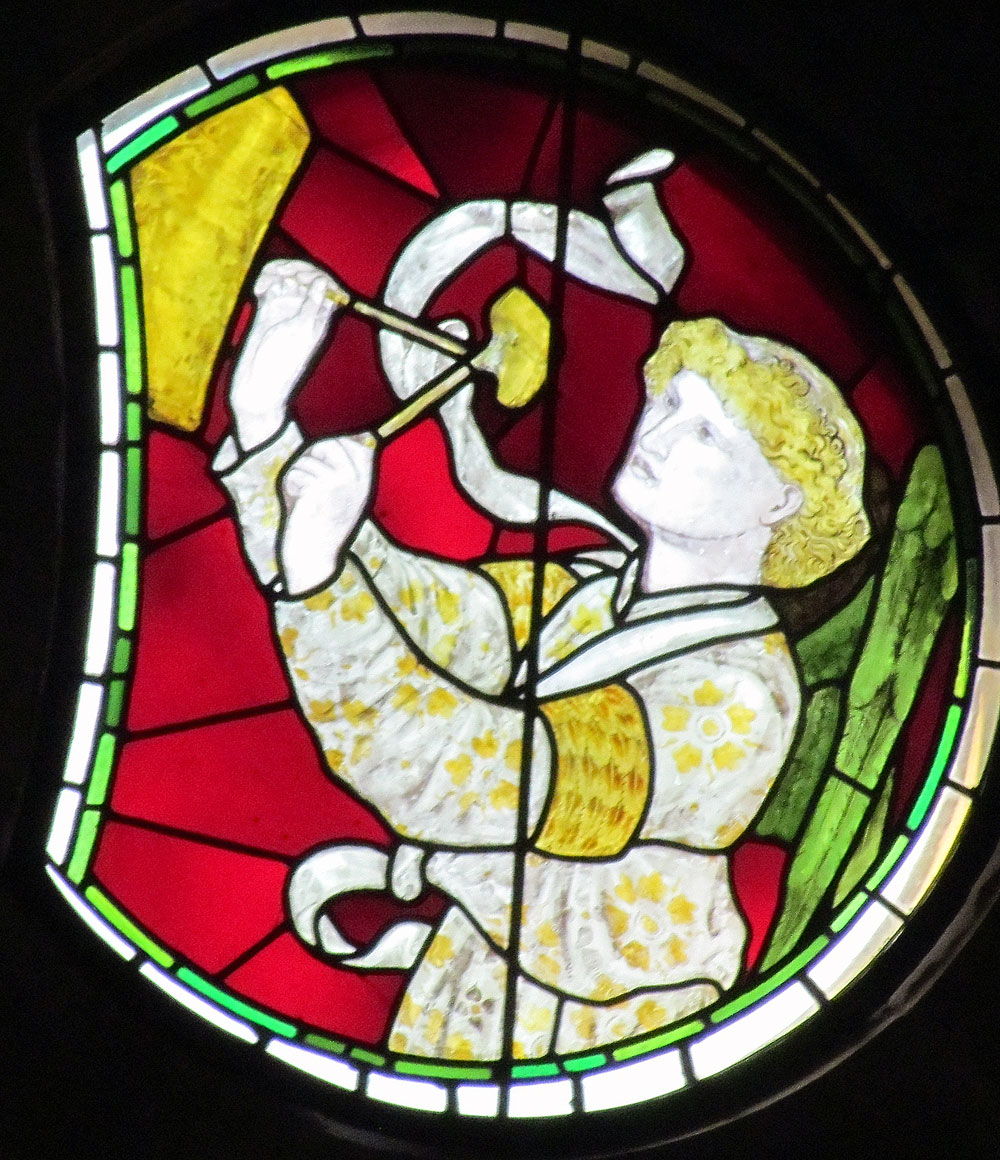
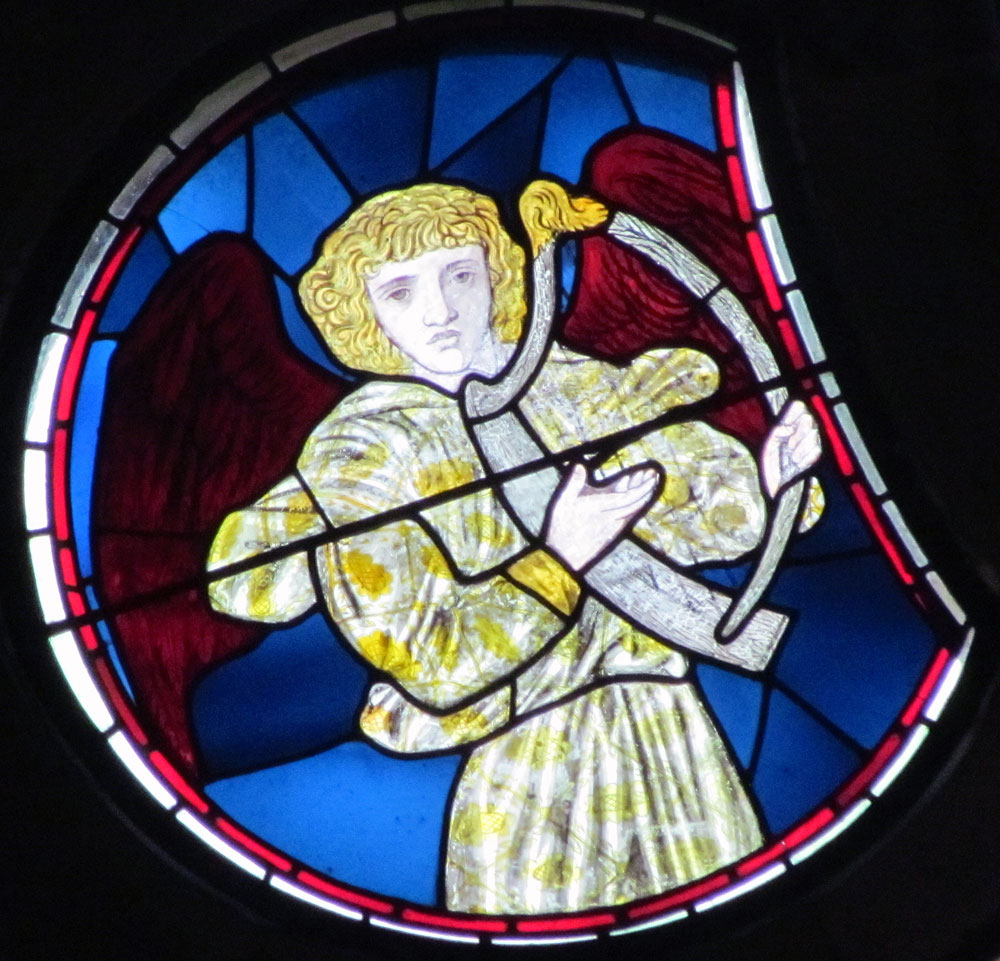
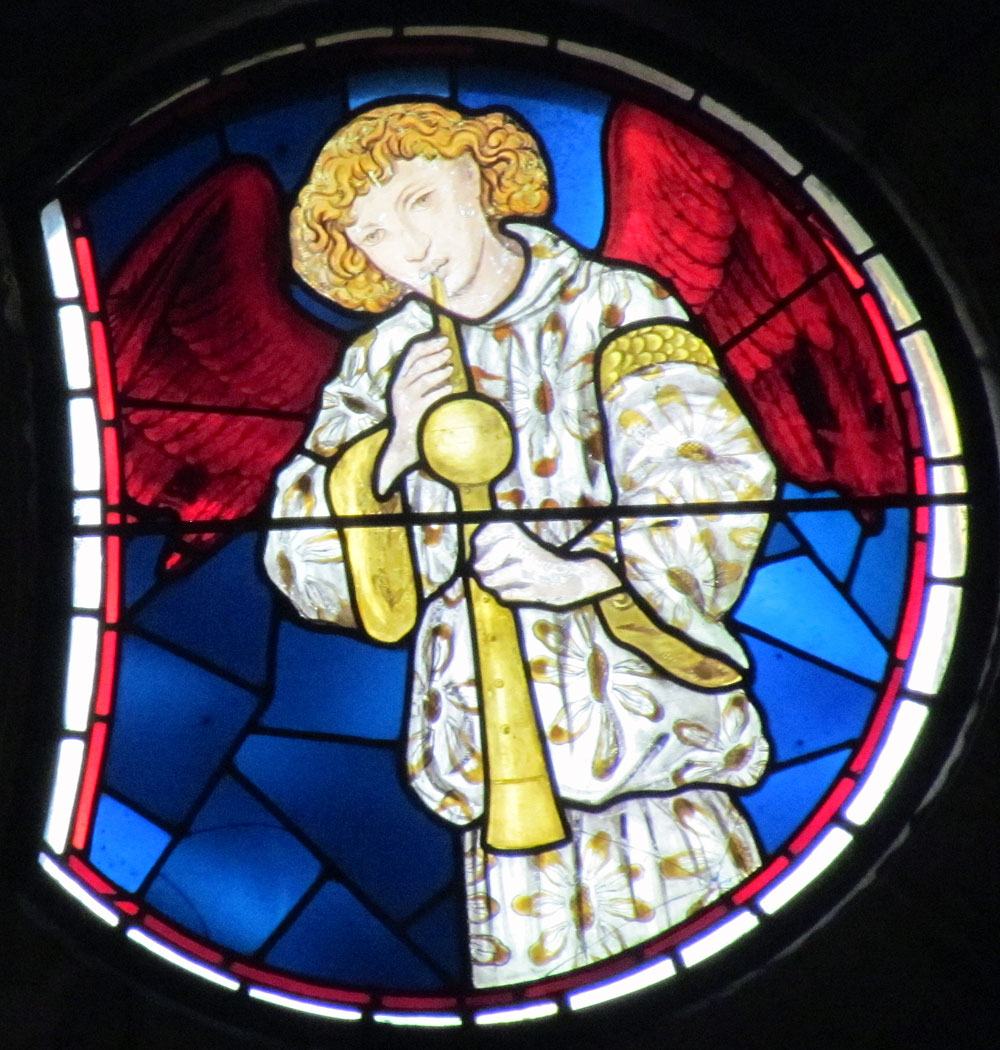
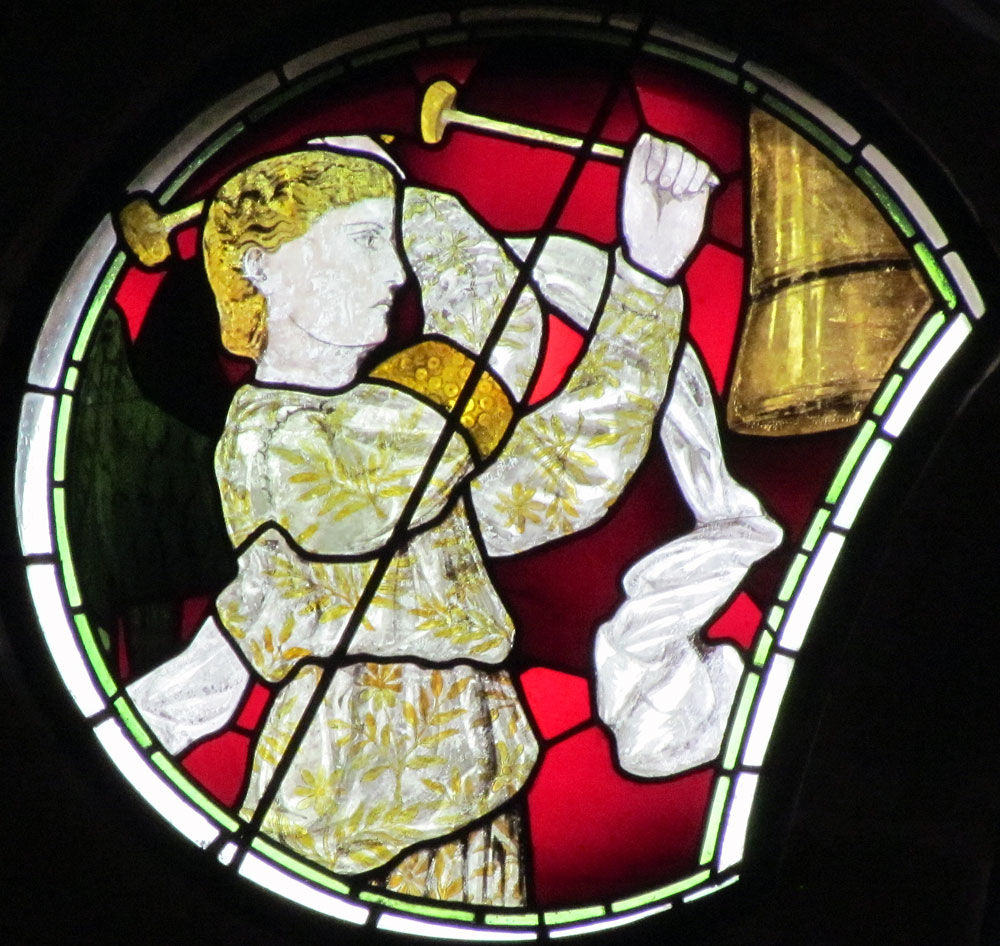
The Rose Window has a central Annunciation by Burne-Jones, surrounded bynine cusped panels around depicting angels with instruments, to designs by Burne-Jones and Morris.


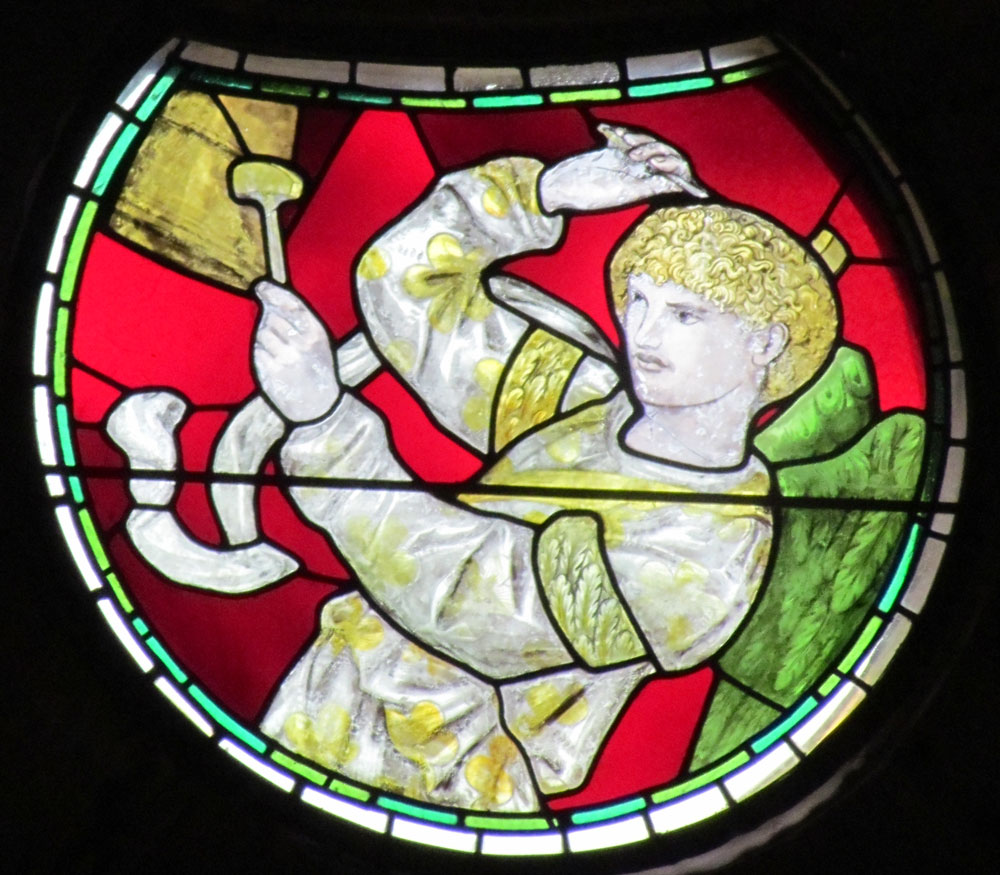
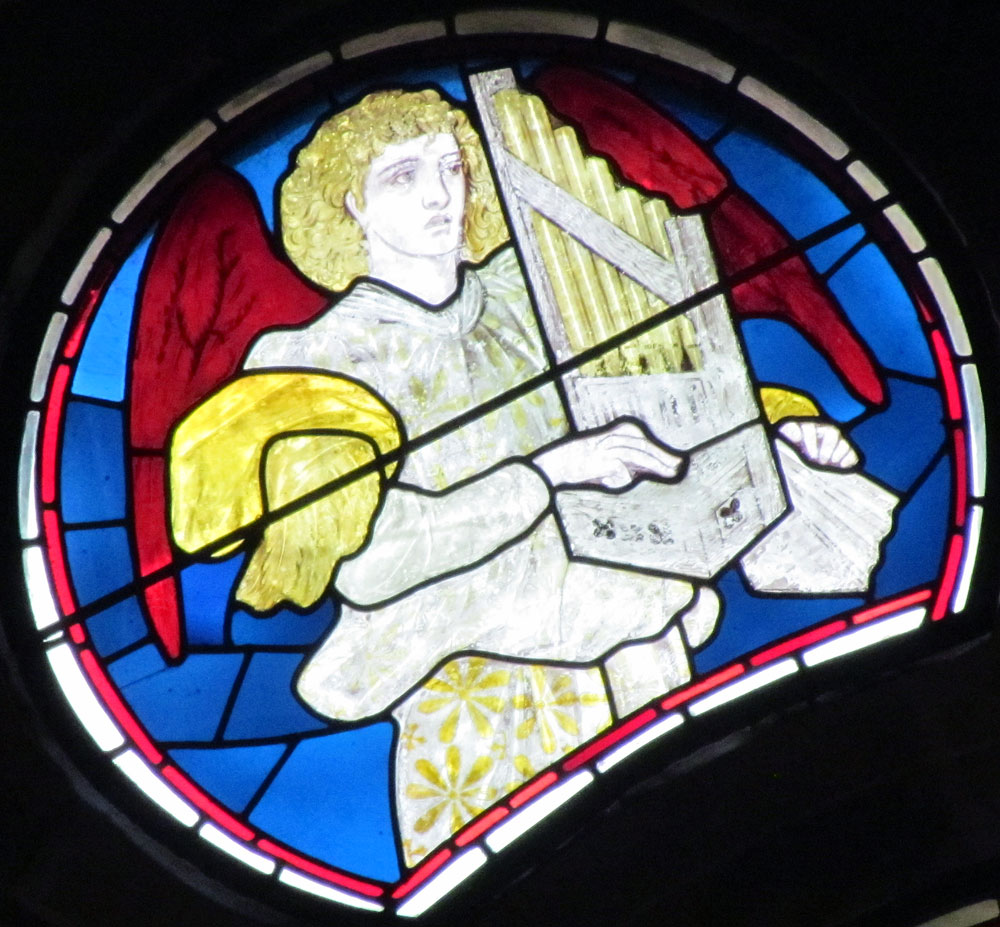
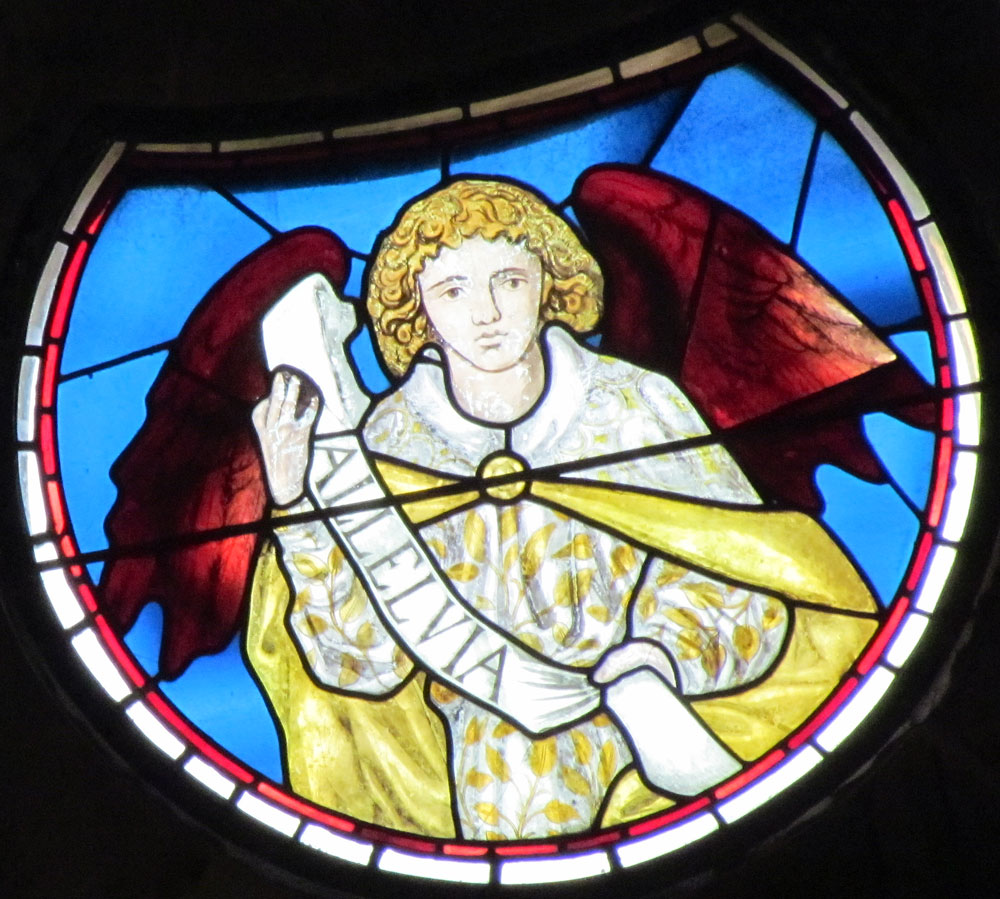
In 1861, according to the report in the Builder which is our only evidence for Bodley's thinking behind St. Martin's (apart from St. Martin's itself), the idea was to have a last Judgement in the west rose window.
This was in line with the symbolic meaning behind orientation. The west was where the sun set, and it represented death and finality. Judgements were commonly to be found either here, or painted above chancel arches which, as we have seen, also symbolise an aspect of death.
A number of cartoons by Rossetti for the Judgement which was never executed still survive. But at some time in 1862 the scheme was changed. A new message was devised to make more of the lancets showing Adam and Eve executed by Ford Maddox Brown for the west wall below the rose window.
The new theme was Christ as the second Adam bringing redemption through sacrifice. The Crucifixion to be placed in the East Window was augmented by the narrative glass panels surrounding it which portray the parable of the Vineyard, in which Christ figures as the King's son murdered by his treacherous servants.
The final scheme is founded on the medieval idea of Christ as the new Adam sent to redeem the world from the sin of the original. The west rose window under the new scheme contained an Annunciation by Burne-Jones. This features the Virgin Mary as the physical means of redemption. As God drew the original Eve from the side of Adam so the second Adam was drawn by God from the second Eve. Ave Maria were the words by which the angel greeted the Virgin. Medieval commentators made much of the similarity between Ave (meaning 'greetings') and Eva, (Latin form of Eve). In this way Bodley and Morris neatly repackaged several medieval ideas into something quite original. West and East windows complement and answer each other, or at least they did, until the rood cross and screen introduced a discordant echo.
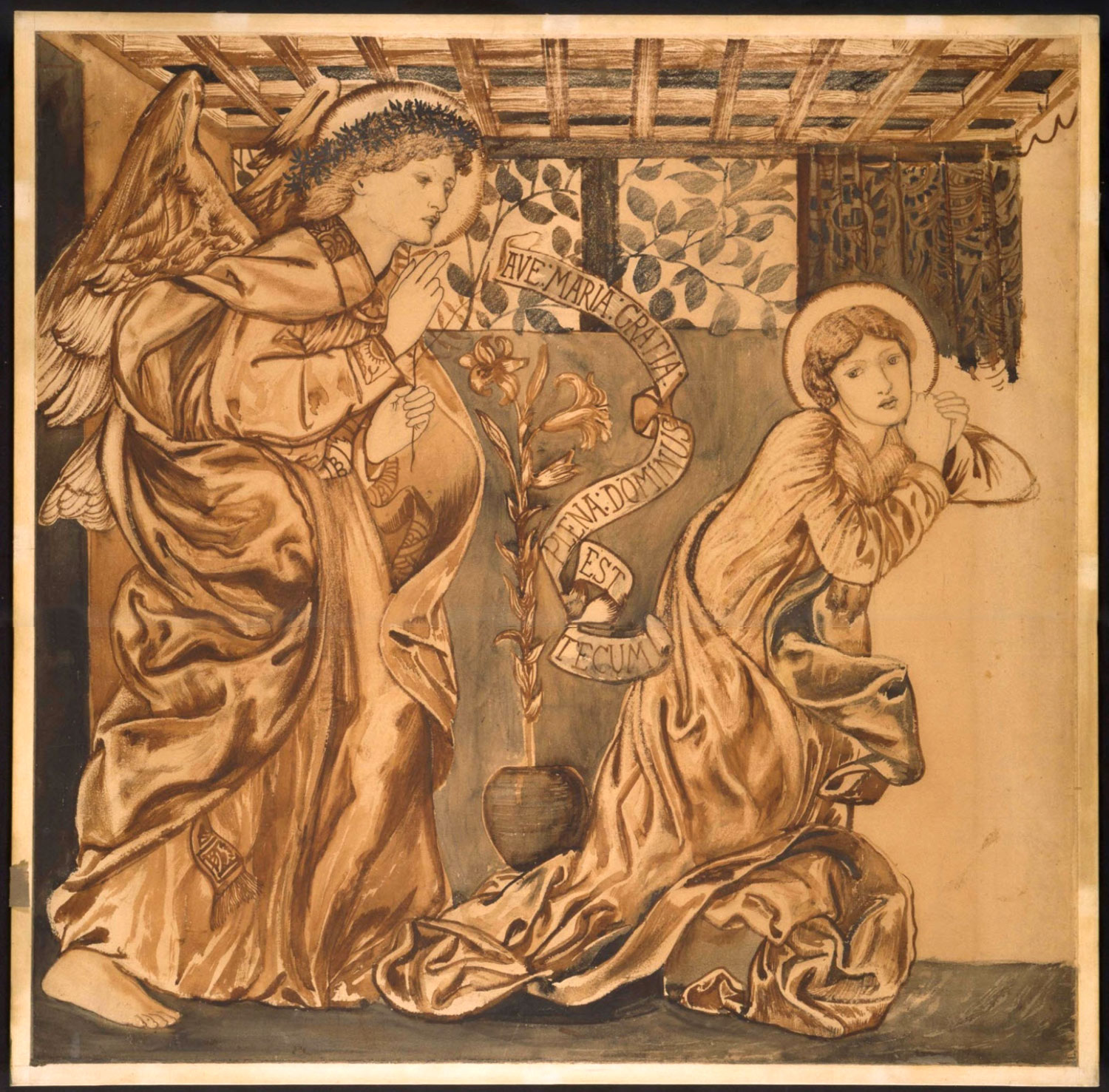
The original cartoon by Burne-Jones was apparently designed as tile panel in which he used Jane Morris, the wife of William Morris, as the model for both Mary and the young man. Visit the pre-Raphaelite Online Resource for a detailed version.
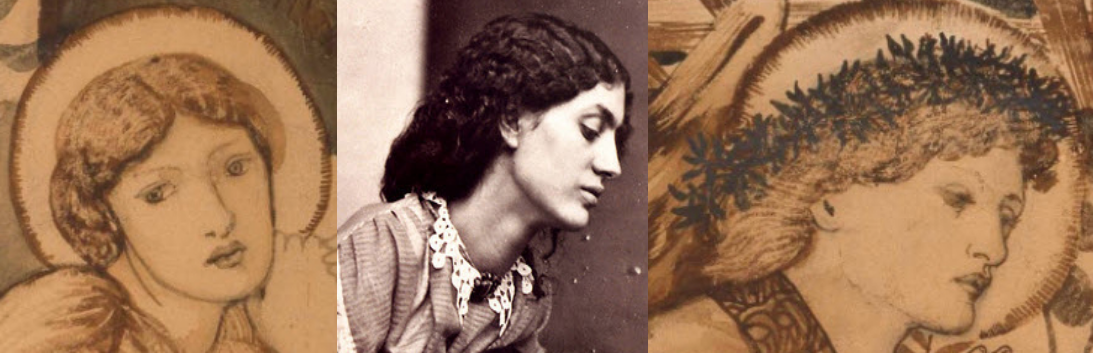
This cropped and horizontally flipped photo of Jane, posed by Rossetti in 1865, provides a comparison.
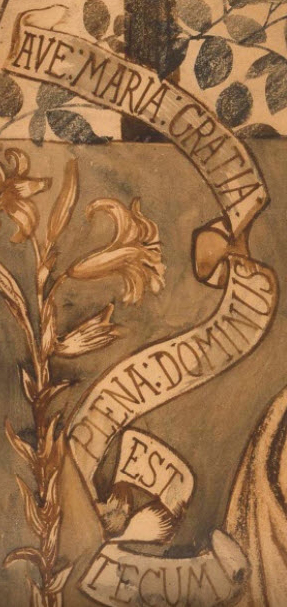
The banner (left) reads AVE MARIA, gratia plena, Dominus tecum. (Hail Mary, full of grace, the Lord is with you.) This is again a subtle reference to the revival of Catholic rituals in the Anglo-Catholic church.
What may be easily identified on the cartoon, but is unlikely to be seen on the window itself, is that the archangel Gabriel is holding a willow twig in his left hand.
This relates to the Resurrection, although the process of realising this is quite obscure.
Eastern Christians of Byzantine/Slavic liturgical tradition customs are found among most Slavs whether Orthodox, Greek Catholic or Roman Catholic.
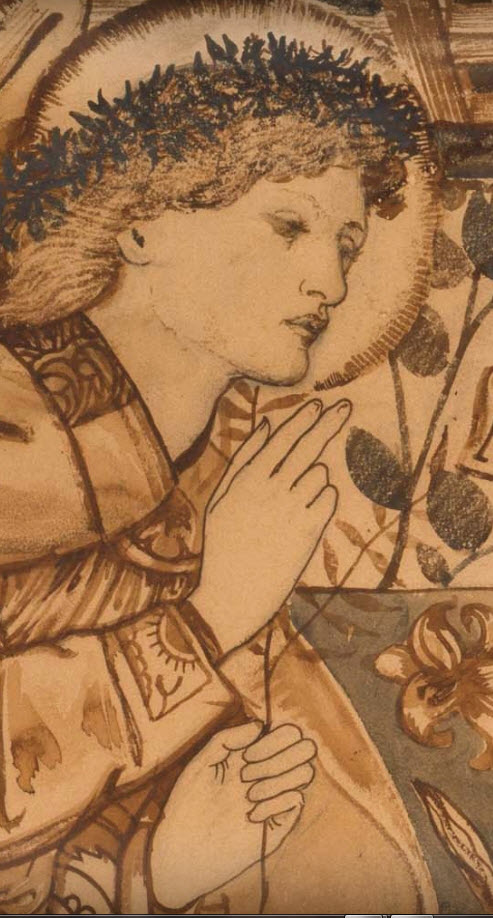
Branches of palm trees are a symbol of victory, and the people met Jesus as the King who had conquered death – he had recently raised from the dead, his friend Lazarus. People shouted, “Hosanna: Blessed is he that cometh in the name of God, the King of Israel!”
In Russia, palms do not grow, so the adoption of Christianity replaced the palms with the plant that first blooms in their area – willow. The willow heralded the end of harsh winter and the renewal of spring, while protecting people and livestock from diseases, the homes from lightening and misfortune and by fostering the fertility of man and beast.
Willow has become a symbol of spring, rebirth, joy and divine resurrection, symbol of the victory of Jesus over evil. Which is why Gabriel is holding a twig of willow in his left hand.
Another Christian symbol of the resurrection is the bay laurel bush we see coming through the open windows behind Gabriel, signifying the future child’s victory over death.
Gabriel’s right hand is raised in the traditional symbol of The Trinity – the thumb, index and middle fingers representing the Father, Son and Holy Spirit, who are divinely impregnating Mary.
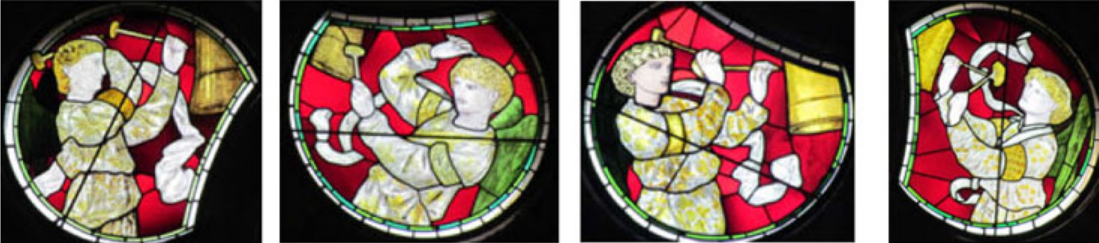

Numerous references to music and musical instruments can be found in both the Old and New Testaments, as well as frequent episodes involving music, song, dance and praises to God in religious ceremonies, and mournful occasions such as burial rites. The instruments mentioned in the Bible include: harps (and other stringed instruments), pipes, flutes, organs, horns, trumpets (and other wind instruments), and percussion instruments such as bells, cymbals, timbrels (or tambourines).
Angels announce the Last Judgment by blowing on trumpets, they serenade God and the blessed in heaven with harps and other stringed instruments, and may accompany the Virgin and Child, or various saints, with instruments such as portative organs.
William Morris & Co. made good use of Burne-Jones’ cartoon by installing windows closely based on the same design in churches throughout the country.
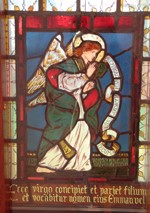
The inscription below the Angel is ‘Ecce virgo concipiet et pariet filiumet volcabitur nomen eius Emmanuel’. This translates as ‘Behold a virgin shall conceive and bear a son and his name shall be called Emmanuel’. The scroll that is held by the Angel says ‘Ave Maria gratia plena Dominustecum’ which translates as ‘Hail Mary full of Grace, the Lord is with you’.
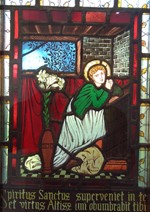
The inscription below Mary is ‘Spiritus Sanctus superveniet in te et virtus Altissimi obumbrabit tibi’. This translates as ‘The Holy Spirit shall come over you and the power of the Most High shall overshadow you’.
Visit: http://www.allsaintschurchwindsor.co.uk/history-of-all-saints/
Dedworth Church, by Bodley opened in 1863 and was demolished in 1973. Pevsner thought the Annunciation "specially lovely". Burne-Jones was paid 15s to adapt the tile design to stained glass. (Parry -pg. 126, V&A Morris Centenary Exhibition Catalogue).
The same cartoon was also used in an 1873 window at St Michael, Forden in Wales. You can see images of it on the site of the University of Wales 'Imaging the Bible': http://imagingthebible.llgc.org.uk/image/708
Finally, the east window of St. Mary’s at Nun Monkton has and identical panel by Burne-Jones. The whole window has been the subject of a fund-raising talk A Pre-Raphaelite Masterpiece in Yorkshire: the stained glass of St Mary's, Nun Monkton by Suzanne Fagence Cooper. The research for this talk can be read on Suzanne’s Blog at: http://suzannefagencecooper.blogspot.co.uk/2012/05/pre-raphaelite-masterpiece-in-yorkshire.html
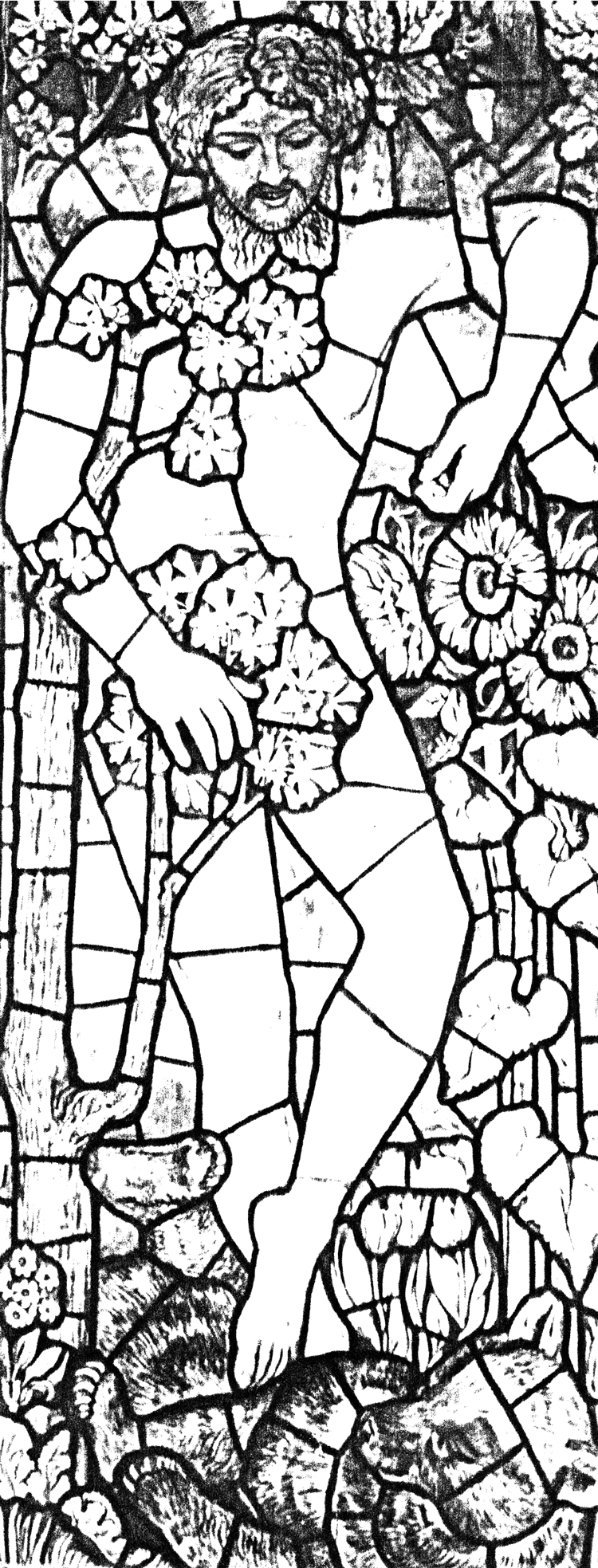
4 : West wall north lancet: Adam by Ford Madox Brown
The cartoons on this page show the artist and his second wife, Emma Hill, as Adam and Eve.
Brown himself described the two as being in attitudes of indolent repose. Adam is tickling a bear with his foot. This is both a pun and a symbol of the downfall of man. Adam is “bare” while the bear, as a wild animal, has symbolized cruelty and evil influence. In the Old Testament it is used to represent the Kingdom of Persia, which brought death and corruption into the world, and was finally destroyed by God (Daniel 7: 5).
Two bears are said to have appeared from the woods and eaten the children who mocked the prophet Elisha because of his baldness (II Kings 2: 24).
Bear cubs were believed to be born shapeless, their form being given to them by the mother bear. This legendary act became a symbol of Christianity, which reforms and regenerates heathen people. It is in this sense that a number of legends concerning the taming of a bear by a saint may be interpreted. Typical is the story of St. Euphemia, who, when thrown to the wild animals in the arena, was worshiped, rather than eaten, by the bear.
The red squirrel appearing eating an acorn on a branch above Adam's left arm is also symbolic of the devil, as the glowing colour of the squirrel’s fur were equated with the fires of hell. Also, the squirrel's lightning-fast turn of speed and destructive, tricky ways were considered further confirmation that this was indeed a creature of Satan.
Eve, however, cradles a bird thought to be a duck, and has an owl on her shoulder. The duck is generally thought to be a symbol of freedom. They can walk on the earth and swim in the sea as humans do but they also have the ability to soar into the sky. Birds are free to roam to earth and the sky. Many cultures believe that they are a symbol of eternal life; the link between heaven and earth. The fact that Eve cradles the duck may represent that link has just been lost. Furthermore, she may be cradling the duck because it is injured – a symbol of fateful or deep sadness caused by erring offspring.
The owl has a variety of meanings, but in this instance it is most likely to symbolize Satan, the Prince of Darkness, because the owl hides in darkness and fears the light. As Satan deceives humanity, so the owl is said to trick other birds, causing them to fall into the snares set by hunters.
Its most ancient gift, however, is that of wisdom, and, with this meaning, it is sometimes shown with St. Jerome.
In another sense, the owl is an attribute of Christ, who sacrificed Himself to save mankind, 'To give light to them that sit in darkness and in the shadow of death . . .' (Luke I: 79). This explains the presence of the owl in scenes of the Crucifixion.
The images portray Adam and Eve after the downfall of man as they are both clothed in leaves having become aware of their nakedness.
Both windows were donated by Miss Mary Craven at a cost of £100.
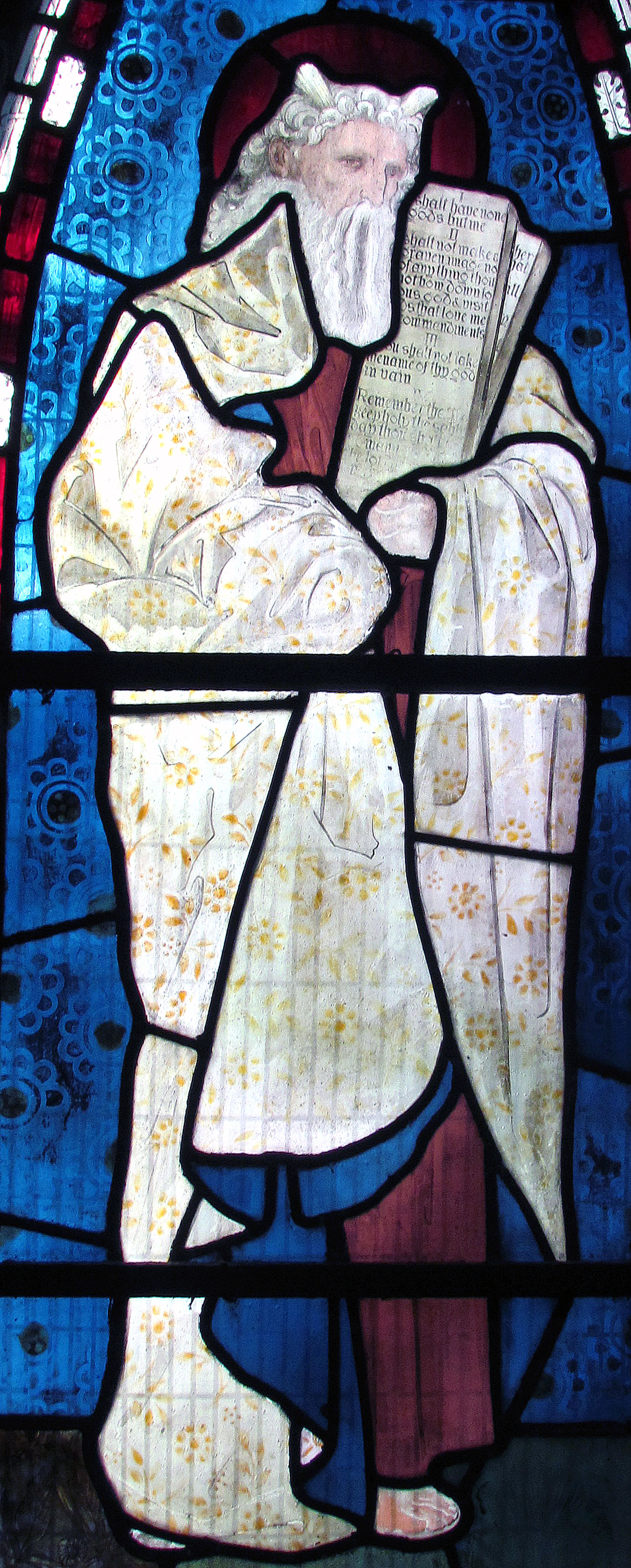
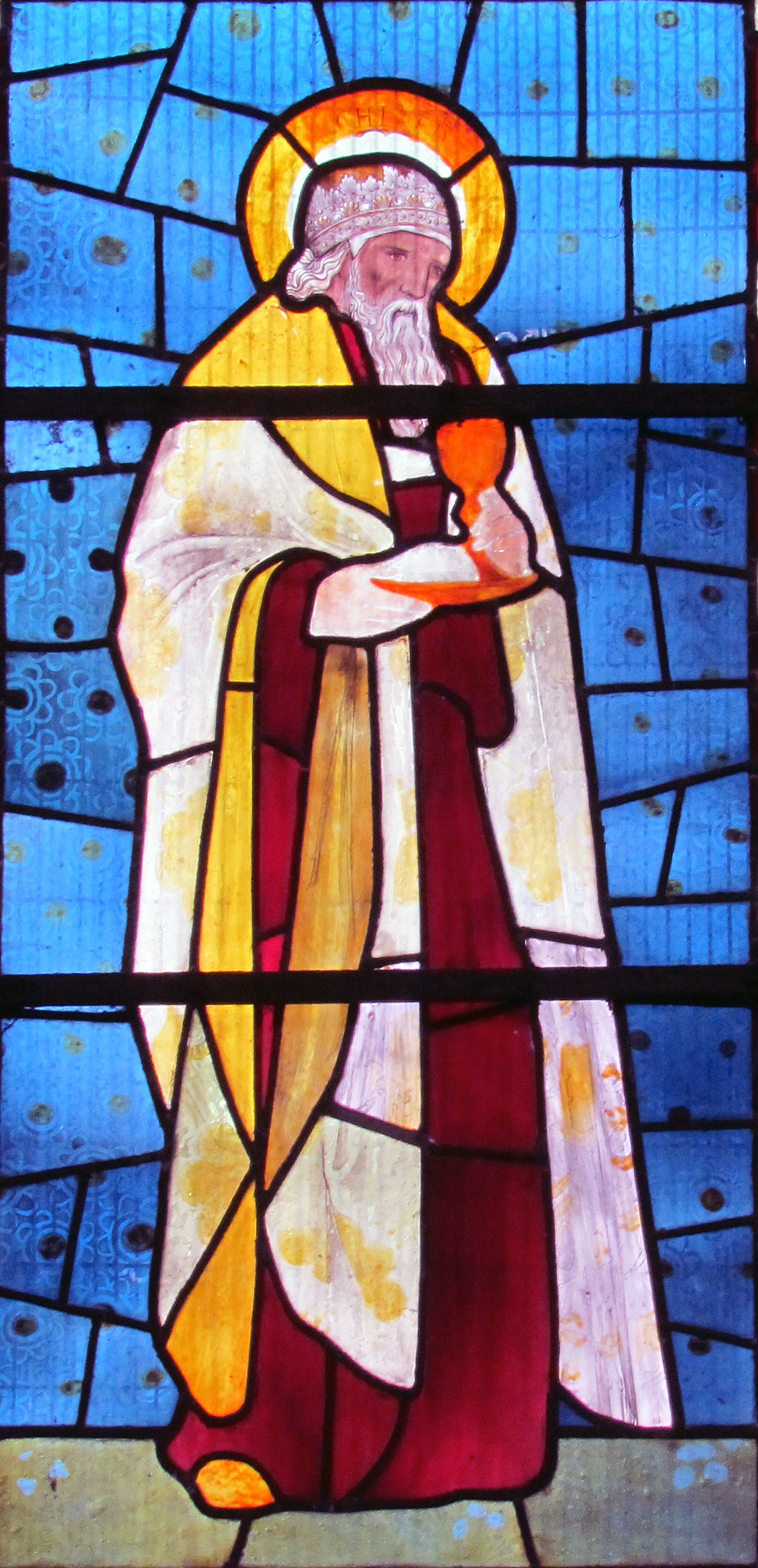
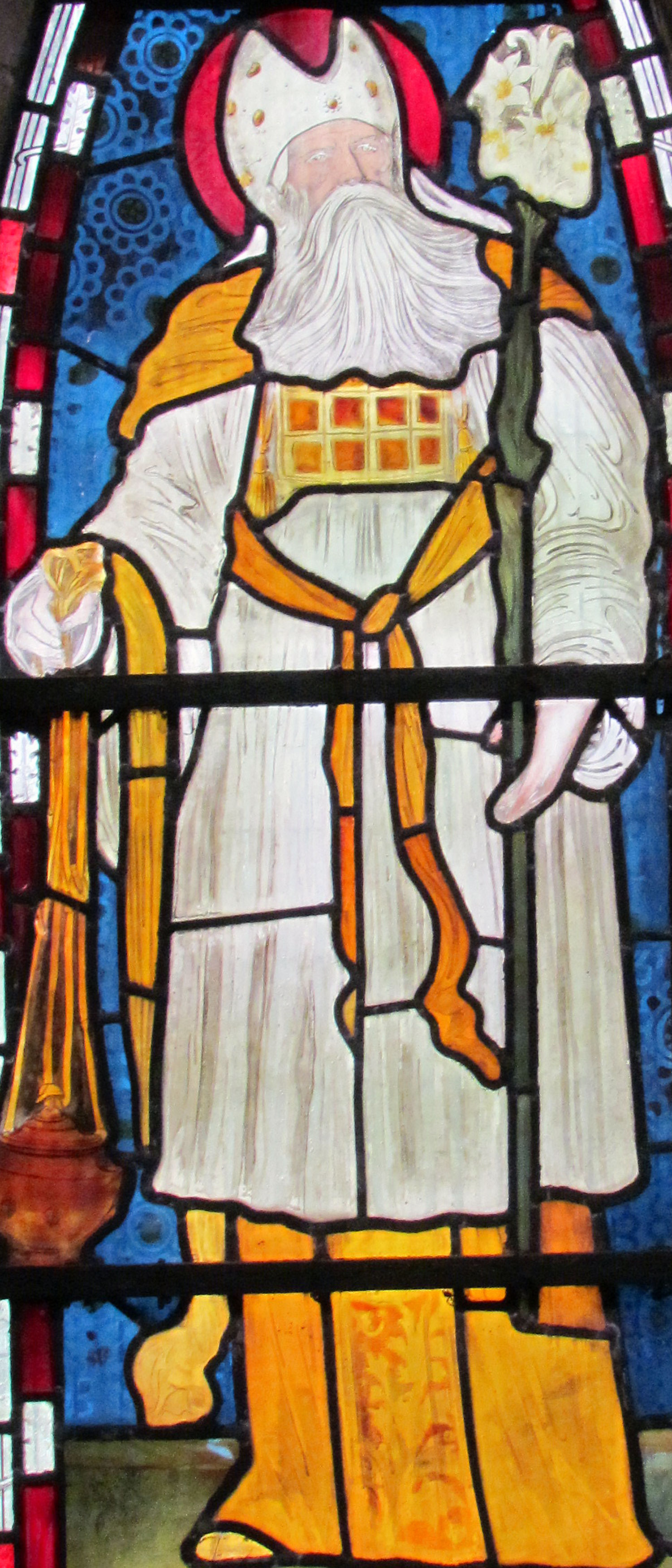
5 : North aisle west window: Moses, Melchizedek and Aaron by Sir Edward Burne-Jones
The westernmost window on the north aisle is the third to be installed on Miss Mary Craven's instructions to thank God for the recovery of The Prince of Wales. This window is dedicated to Queen Victoria herself and dates from 1872.
Interesting features include the depiction of Moses with "horns" on his head - a medieval way if depicting the facial transifuration of the prophet after his encounter with God. This copies Michael Angelo's sculpture of Moses (1513-15) which stems from the description of Moses' face as "cornuta" ("horned") in the Latin Vulgate translation of the passage from Exodus in which Moses returns to the people after receiving the commandments for the second time.
Melchizadek was a priest of God and King of Salem, while Aaron was the brother of Moses and the first High Priest of Israel.
Moses
Melchizadek
Aaron
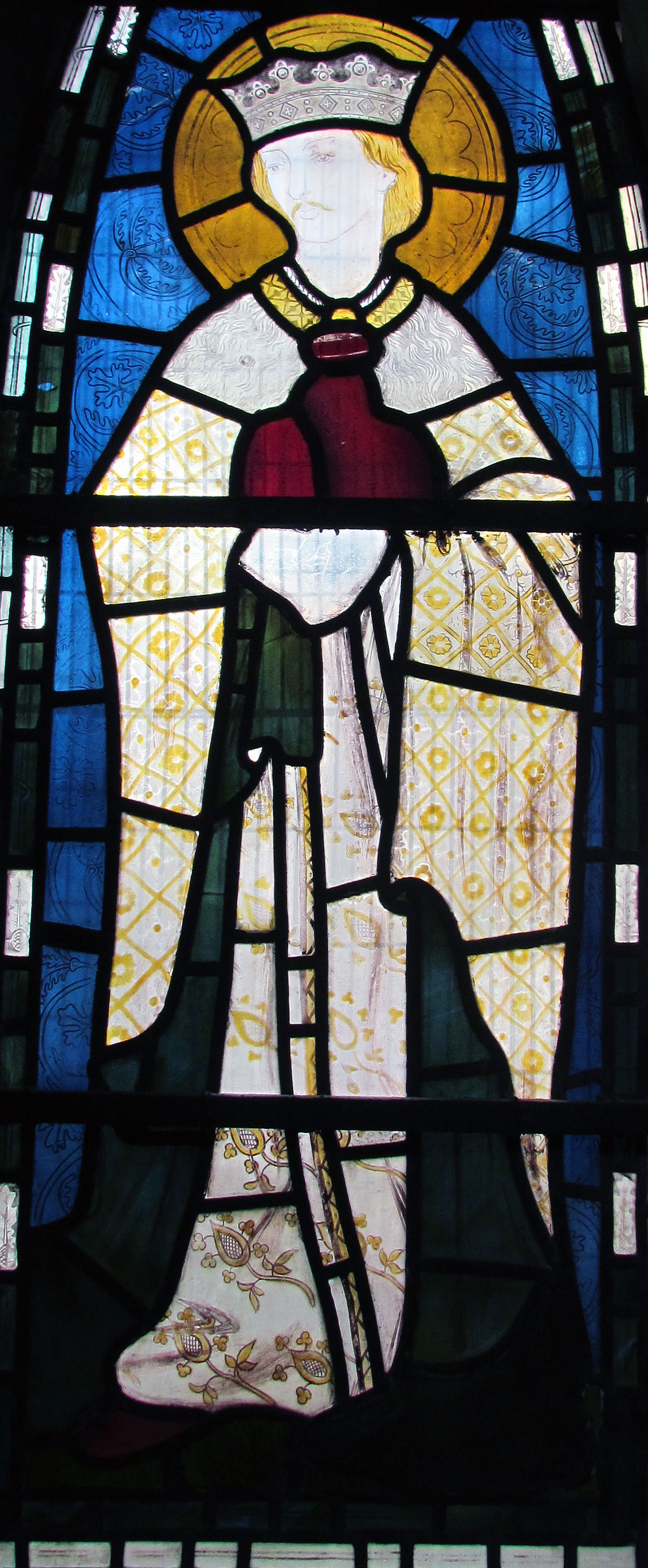
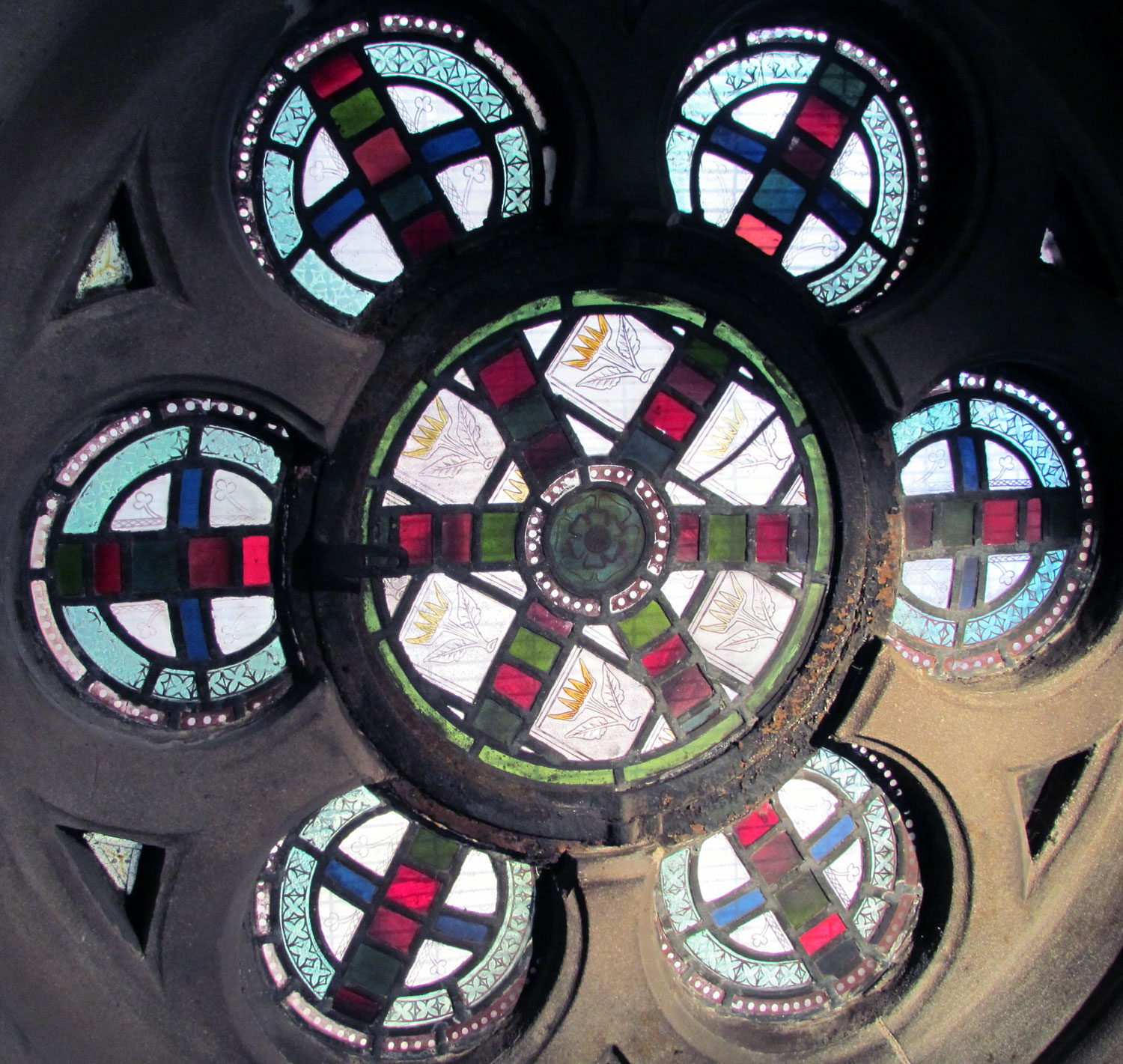
6 : North aisle centre-west: Hezekiah and Josiah by George Campfield; David by William Morris
The Kings' Window
This window (centre-west, north aisle) was also installed by Miss Mary Craven but a decade earlier in 1862, this time to commemorate the death of Victoria's husband, Prince Albert, in December 1861 - the foundation stone of St. Martin's Church had been laid in the previous month.
This window features Hezekiah (left) and Josiah (right) by George Campfield, and David (centre) by William Morris.
George Campfield, who Morris had met at the Working Men's College in Great Ormond Street, was employed as the Firm's (Morris, Marshall, Faulkner & Co) foreman of stained glass painters in 1861.
Hezekiah
Tracery
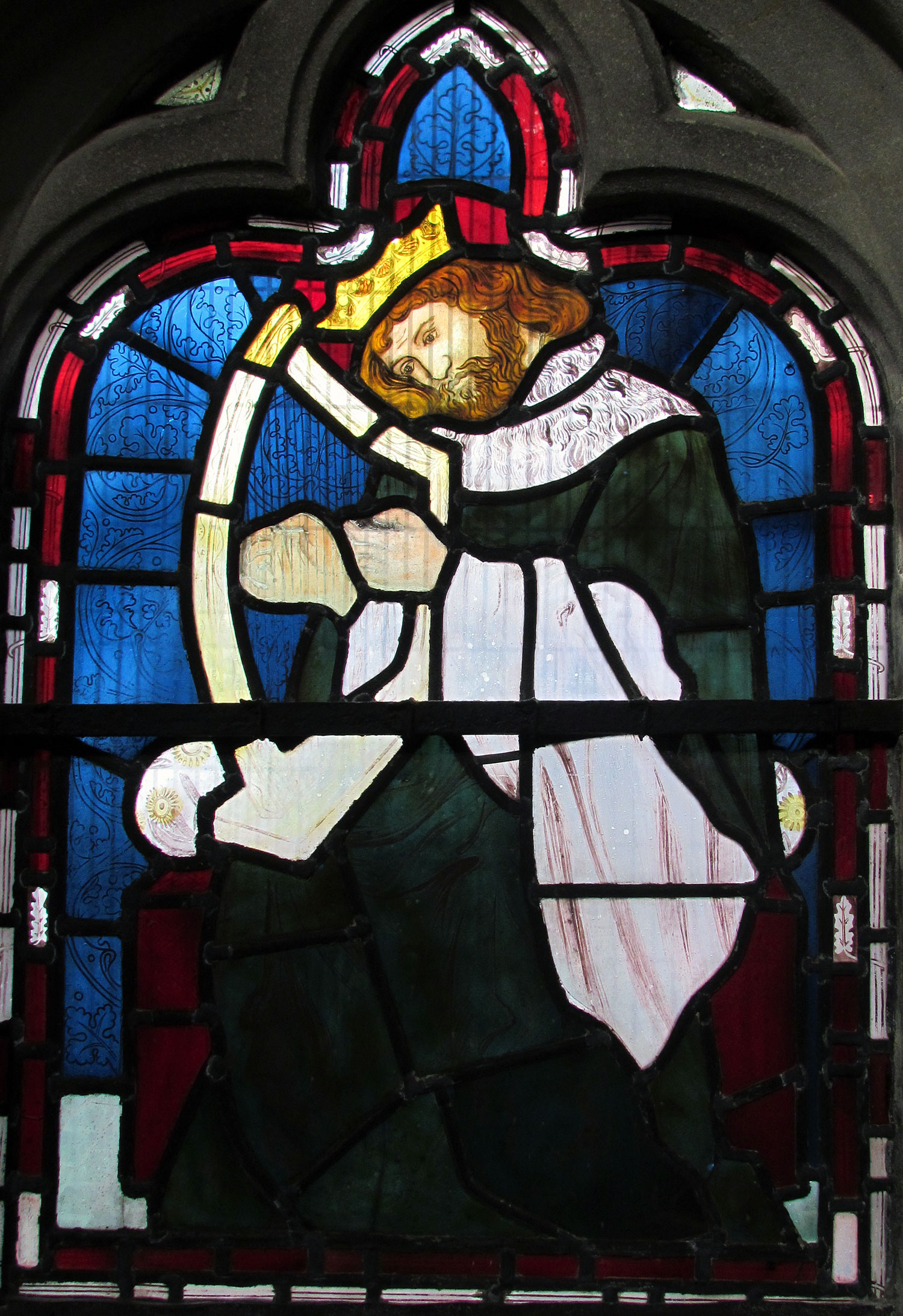
David
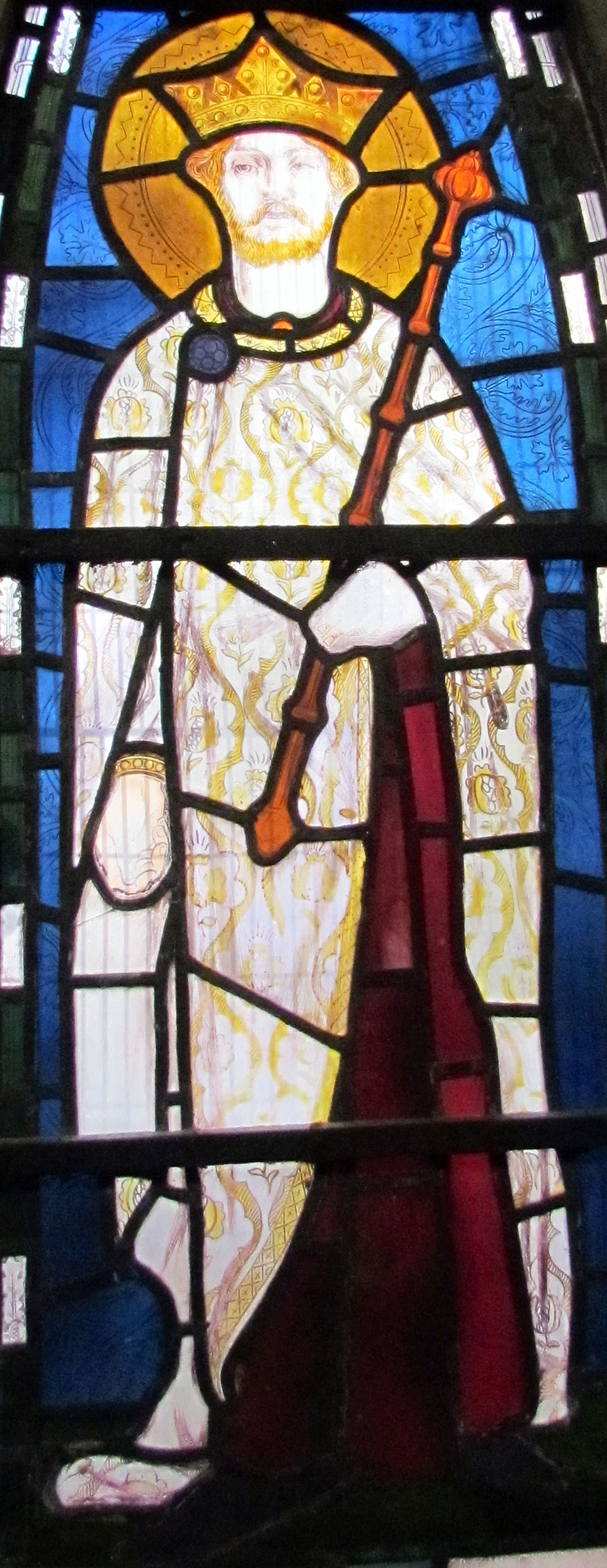
Josiah
7 : North aisle centre east: The military window - Joshua and St. Michael the Archangel by Peter Paul Marshall, and Gideon by Ford Madox Brown
The Military Window
This north aisle, centre-east window features:
Joshua (Peter Paul Marshall)
St. Michael the Archangel (Peter Paul Marshall)
Gideon (by Ford Madox Brown).
It is one of the earliest windows produced by Morris and Company, and was installed in 1862 in memory of a Major Monnins who died in 1860. The windows by Marshall are two of the few he executed for The Firm.
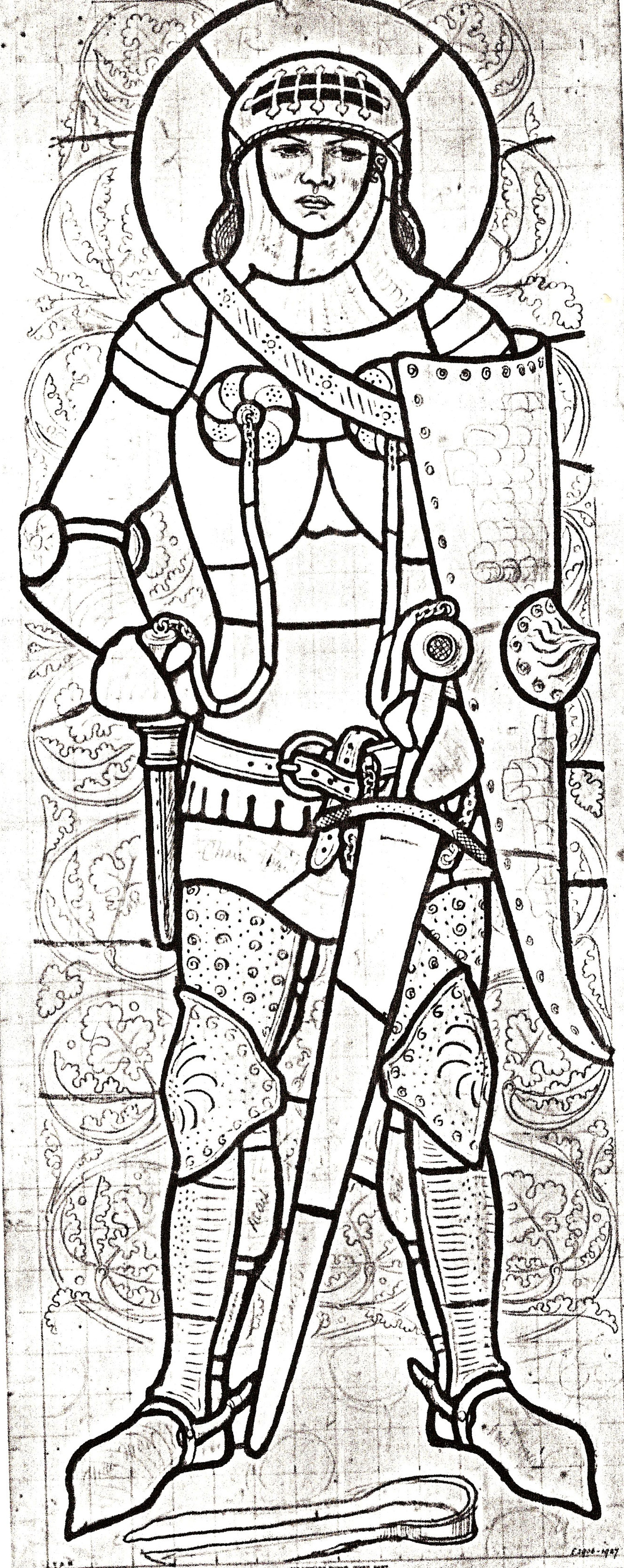
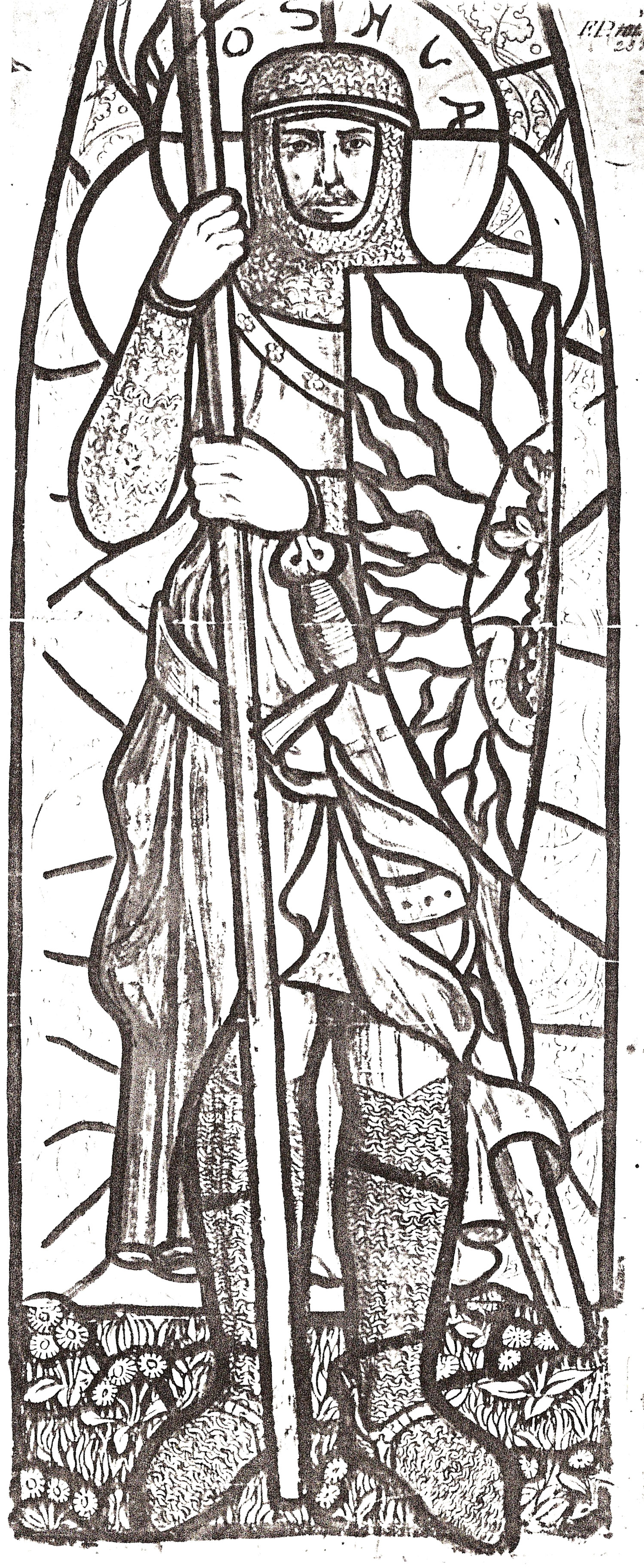
Madox Brown's Gideon is a strong composition , and the same figure is used as Sir Lancelot in the Story of Tristram windows, Bradford City Art Gallery.
However, A.C. Sewter writes in A Checklist of Designs for Stained Glass by Ford Madox Brown (p19): When the Morris firm was founded in 1861, Madox Brown, although already a mature artist of forty years of age, was relatively inexperienced in the art of designing for stained glass.
He had, prior to that date, only produced the single design of 'The Transfiguration' for Messrs. Powell & Sons, in 1857. It is not altogether surprising, therefore, that one or two of his earliest cartoons, such as the 'Gideon' for Scarborough and the 'Archangels Michael and Uriel' for Brighton, show little sign of his real artistic personality.
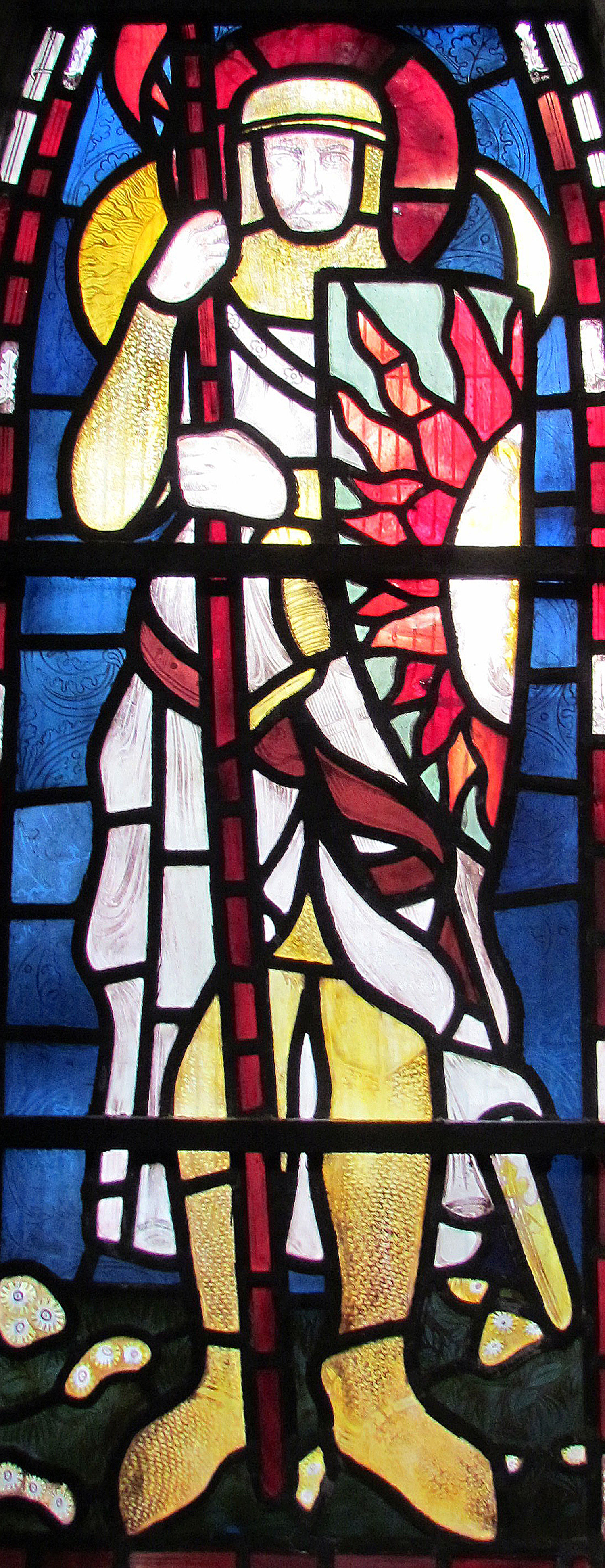
Joshua
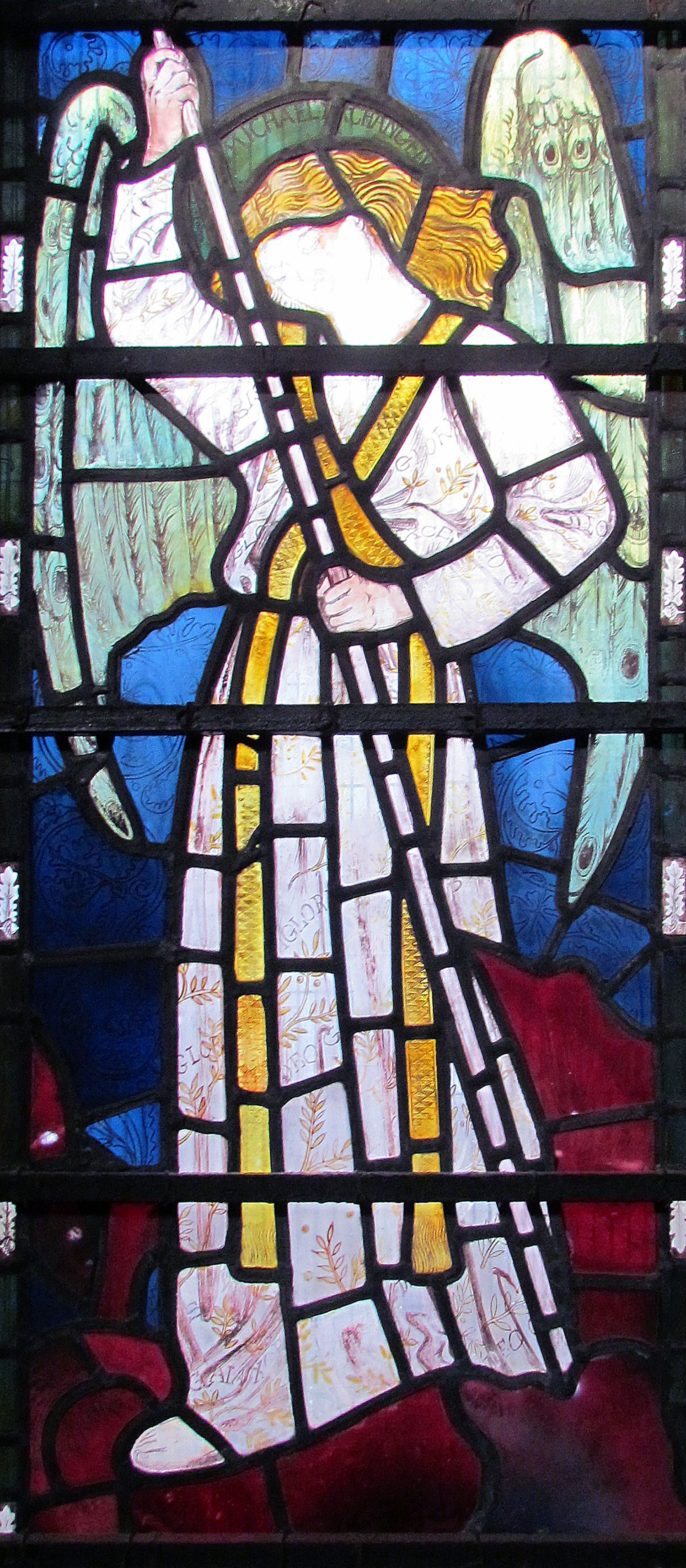
Michael
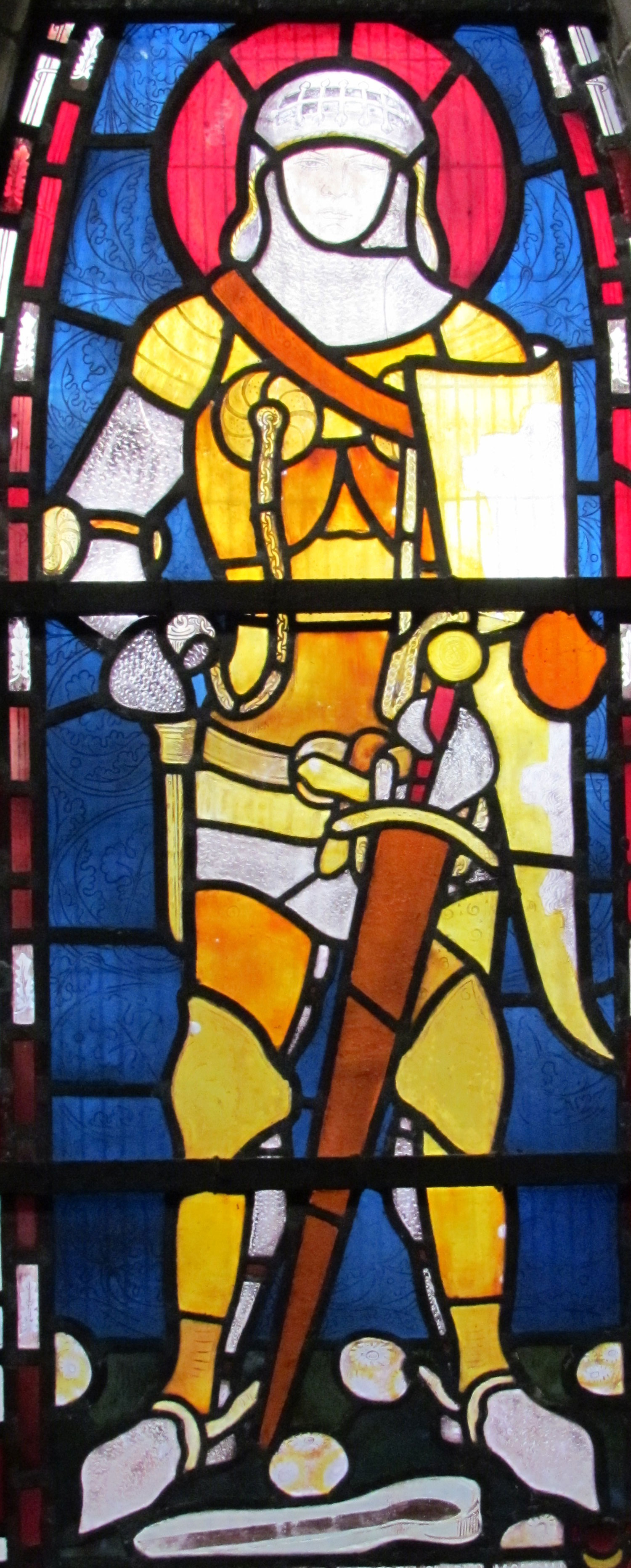
Gideon
8 : North aisle east: Isaiah by William Morris; Daniel and Ezekiel by Sir Edward Burne-Jones
The 1872 Mission Window
The easternmost window on the north aisle shows Isaiah (by Morris), Daniel and Ezekiel (by Burne-Jones). Isaiah holds a banner with the words: For unto us a Child is born, Unto us a Son is given. (Ch9 6-7), while Ezekial carries a shield showing the vision he had when he received his call from God. (He sees the God as a kind of chariot that moves on four creatures, each having a human form, two pairs of wings, a head with four faces - a man, an eagle, a lion and an ox.)
It was commissioned by Miss Mary Craven as a thank-offering for the success of the 1872 mission in St. Martin's parish. Early in that year a sustained mission effort was made which led to a very pleasing increase in church attendance.
A St. Martin's Guild (for ladies and gentlemen) was founded to consolidate the effort. The Guild came under virulent local attack from evangelical Anglians as a popish quasi-monastic organisation, tainted by Masonic oaths and secrecy. The vicar, Henning-Parr, defended it just as stoutly as his decision not to charge pew rents.
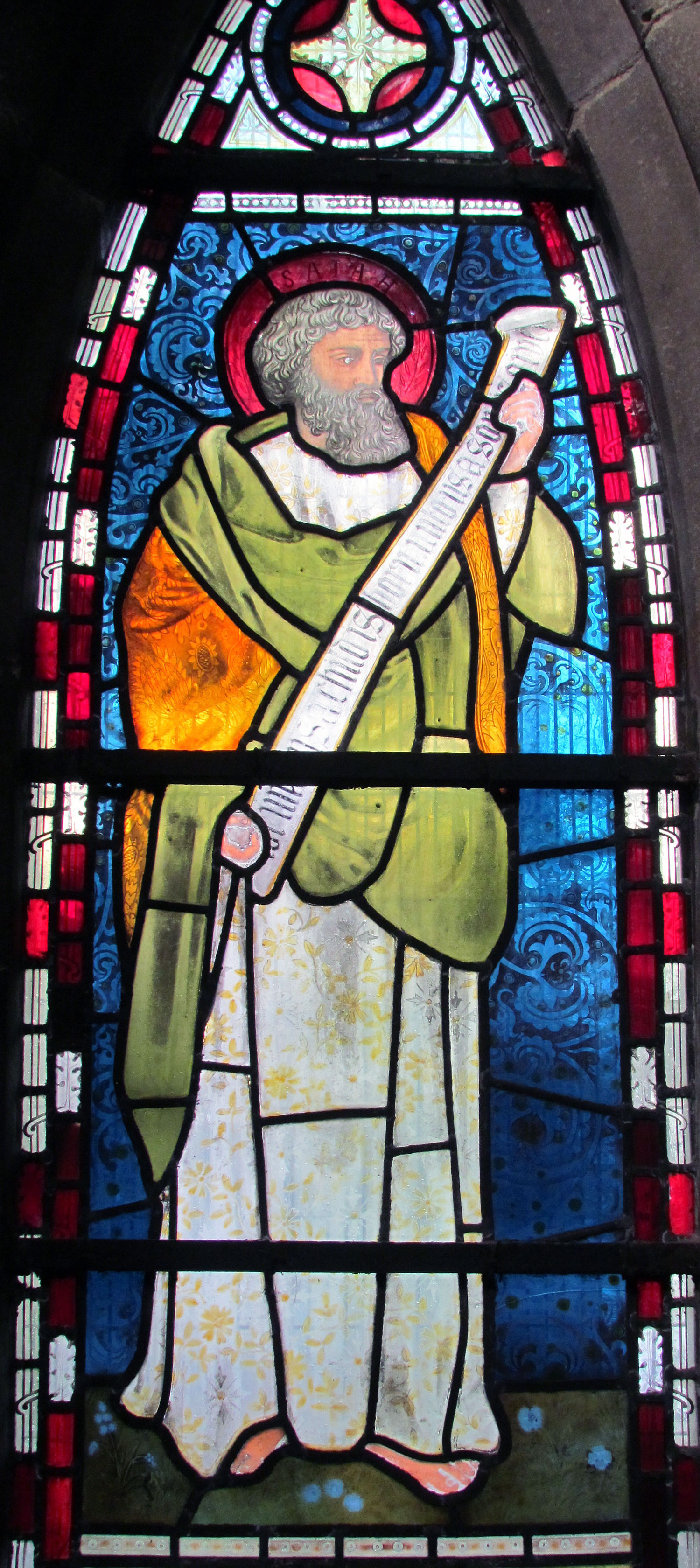
Isaiah
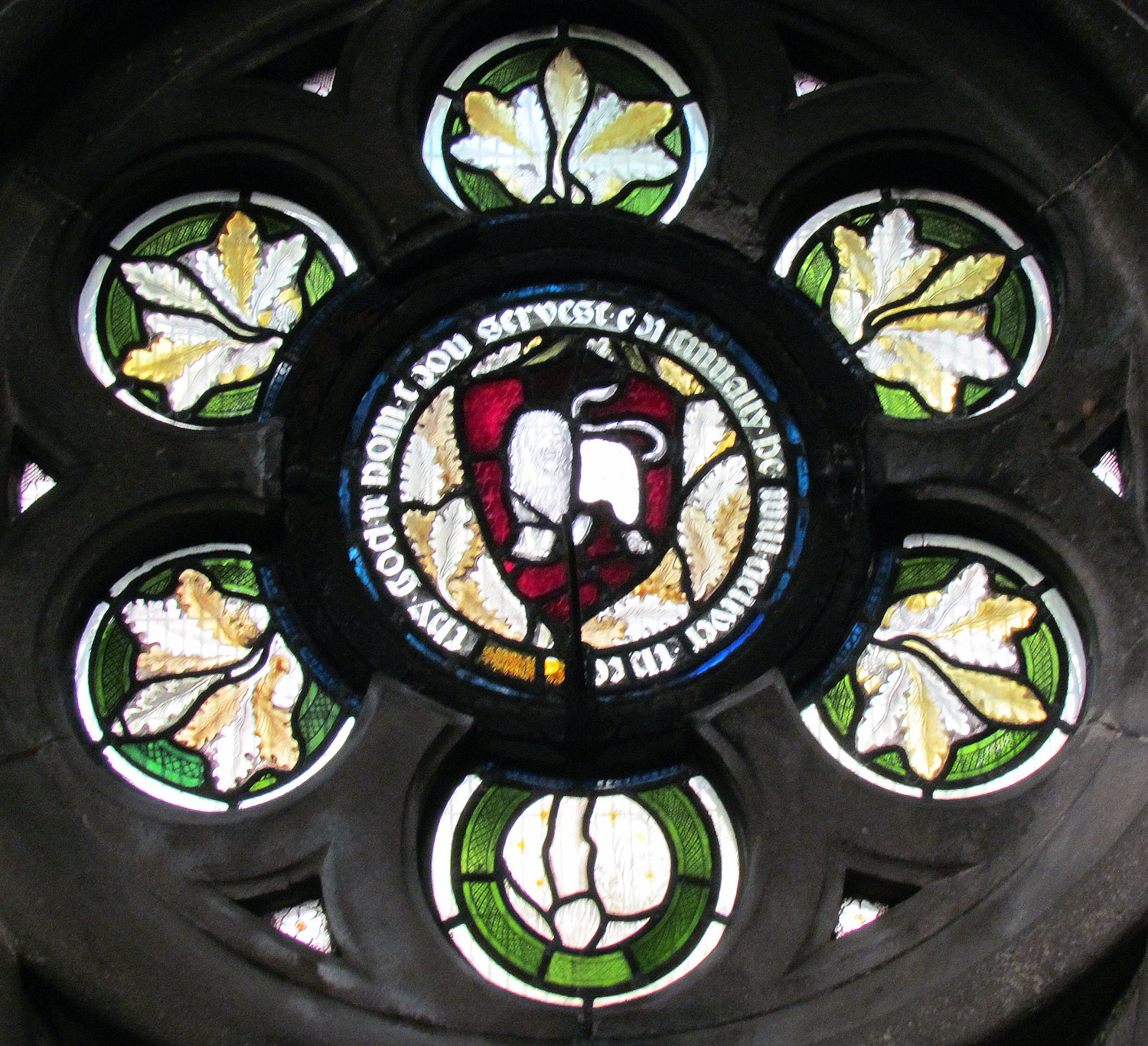
Tracery
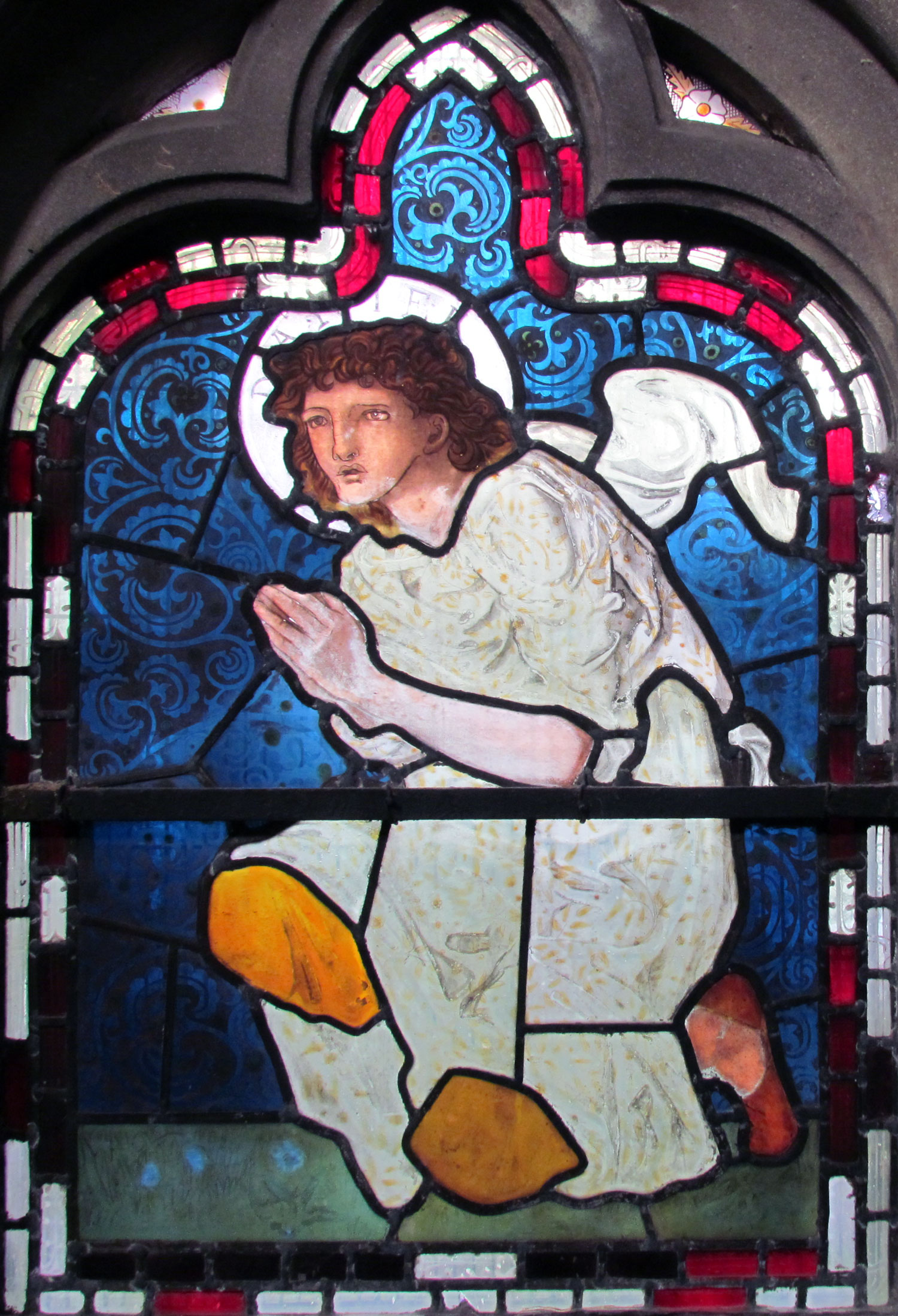
Daniel
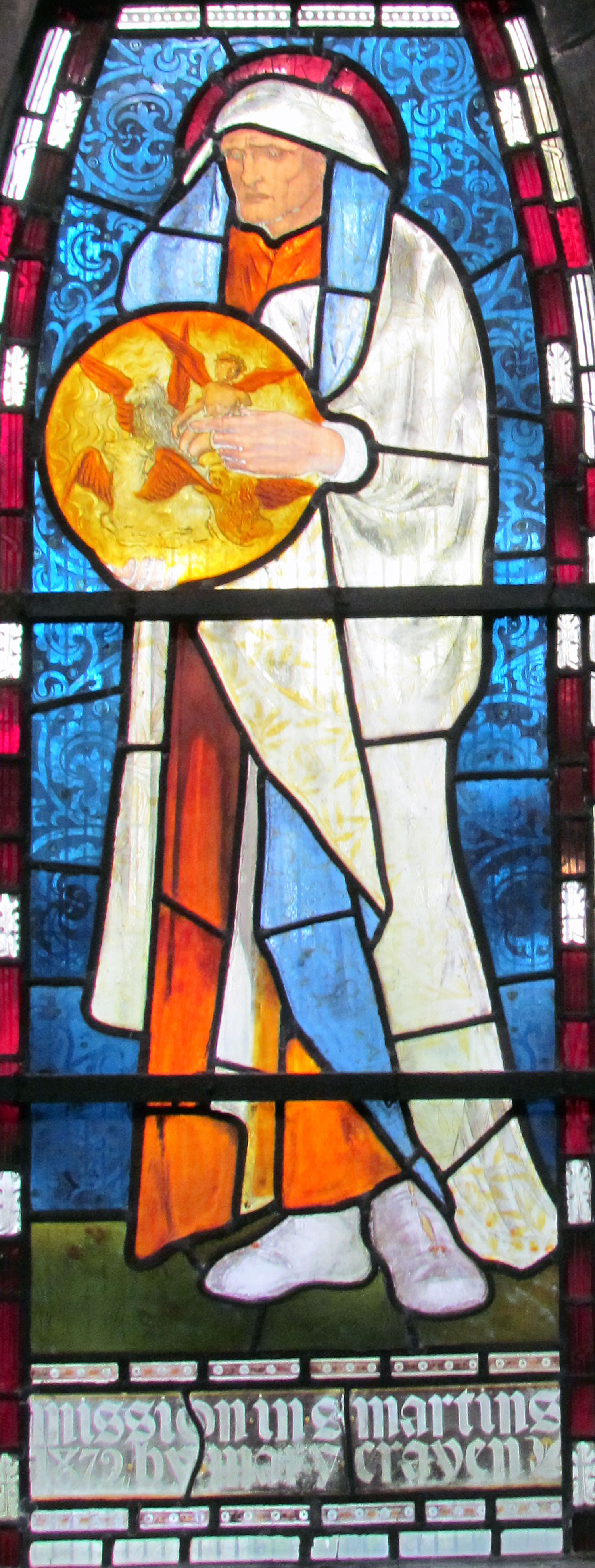
Ezekiel
The centre of the tracery glass shows one of Daniel's lions, and the text, Thy God whom thou servest continually, he will deliver thee (Daniel 6, 16), was spoken by King Darius as he threw Daniel into the lions' den.

9 : The Lady Chapel west window: Boaz and Ruth by William Morris; tracery by Philip Webb
The Harvest Window in The Lady Chapel
The west window of the chapel is one of the more satisfying compositions in the church. By William Morris it depicts both Boaz and Ruth in the harvested field , where Ruth is gleaning for ears of corn in a most inappropriately elaborate fifteenth-century robe.
The window commemorates the good harvest 1863 - the dedication is at the very bottom right of Ruth's window.
Above, in the tracery, is the prophet Isaiah, by Philip Webb, bearing a scroll reading: Verda de radice Jesse - Isaiah 11:1.

Boaz
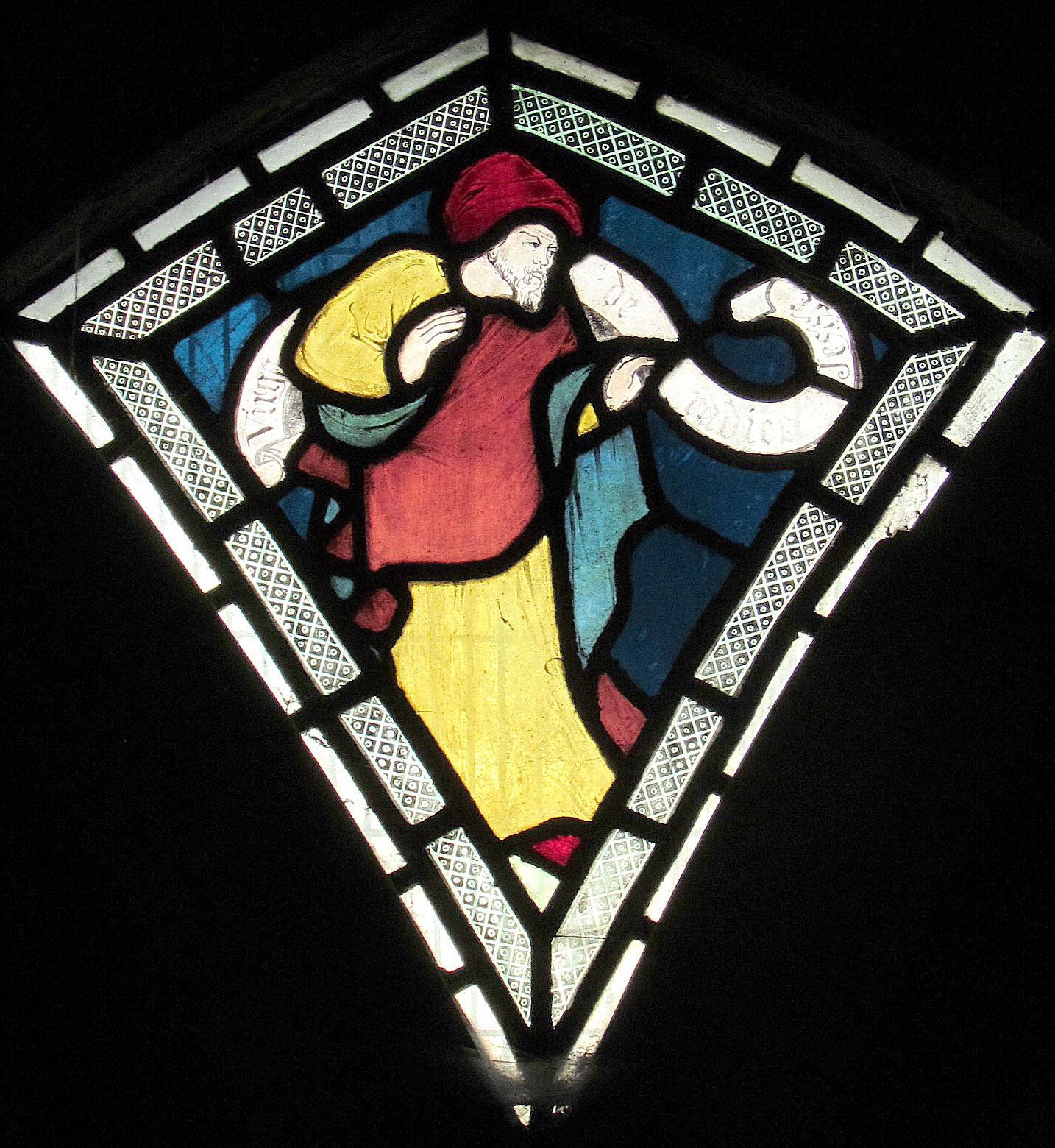
Tracery
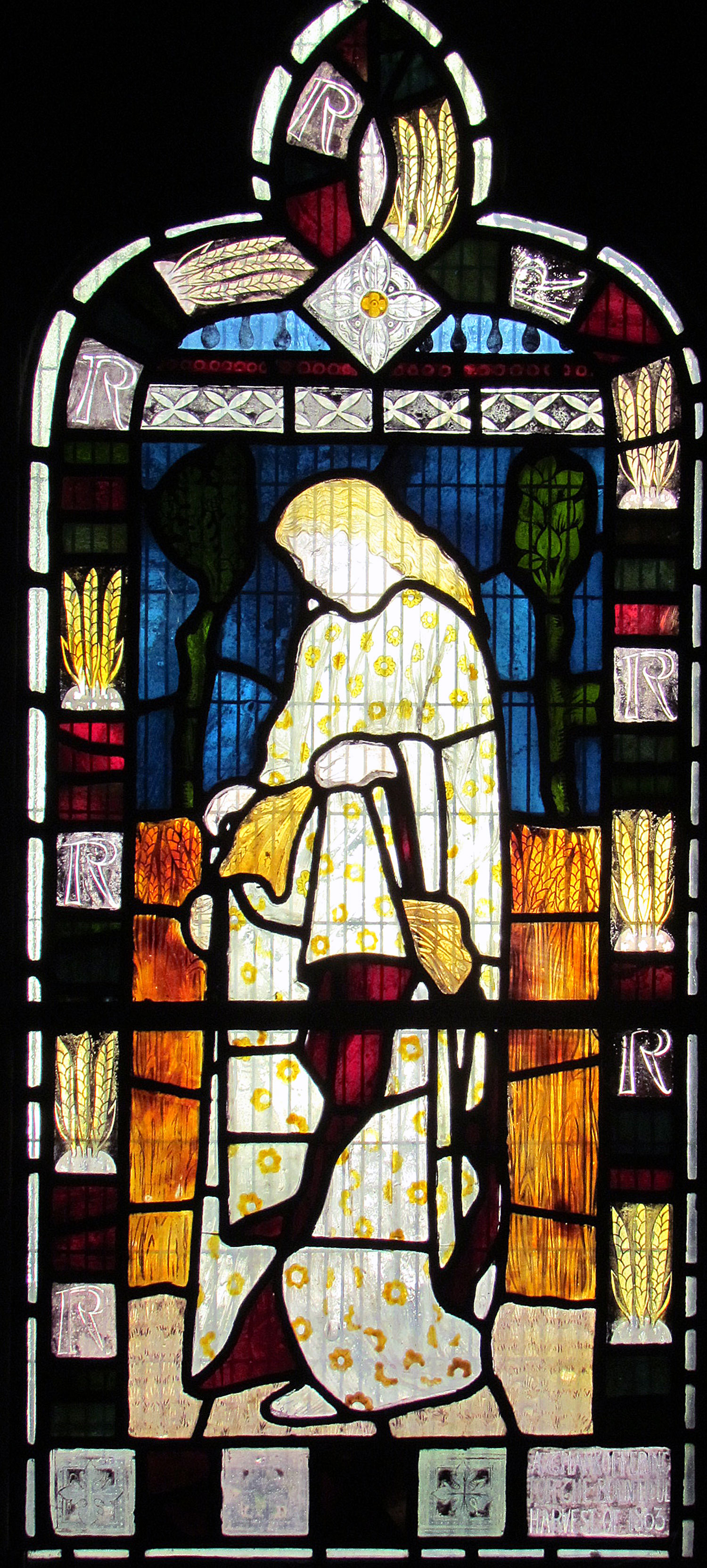
Ruth
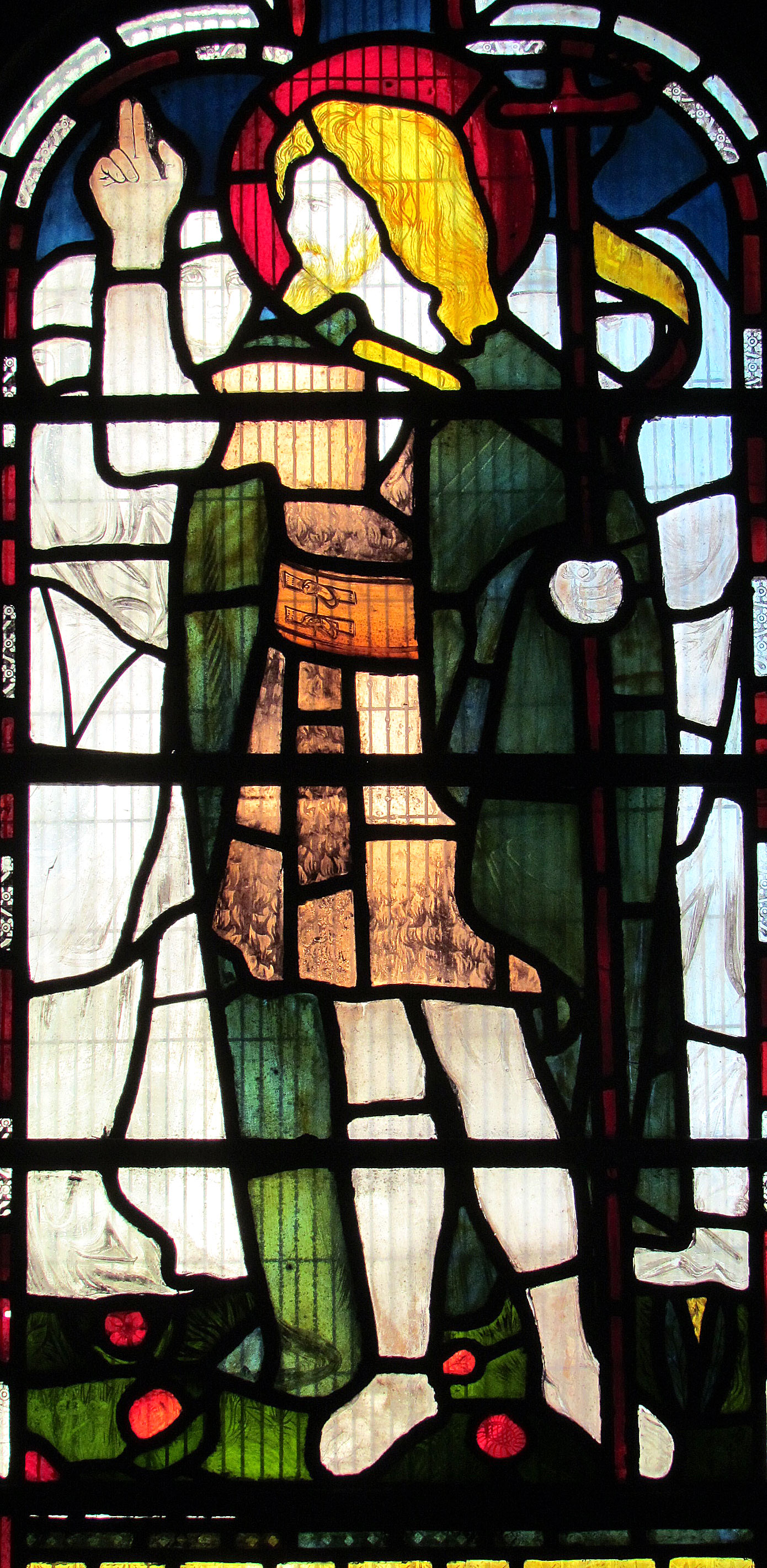
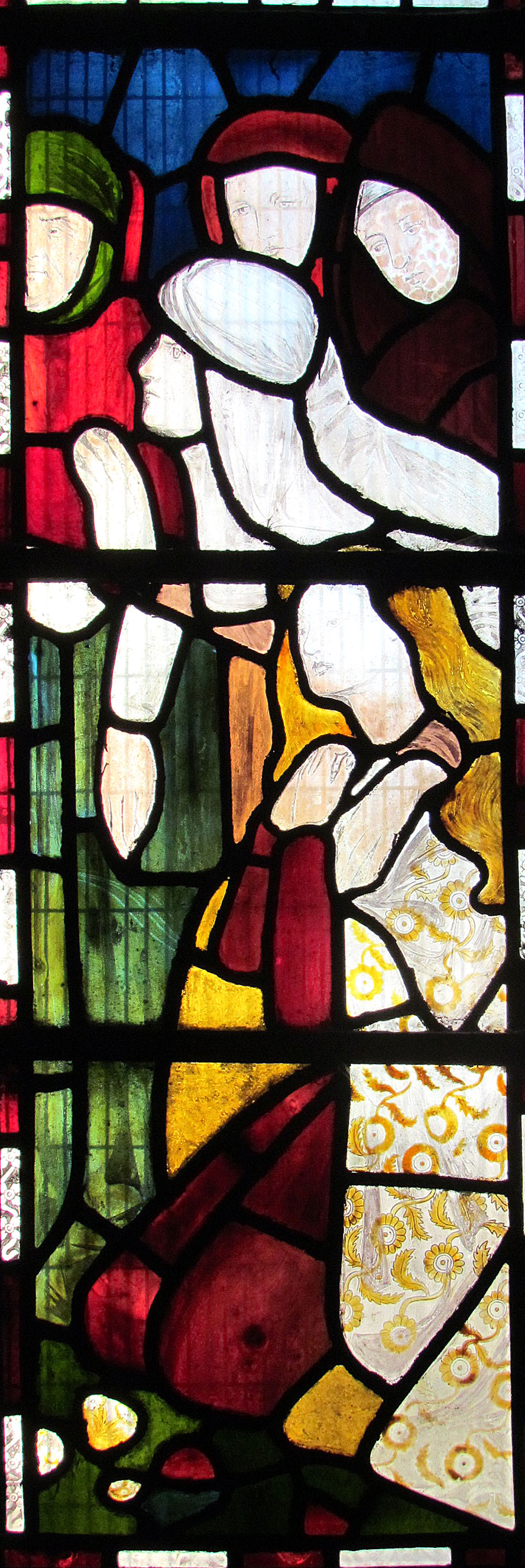
10: St. John the Baptist preaching by William Morris; tracery by Philip Webb
St. John the Baptist Preaching - Lady Chapel
This window was originally at the east end of the north aisle, but was moved to its present position when the Lady Chapel was built in 1902.
Because it was so large, a gabled dormer roof had to be constructed to accomodate its height (this can be best viewed from outside).
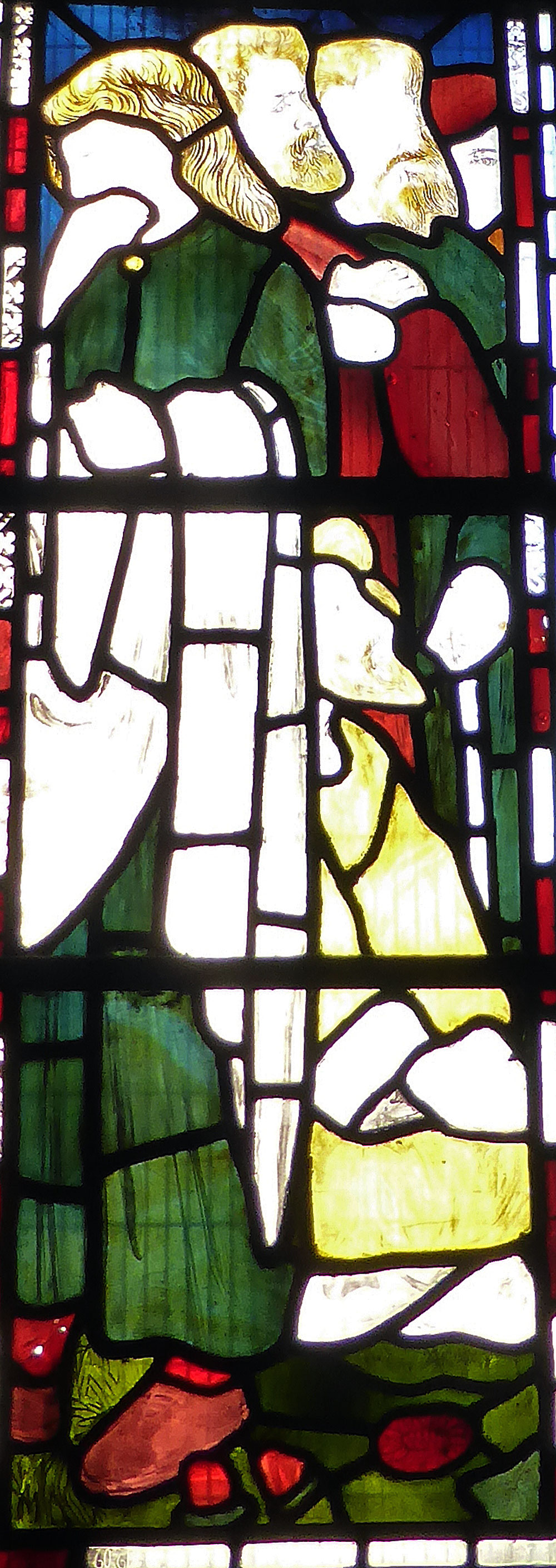
The three lights of the window show designs by Morris of St. John the Baptist preaching penitence; Morris used Rossetti as a model for John.
Burne-Jones’s Account Book of the 27th November 1862 throws interesting light on Morris’s difficulty in drawing figures:
“Alterations to St. John Baptist designs 5s (shillings or 25p today). Altering a figure for poor Topsy (Morris’s nickname) - this I won’t charge for - I’ll give it to poor Topsy. N.B. To threaten to charge this if the firm behaves meanly in any case."
The tracery glass is by Philip Webb and relates to John the Baptist's warning that the coming judgement is very close, being based on Luke 3: 9 - "The axe is already at the root of the trees, and every tree that does not produce good fruit will be cut down and thrown into the fire." The axe can clearly be seen in the bottom tracery light.
Note also the two very catholic symbols in the lozenges at the top of the left and right lights: the Pelican-in-her-Piety (left) and Agnus Dei (right, which unfortunately is very much faded).
Click on any of these windows below for greater detail:
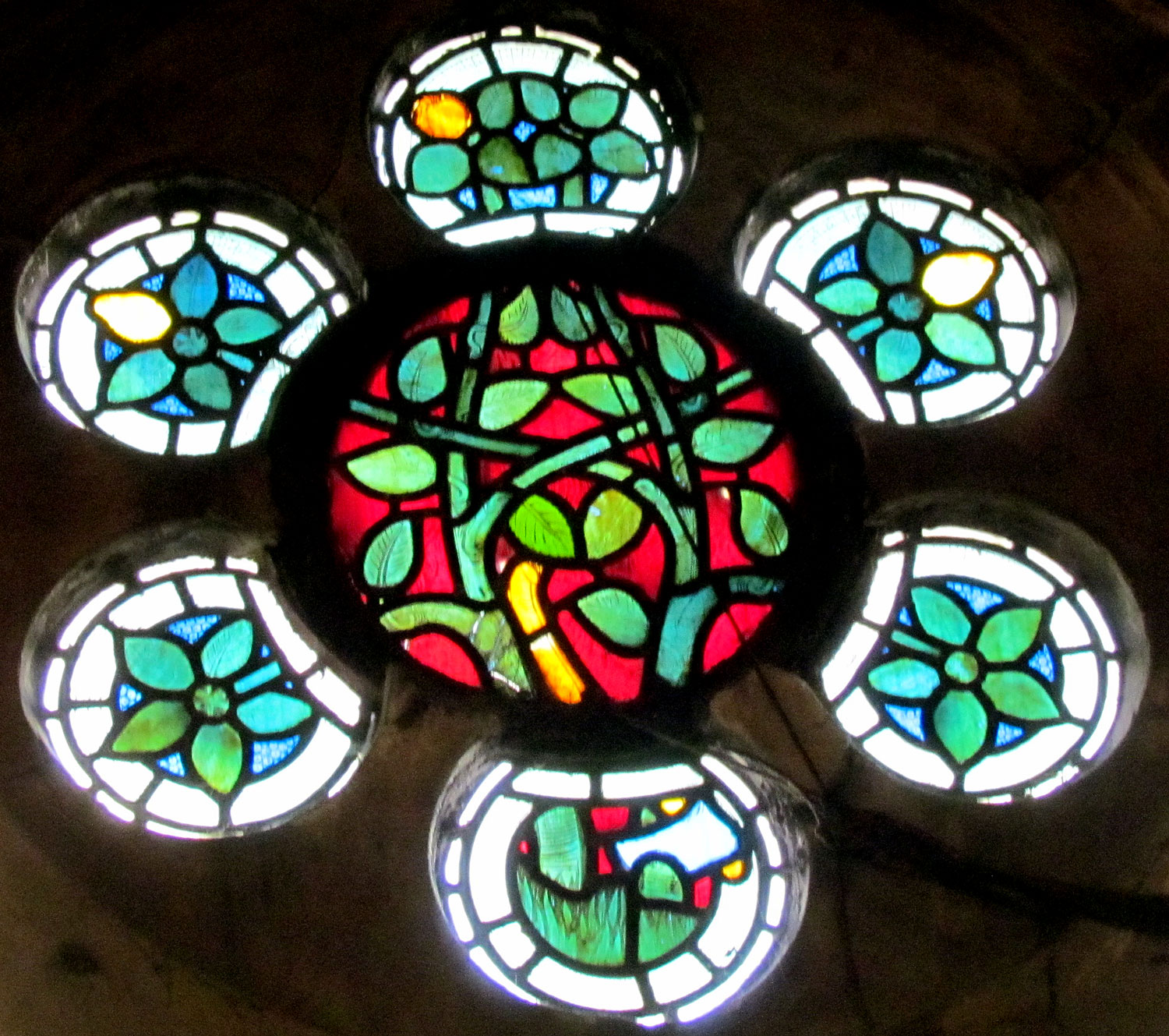
Tracery
11 : East window: seven panels depicting The Parable of the Vineyard by Rossetti
The East Window
Designs by Rossetti, Madox Brown and Burne-Jones
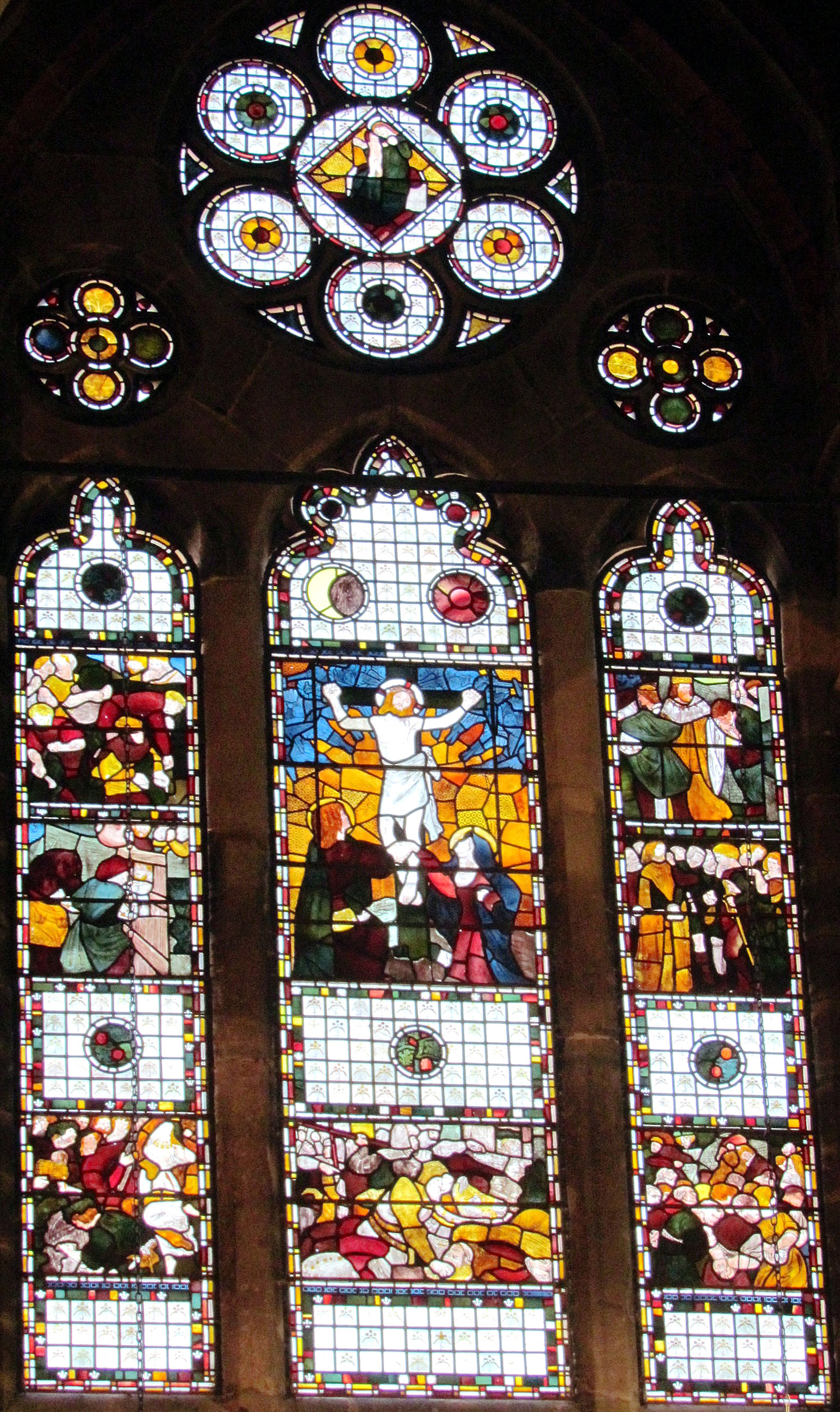
The East Window is altogether the work of three pre-Raphaelite artists and initially may appear somewhat confusing, although the symbolism is quite plain.
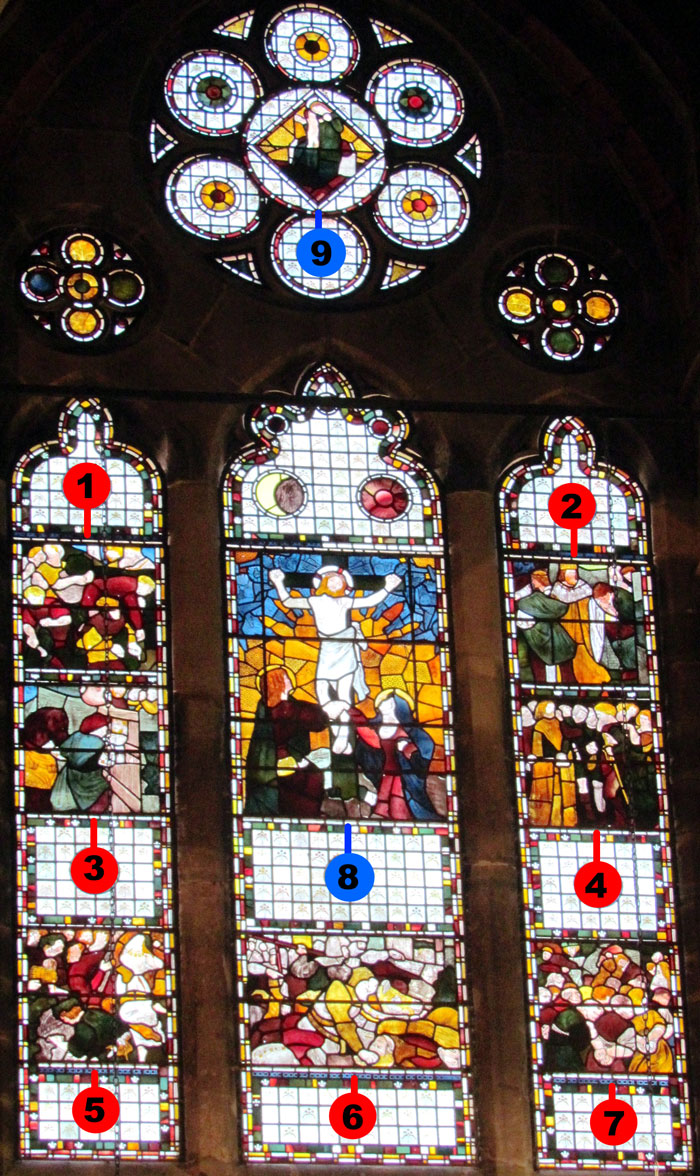
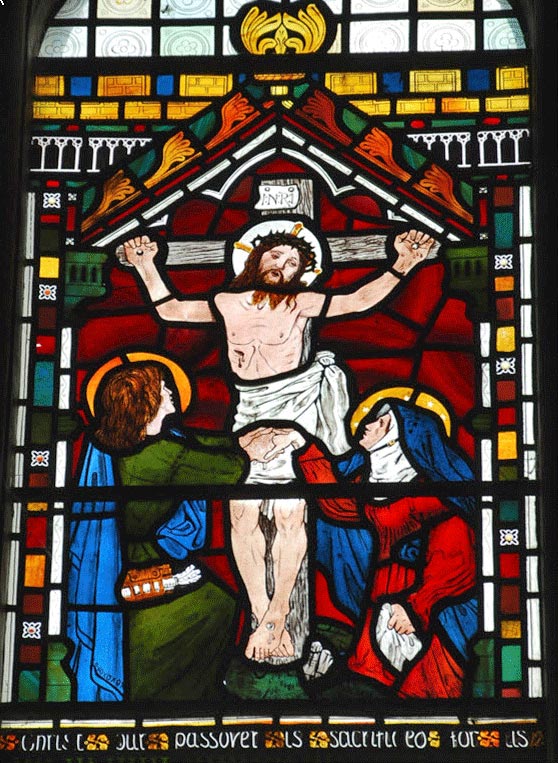
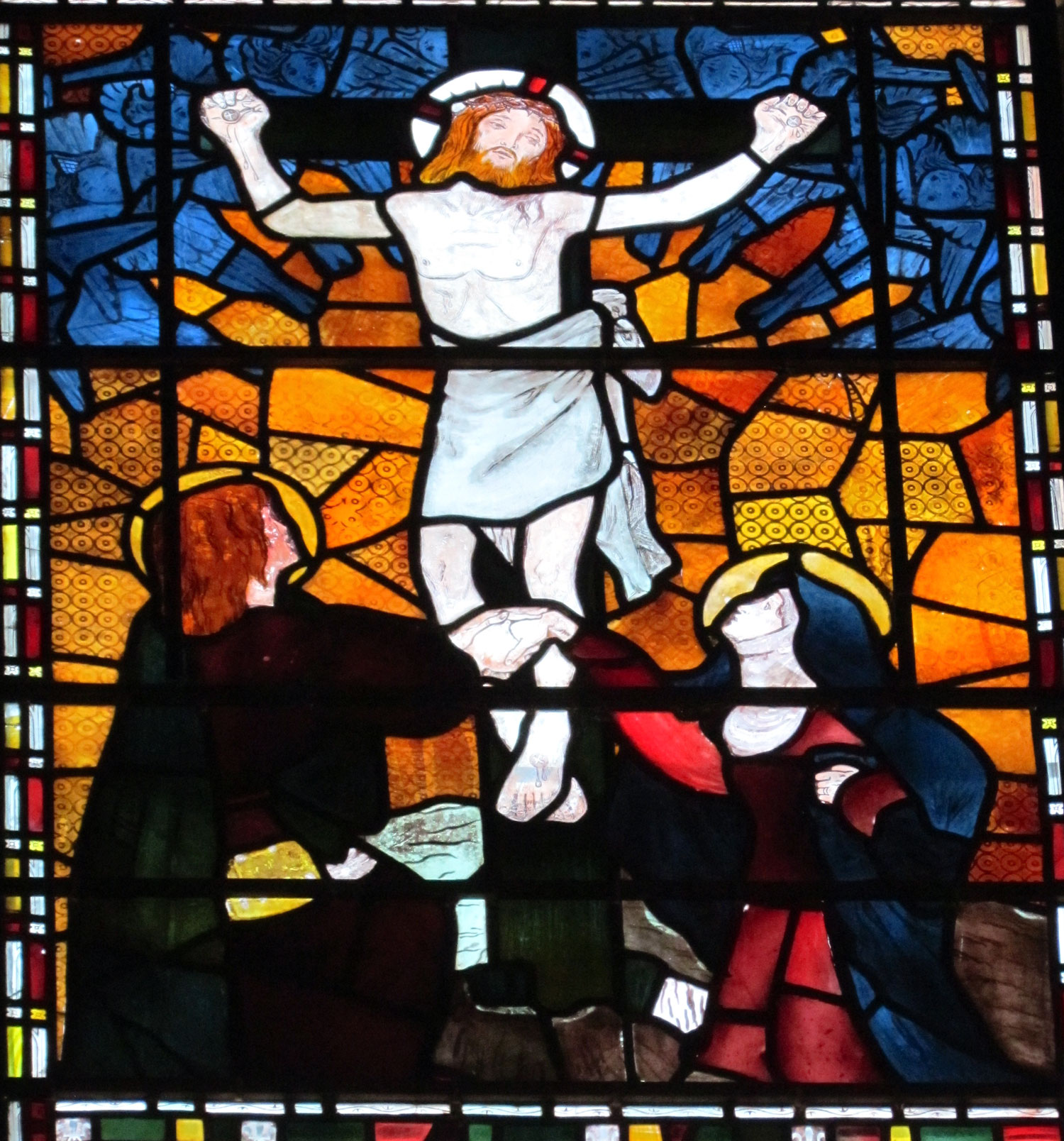
The top central panel (no.8 in the blue circle below) is the crucifixion by Ford Maddox Brown. Notice that Jesus' mother, Mary, and John, the disciple whom Jesus loved, and who Jesus, as he was dying on the cross, charged with the responsibility of looking after his mother, are holding hands. This is considered to be an unusual pose that the artist has produced.
The surrounding panels (nos. 1 - 7 in the red circles below) are to designs by Rossetti of 1861, and they won the silver medal at the South Kensington Exhibition of 1862. The Firm took two stands at the International Exhibition held at the South Kensington Museum. One was for the sole promotion of stained-glass, the other for embroideries and painted Gothic furniture.
The medal the Firm received for its stained glass was challenged by a petition raised by those in the trade who alleged the seven panels depicting the Parable of the Vineyard by Rossetti consisted of genuine medieval glass touched up and remounted. This petition was rejected by the judges. The offending glass was later erected in the east window of St Martin's.
The designs appear to be rather confused but they tell the story of the Parable of the Tenants of the Vineyard, by which Jesus foretold his death on the cross; the fulfillment of which is Brown's Crucifixion.
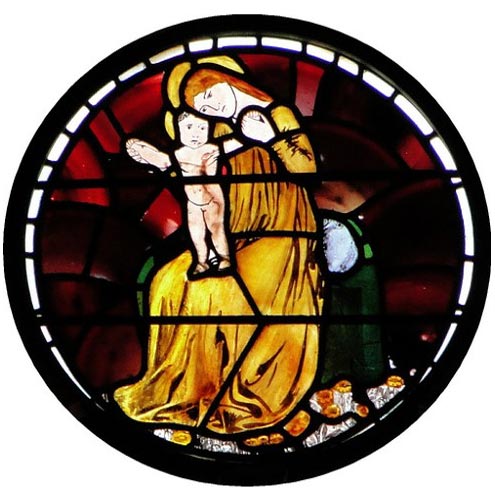
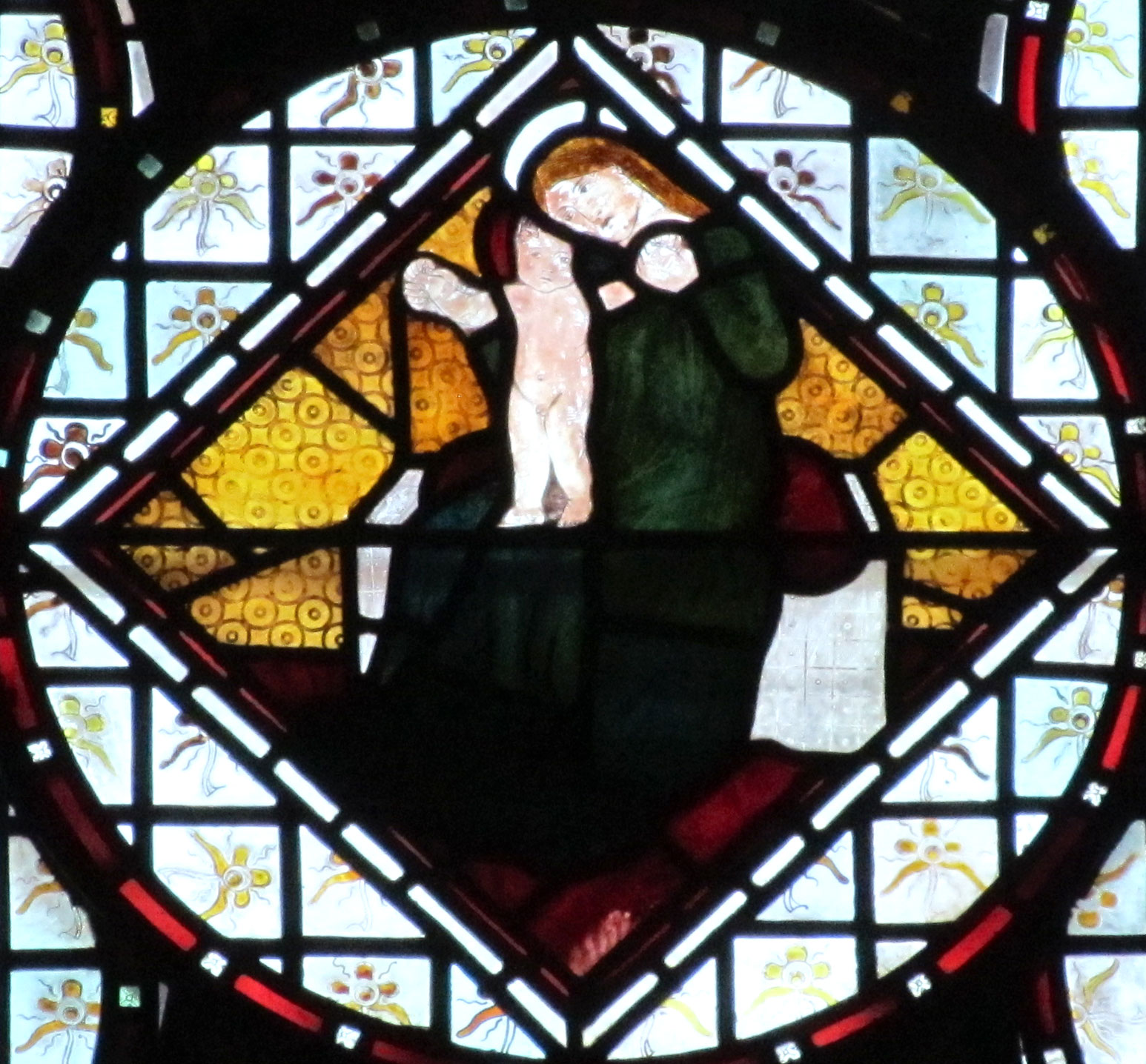
The Virgin and the Child in the tracery (no.9 in the blue circle below) is by Edward Burne-Jones, and was originally intended for St. Michael's Church in Brighton.
Click the east window without the numbers to enlarge.
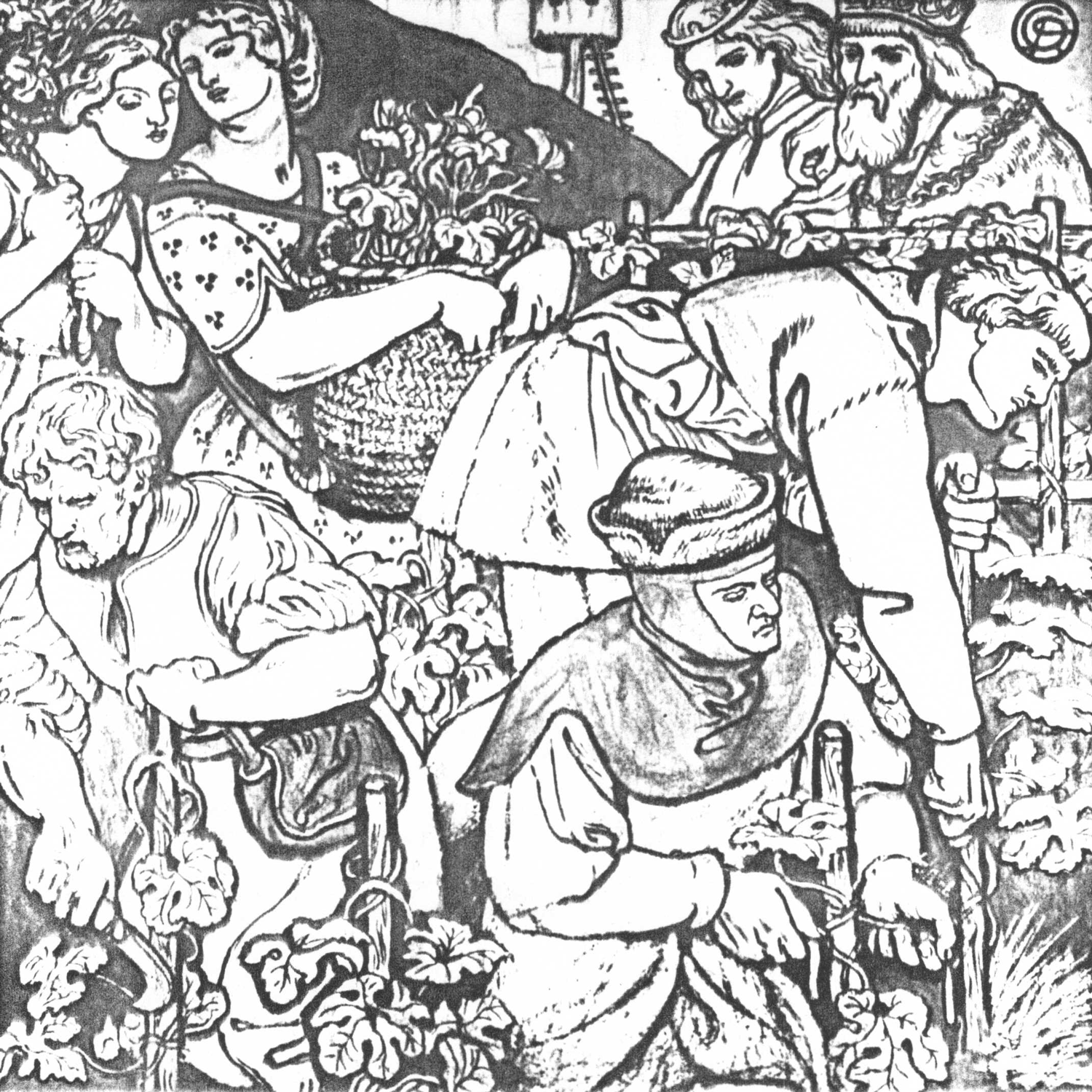
The Parable of the Tenants of the Vineyard : 1
by Dante Gabriel Rossetti 1861
A certain Lord planted a vineyard...Click for larger images
The Parable of the Wicked Tenants Matthew 21: 33-45, Mark 12: 1-12, Luke 20: 9-18
33 Hear another parable: There was a certain householder, which planted a vineyard, and hedged it round about, and digged a winepress in it, and built a tower, and let it out to husbandmen, and went into a far country:
34 And when the time of the fruit drew near, he sent his servants to the husbandmen, that they might receive the fruits of it.
35 And the husbandmen took his servants, and beat one, and killed another, and stoned another.
36 Again, he sent other servants more than the first: and they did unto them likewise.
37 But last of all he sent unto them his son, saying, They will reverence my son.
38 But when the husbandmen saw the son, they said among themselves, This is the heir; come, let us kill him, and let us seize on his inheritance.
39 And they caught him, and cast him out of the vineyard, and slew him.
40 When the lord therefore of the vineyard cometh, what will he do unto those husbandmen?
41 They say unto him, He will miserably destroy those wicked men, and will let out his vineyard unto other husbandmen, which shall render him the fruits in their seasons.
42 Jesus saith unto them, Did ye never read in the scriptures, The stone which the builders rejected, the same is become the head of the corner: this is the Lord's doing, and it is marvellous in our eyes?
43 Therefore say I unto you, The kingdom of God shall be taken from you, and given to a nation bringing forth the fruits thereof.
44 And whosoever shall fall on this stone shall be broken: but on whomsoever it shall fall, it will grind him to powder.
45 And when the chief priests and Pharisees had heard his parables, they perceived that he spake of them.
46 But when they sought to lay hands on him, they feared the multitude, because they took him for a prophet.
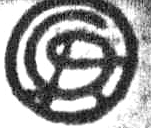
Note the DCR monogram
The Parable of the Tenants of the Vineyard : 2
by Dante Gabriel Rossetti 1861
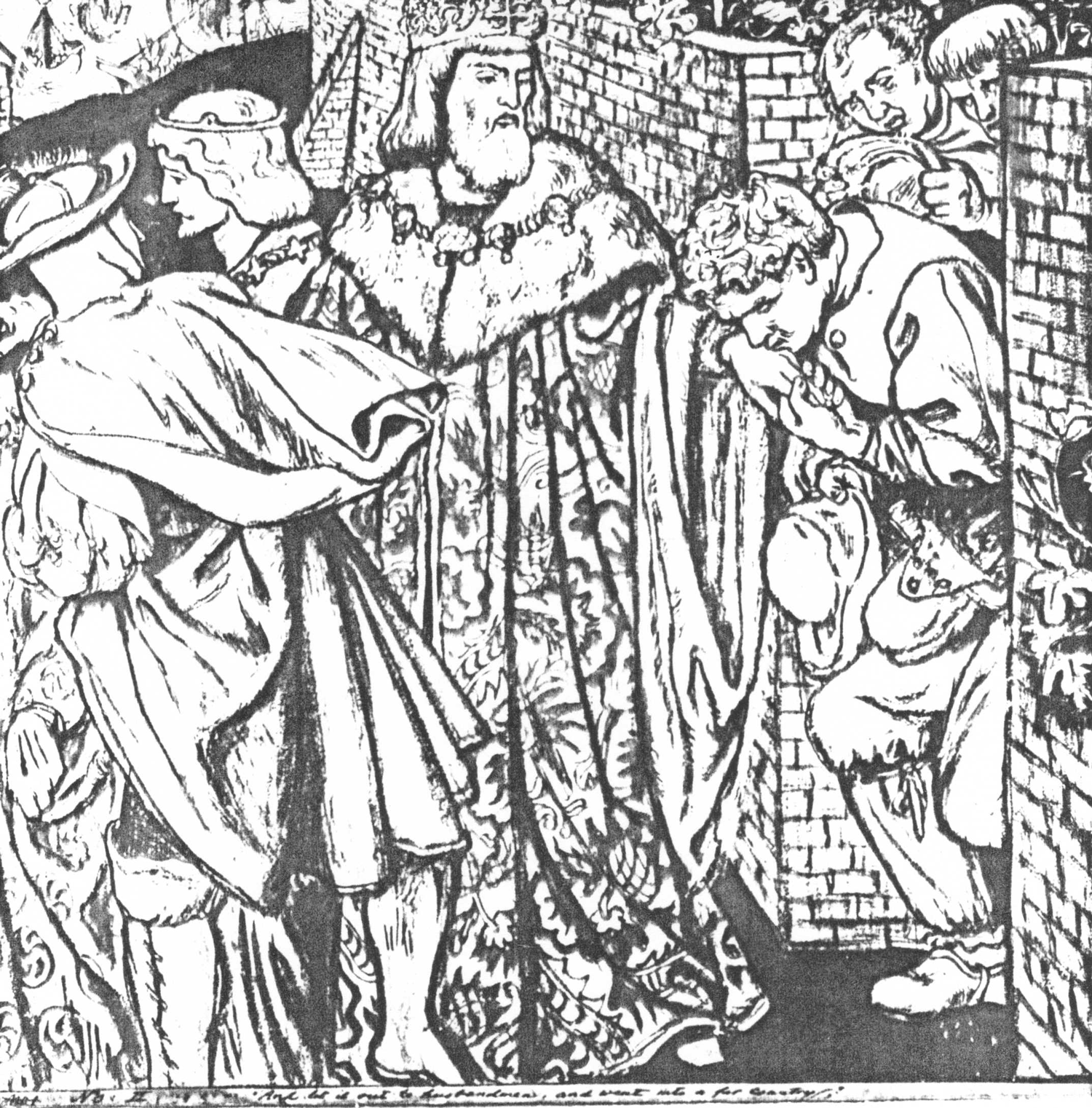
...and let it out to husbandmen, and went into a far country...Click for larger images
The Parable of the Wicked Tenants Matthew 21: 33-45, Mark 12: 1-12, Luke 20: 9-18
33 Hear another parable: There was a certain householder, which planted a vineyard, and hedged it round about, and digged a winepress in it, and built a tower, and let it out to husbandmen, and went into a far country:
34 And when the time of the fruit drew near, he sent his servants to the husbandmen, that they might receive the fruits of it.
35 And the husbandmen took his servants, and beat one, and killed another, and stoned another.
36 Again, he sent other servants more than the first: and they did unto them likewise.
37 But last of all he sent unto them his son, saying, They will reverence my son.
38 But when the husbandmen saw the son, they said among themselves, This is the heir; come, let us kill him, and let us seize on his inheritance.
39 And they caught him, and cast him out of the vineyard, and slew him.
40 When the lord therefore of the vineyard cometh, what will he do unto those husbandmen?
41 They say unto him, He will miserably destroy those wicked men, and will let out his vineyard unto other husbandmen, which shall render him the fruits in their seasons.
42 Jesus saith unto them, Did ye never read in the scriptures, The stone which the builders rejected, the same is become the head of the corner: this is the Lord's doing, and it is marvellous in our eyes?
43 Therefore say I unto you, The kingdom of God shall be taken from you, and given to a nation bringing forth the fruits thereof.
44 And whosoever shall fall on this stone shall be broken: but on whomsoever it shall fall, it will grind him to powder.
45 And when the chief priests and Pharisees had heard his parables, they perceived that he spake of them.
46 But when they sought to lay hands on him, they feared the multitude, because they took him for a prophet.
The Parable of the Tenants of the Vineyard : 3
by Dante Gabriel Rossetti 1861
The Lord's agent sent to the vineyard is killed...Click for larger images
The Parable of the Wicked Tenants Matthew 21: 33-45, Mark 12: 1-12, Luke 20: 9-18
33 Hear another parable: There was a certain householder, which planted a vineyard, and hedged it round about, and digged a winepress in it, and built a tower, and let it out to husbandmen, and went into a far country:
34 And when the time of the fruit drew near, he sent his servants to the husbandmen, that they might receive the fruits of it.
35 And the husbandmen took his servants, and beat one, and killed another, and stoned another.
36 Again, he sent other servants more than the first: and they did unto them likewise.
37 But last of all he sent unto them his son, saying, They will reverence my son.
38 But when the husbandmen saw the son, they said among themselves, This is the heir; come, let us kill him, and let us seize on his inheritance.
39 And they caught him, and cast him out of the vineyard, and slew him.
40 When the lord therefore of the vineyard cometh, what will he do unto those husbandmen?
41 They say unto him, He will miserably destroy those wicked men, and will let out his vineyard unto other husbandmen, which shall render him the fruits in their seasons.
42 Jesus saith unto them, Did ye never read in the scriptures, The stone which the builders rejected, the same is become the head of the corner: this is the Lord's doing, and it is marvellous in our eyes?
43 Therefore say I unto you, The kingdom of God shall be taken from you, and given to a nation bringing forth the fruits thereof.
44 And whosoever shall fall on this stone shall be broken: but on whomsoever it shall fall, it will grind him to powder.
45 And when the chief priests and Pharisees had heard his parables, they perceived that he spake of them.
46 But when they sought to lay hands on him, they feared the multitude, because they took him for a prophet.
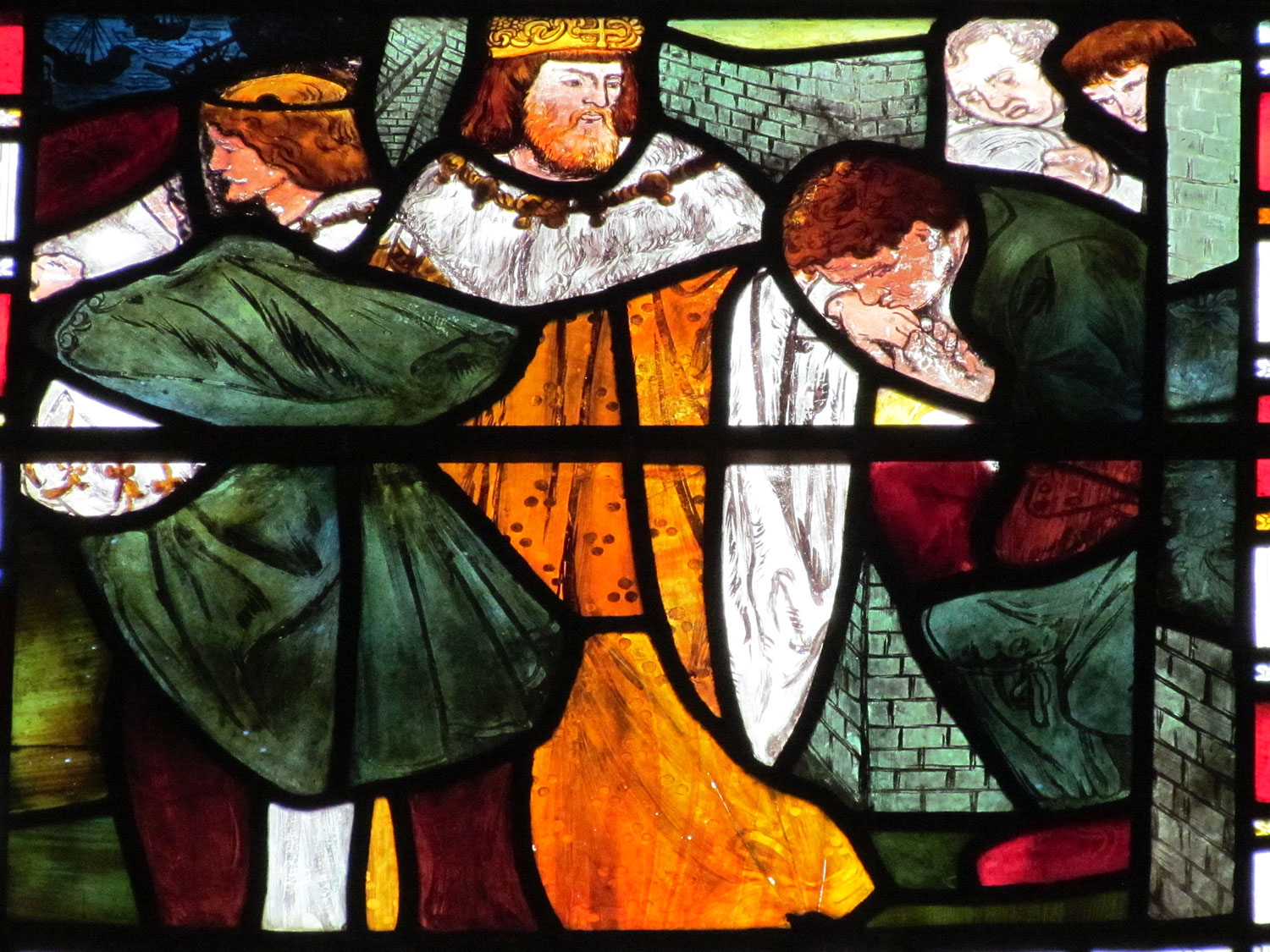
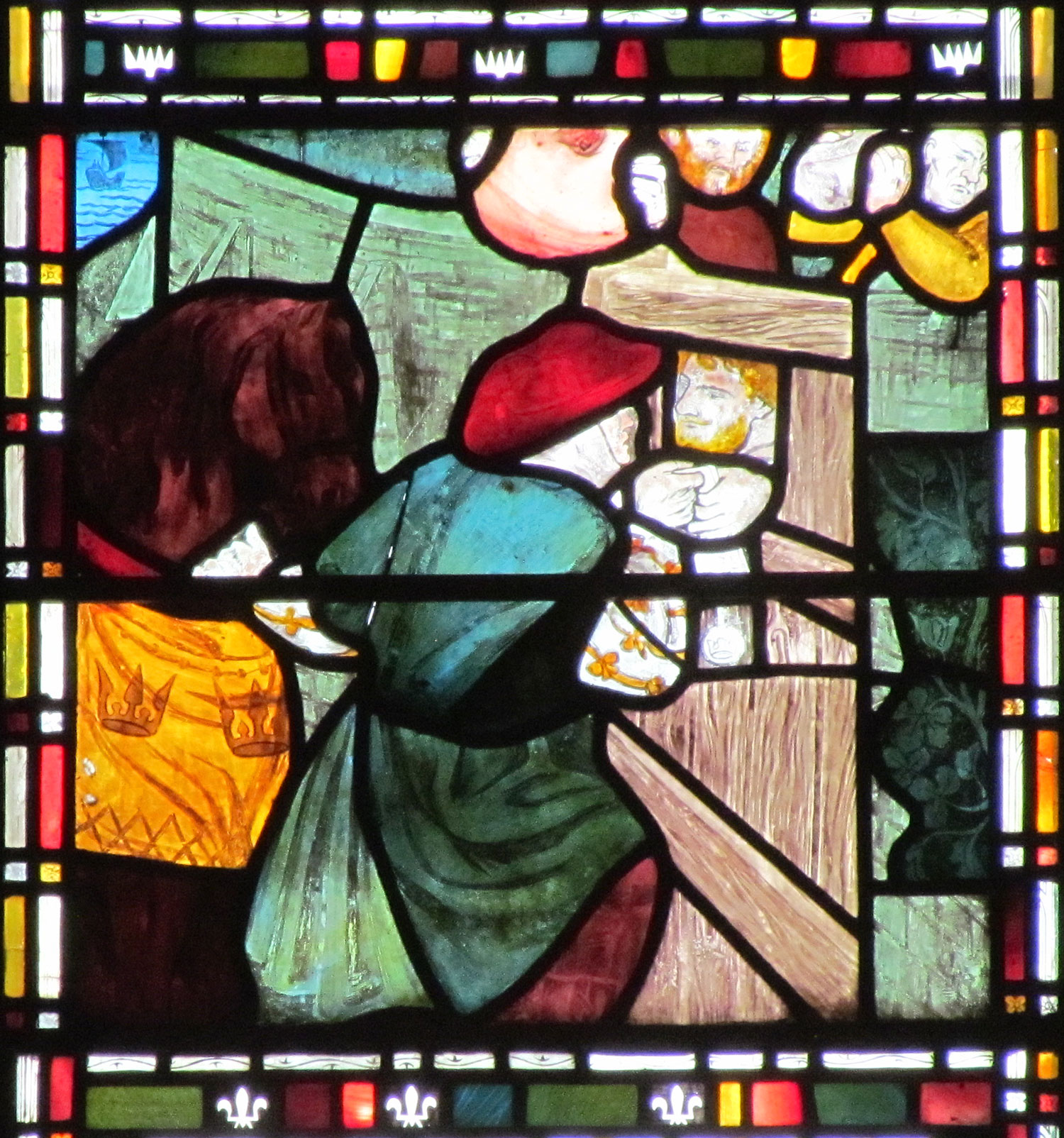
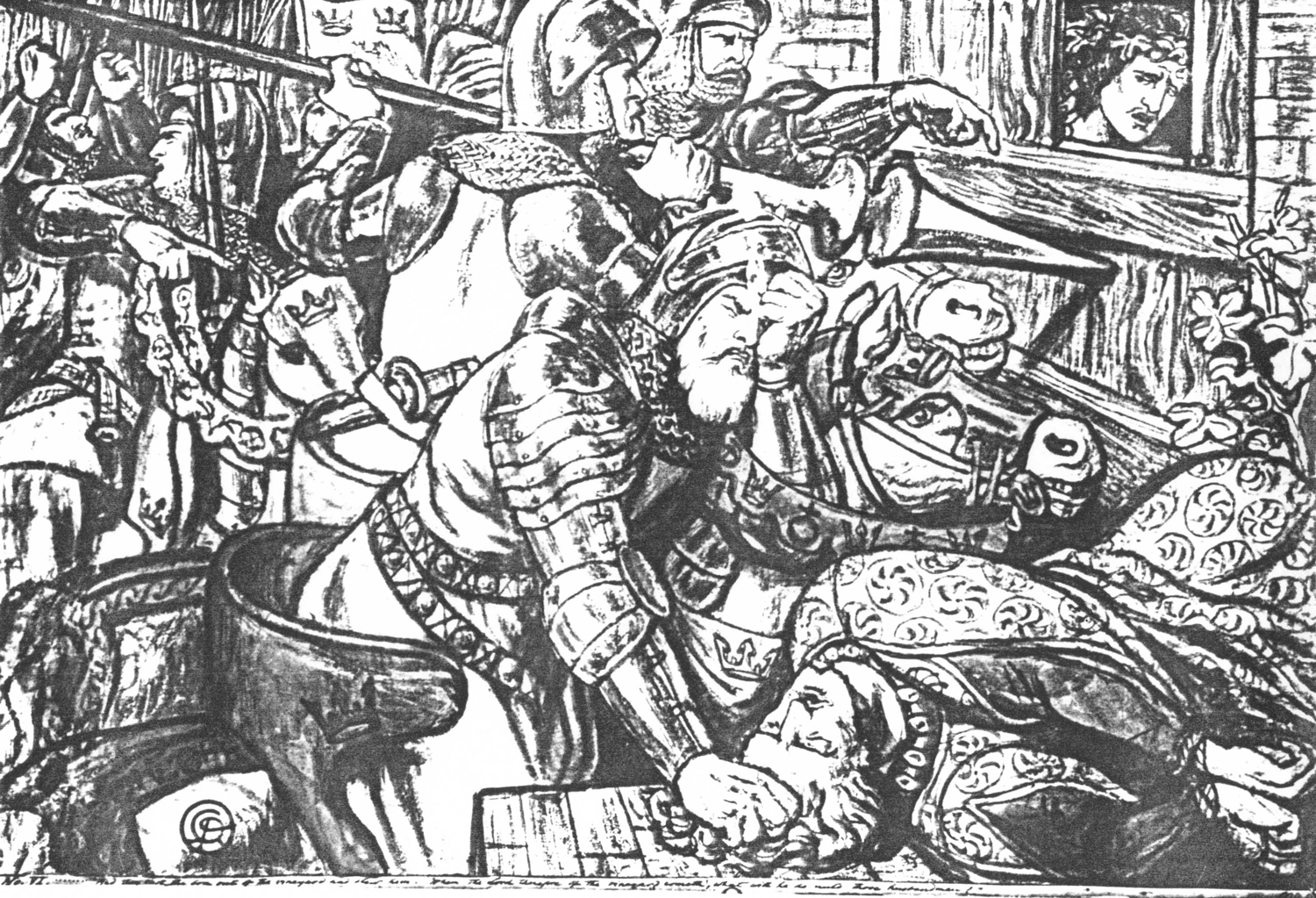
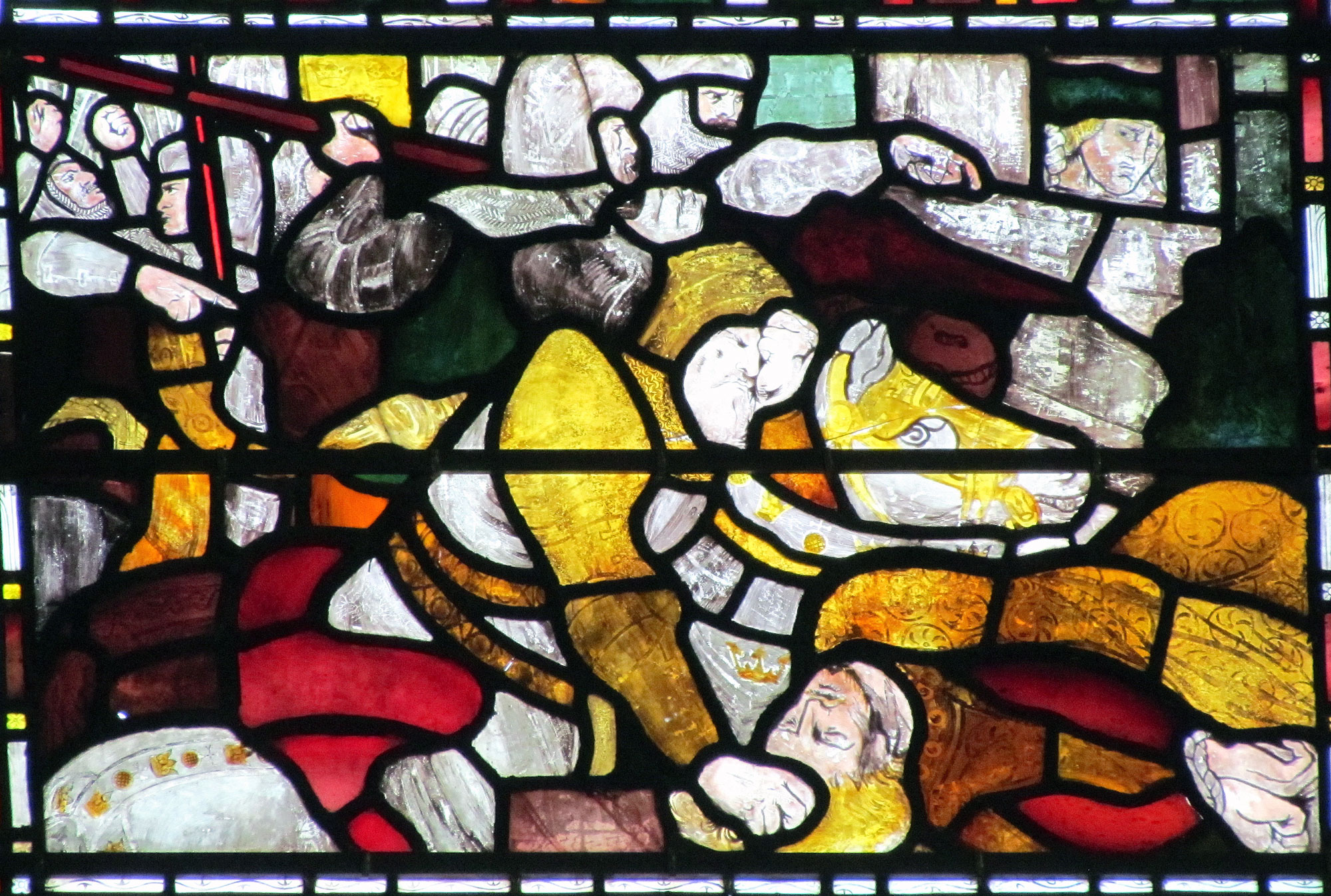
Note that the head of William Morris is portrayed at the opening in the gate. Behind him the two men dropping the stones are Gambart, the art dealer and, left, Val Princep, the artist.
Formerly on fairly good terms, Rossetti and Gambart fell out during the commission, and so a vicious-looking Gambart is shown as the bad husbandman and killer.
The detail of Rossetti’s cartoons resulted in shapes so complicated that they had to be drastically simplified, usually by Morris, before an attempt could be made to cut from them.

The Parable of the Tenants of the Vineyard : 4
by Dante Gabriel Rossetti 1861
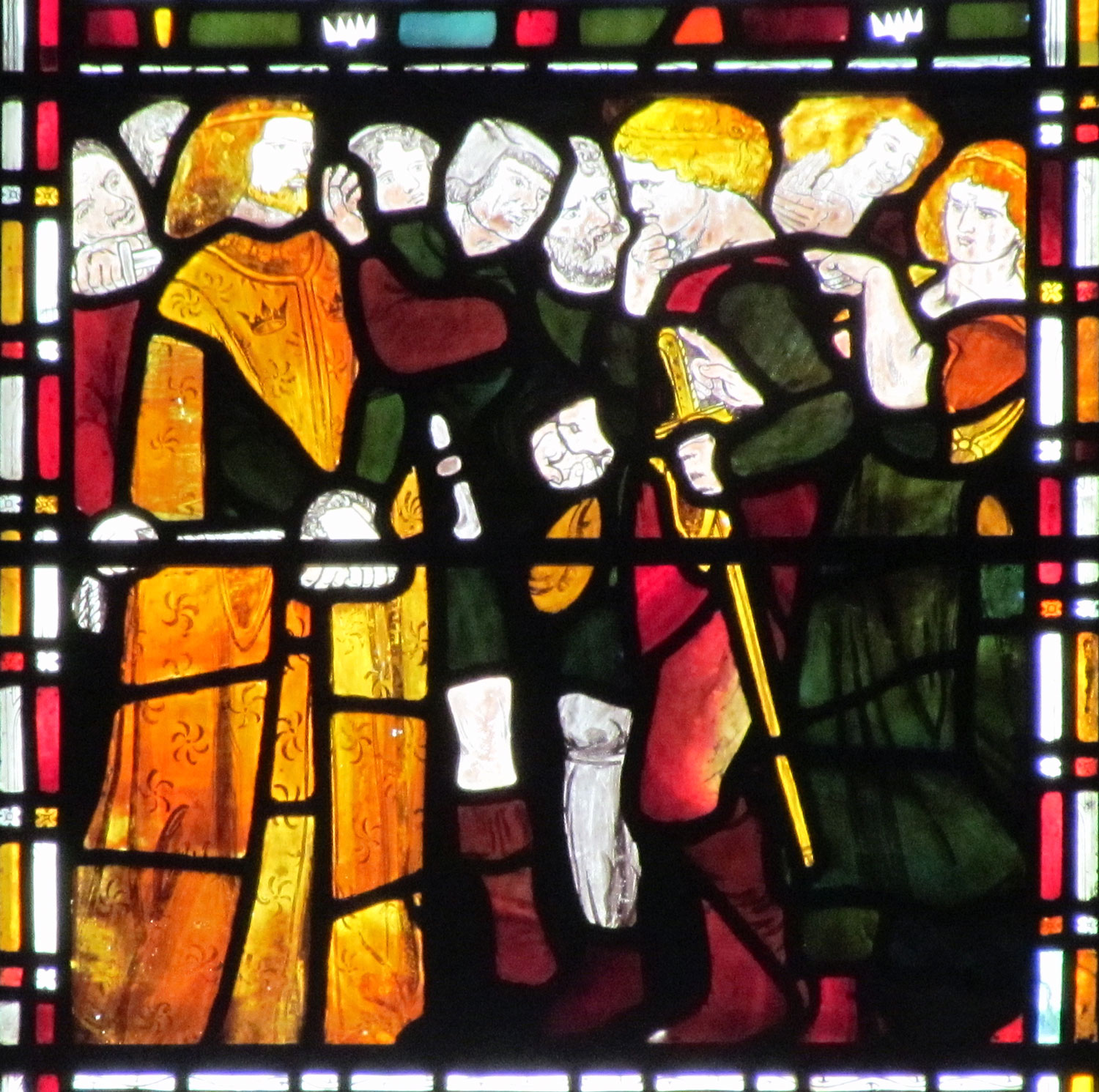
The Lord's son sent to the husbandmen: come let us kill him...Click for larger images
The Parable of the Wicked Tenants Matthew 21: 33-45, Mark 12: 1-12, Luke 20: 9-18
33 Hear another parable: There was a certain householder, which planted a vineyard, and hedged it round about, and digged a winepress in it, and built a tower, and let it out to husbandmen, and went into a far country:
34 And when the time of the fruit drew near, he sent his servants to the husbandmen, that they might receive the fruits of it.
35 And the husbandmen took his servants, and beat one, and killed another, and stoned another.
36 Again, he sent other servants more than the first: and they did unto them likewise.
37 But last of all he sent unto them his son, saying, They will reverence my son.
38 But when the husbandmen saw the son, they said among themselves, This is the heir; come, let us kill him, and let us seize on his inheritance.
39 And they caught him, and cast him out of the vineyard, and slew him.
40 When the lord therefore of the vineyard cometh, what will he do unto those husbandmen?
41 They say unto him, He will miserably destroy those wicked men, and will let out his vineyard unto other husbandmen, which shall render him the fruits in their seasons.
42 Jesus saith unto them, Did ye never read in the scriptures, The stone which the builders rejected, the same is become the head of the corner: this is the Lord's doing, and it is marvellous in our eyes?
43 Therefore say I unto you, The kingdom of God shall be taken from you, and given to a nation bringing forth the fruits thereof.
44 And whosoever shall fall on this stone shall be broken: but on whomsoever it shall fall, it will grind him to powder.
45 And when the chief priests and Pharisees had heard his parables, they perceived that he spake of them.
46 But when they sought to lay hands on him, they feared the multitude, because they took him for a prophet.

The Parable of the Tenants of the Vineyard : 5
by Dante Gabriel Rossetti 1861
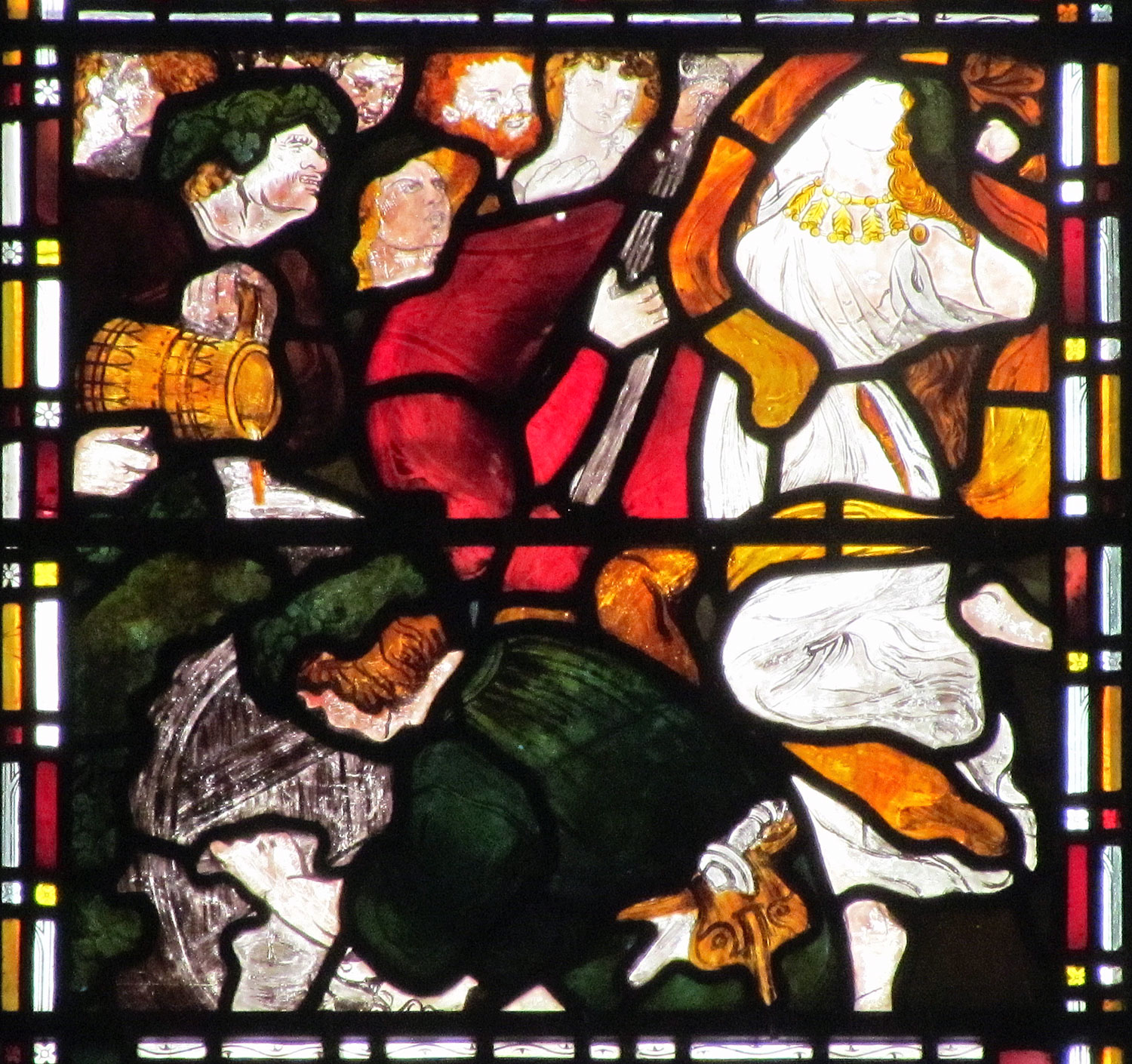
And the inheritance shall be ours..Click for larger images
The Parable of the Wicked Tenants Matthew 21: 33-45, Mark 12: 1-12, Luke 20: 9-18
33 Hear another parable: There was a certain householder, which planted a vineyard, and hedged it round about, and digged a winepress in it, and built a tower, and let it out to husbandmen, and went into a far country:
34 And when the time of the fruit drew near, he sent his servants to the husbandmen, that they might receive the fruits of it.
35 And the husbandmen took his servants, and beat one, and killed another, and stoned another.
36 Again, he sent other servants more than the first: and they did unto them likewise.
37 But last of all he sent unto them his son, saying, They will reverence my son.
38 But when the husbandmen saw the son, they said among themselves, This is the heir; come, let us kill him, and let us seize on his inheritance.
39 And they caught him, and cast him out of the vineyard, and slew him.
40 When the lord therefore of the vineyard cometh, what will he do unto those husbandmen?
41 They say unto him, He will miserably destroy those wicked men, and will let out his vineyard unto other husbandmen, which shall render him the fruits in their seasons.
42 Jesus saith unto them, Did ye never read in the scriptures, The stone which the builders rejected, the same is become the head of the corner: this is the Lord's doing, and it is marvellous in our eyes?
43 Therefore say I unto you, The kingdom of God shall be taken from you, and given to a nation bringing forth the fruits thereof.
44 And whosoever shall fall on this stone shall be broken: but on whomsoever it shall fall, it will grind him to powder.
45 And when the chief priests and Pharisees had heard his parables, they perceived that he spake of them.
46 But when they sought to lay hands on him, they feared the multitude, because they took him for a prophet.

The Parable of the Tenants of the Vineyard : 6
by Dante Gabriel Rossetti 1861
The Lord of the vineyard arrives to punish the wicked husbandmen...Click for larger images
The Parable of the Wicked Tenants Matthew 21: 33-45, Mark 12: 1-12, Luke 20: 9-18
33 Hear another parable: There was a certain householder, which planted a vineyard, and hedged it round about, and digged a winepress in it, and built a tower, and let it out to husbandmen, and went into a far country:
34 And when the time of the fruit drew near, he sent his servants to the husbandmen, that they might receive the fruits of it.
35 And the husbandmen took his servants, and beat one, and killed another, and stoned another.
36 Again, he sent other servants more than the first: and they did unto them likewise.
37 But last of all he sent unto them his son, saying, They will reverence my son.
38 But when the husbandmen saw the son, they said among themselves, This is the heir; come, let us kill him, and let us seize on his inheritance.
39 And they caught him, and cast him out of the vineyard, and slew him.
40 When the lord therefore of the vineyard cometh, what will he do unto those husbandmen?
41 They say unto him, He will miserably destroy those wicked men, and will let out his vineyard unto other husbandmen, which shall render him the fruits in their seasons.
42 Jesus saith unto them, Did ye never read in the scriptures, The stone which the builders rejected, the same is become the head of the corner: this is the Lord's doing, and it is marvellous in our eyes?
43 Therefore say I unto you, The kingdom of God shall be taken from you, and given to a nation bringing forth the fruits thereof.
44 And whosoever shall fall on this stone shall be broken: but on whomsoever it shall fall, it will grind him to powder.
45 And when the chief priests and Pharisees had heard his parables, they perceived that he spake of them.
46 But when they sought to lay hands on him, they feared the multitude, because they took him for a prophet.
The Parable of the Tenants of the Vineyard : 7
by Dante Gabriel Rossetti 1861
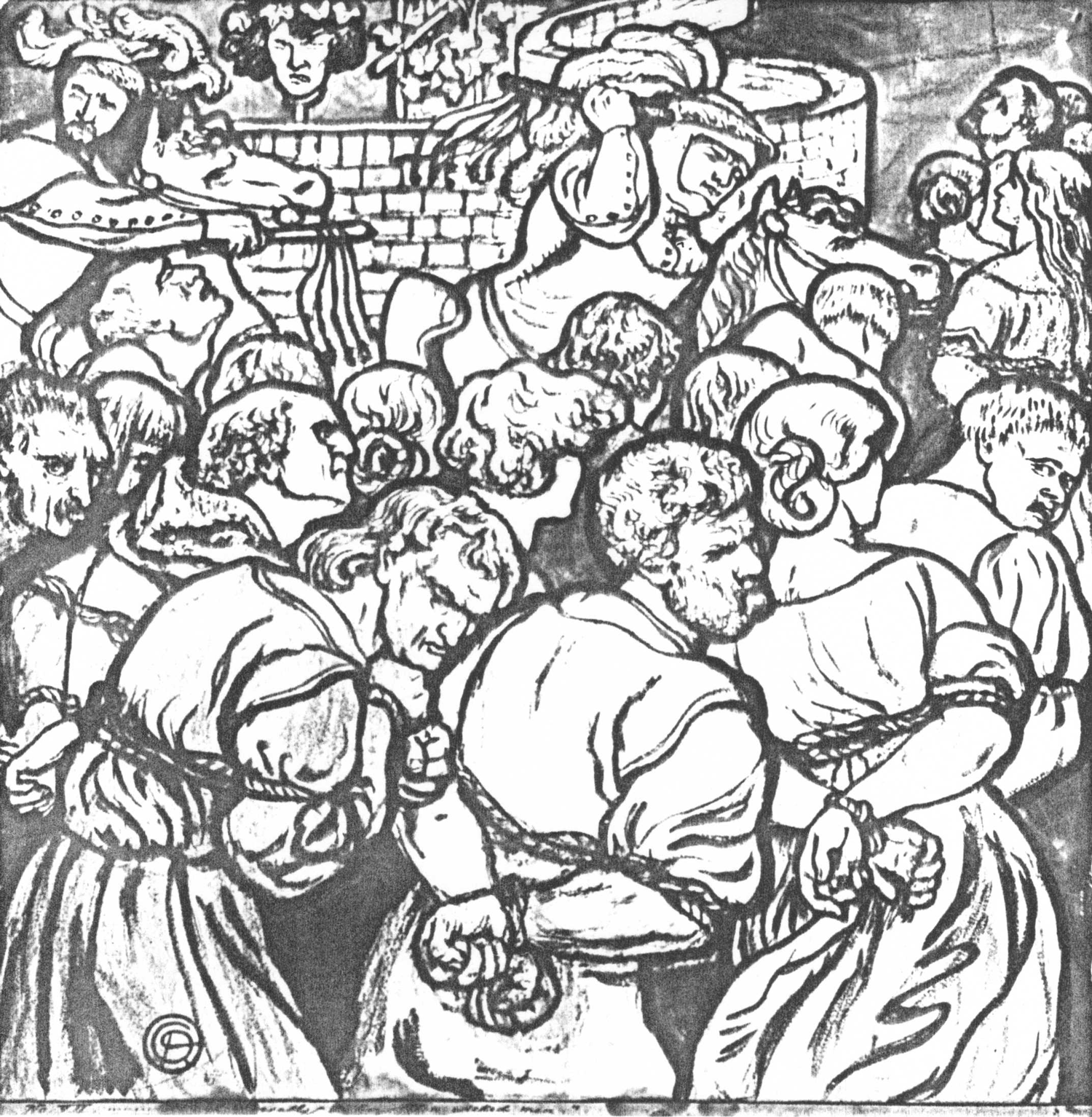
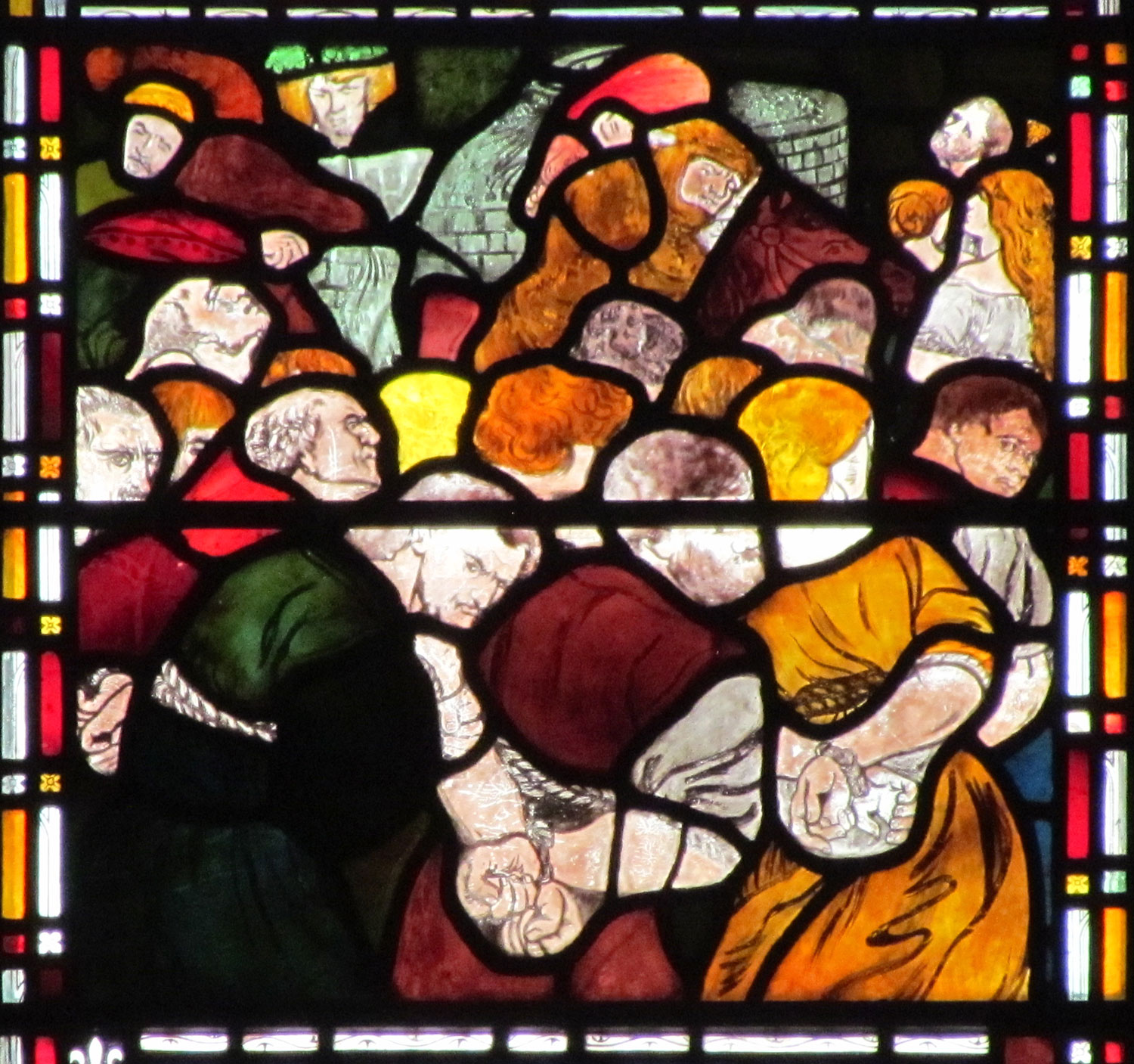
The wicked husbandmen driven away to punishment...Click for larger images
The Parable of the Wicked Tenants Matthew 21: 33-45, Mark 12: 1-12, Luke 20: 9-18
33 Hear another parable: There was a certain householder, which planted a vineyard, and hedged it round about, and digged a winepress in it, and built a tower, and let it out to husbandmen, and went into a far country:
34 And when the time of the fruit drew near, he sent his servants to the husbandmen, that they might receive the fruits of it.
35 And the husbandmen took his servants, and beat one, and killed another, and stoned another.
36 Again, he sent other servants more than the first: and they did unto them likewise.
37 But last of all he sent unto them his son, saying, They will reverence my son.
38 But when the husbandmen saw the son, they said among themselves, This is the heir; come, let us kill him, and let us seize on his inheritance.
39 And they caught him, and cast him out of the vineyard, and slew him.
40 When the lord therefore of the vineyard cometh, what will he do unto those husbandmen?
41 They say unto him, He will miserably destroy those wicked men, and will let out his vineyard unto other husbandmen, which shall render him the fruits in their seasons.
42 Jesus saith unto them, Did ye never read in the scriptures, The stone which the builders rejected, the same is become the head of the corner: this is the Lord's doing, and it is marvellous in our eyes?
43 Therefore say I unto you, The kingdom of God shall be taken from you, and given to a nation bringing forth the fruits thereof.
44 And whosoever shall fall on this stone shall be broken: but on whomsoever it shall fall, it will grind him to powder.
45 And when the chief priests and Pharisees had heard his parables, they perceived that he spake of them.
46 But when they sought to lay hands on him, they feared the multitude, because they took him for a prophet.
Note that the heads of Algernon Charles Swinburne, Ernest Gambart (an art dealer) and William Morris are amongst those being led away.
12 : East window central panel: The Crucifixion by Ford Madox Brown; tracery the Virgin and Child by Burne-Jones
The East Window
Designs by Rossetti, Madox Brown and Burne-Jones
The East Window is altogether the work of three pre-Raphaelite artists and initially may appear somewhat confusing, although the symbolism is quite plain.
The top central panel (no.8 in the blue circle below) is the crucifixion by Ford Maddox Brown. Notice that Jesus' mother, Mary, and John, the disciple whom Jesus loved, and who Jesus, as he was dying on the cross, charged with the responsibility of looking after his mother, are holding hands. This is considered to be an unusual pose that the artist has produced.
The surrounding panels (nos. 1 - 7 in the red circles below) are to designs by Rossetti of 1861, and they won the silver medal at the South Kensington Exhibition of 1862. The Firm took two stands at the International Exhibition held at the South Kensington Museum. One was for the sole promotion of stained-glass, the other for embroideries and painted Gothic furniture.
The medal the Firm received for its stained glass was challenged by a petition raised by those in the trade who alleged the seven panels depicting the Parable of the Vineyard by Rossetti consisted of genuine medieval glass touched up and remounted. This petition was rejected by the judges. The offending glass was later erected in the east window of St Martin's.
The designs appear to be rather confused but they tell the story of the Parable of the Tenants of the Vineyard, by which Jesus foretold his death on the cross; the fulfillment of which is Brown's Crucifixion.
The Virgin and the Child in the tracery (no.9 in the blue circle below) is by Edward Burne-Jones, and was originally intended for St. Michael's Church in Brighton.
Click the east window without the numbers to enlarge.
The Crucifixion by Ford Madox Brown : 8
The Crucifixion by Ford Madox Brown at Selsey is very similar to that in St. Martin's east window.
The artists frequently recycled their cartoons adding minor variations.
Click the St. Martin's image to enlarge.
Selsey
St. Martin's
The Virgin and Child by Burne-Jones : 9
While designing panel 5 "The Feast of the Vintage", Rossetti wrote to Ford Madox Brown:
"I'm doing the 'Parable of the Vineyard' for the shop glass: I think you have a number of
'Pictorial History of England' with a Saxon wine-press in it. Would you kindly send it to me by book post?
If you've anything else in the vineyard line you might include it. Sometime I shall rush down upon you,
but am getting awfully fat and torpid."
Morris's sketchbooks refer to these windows as follows:
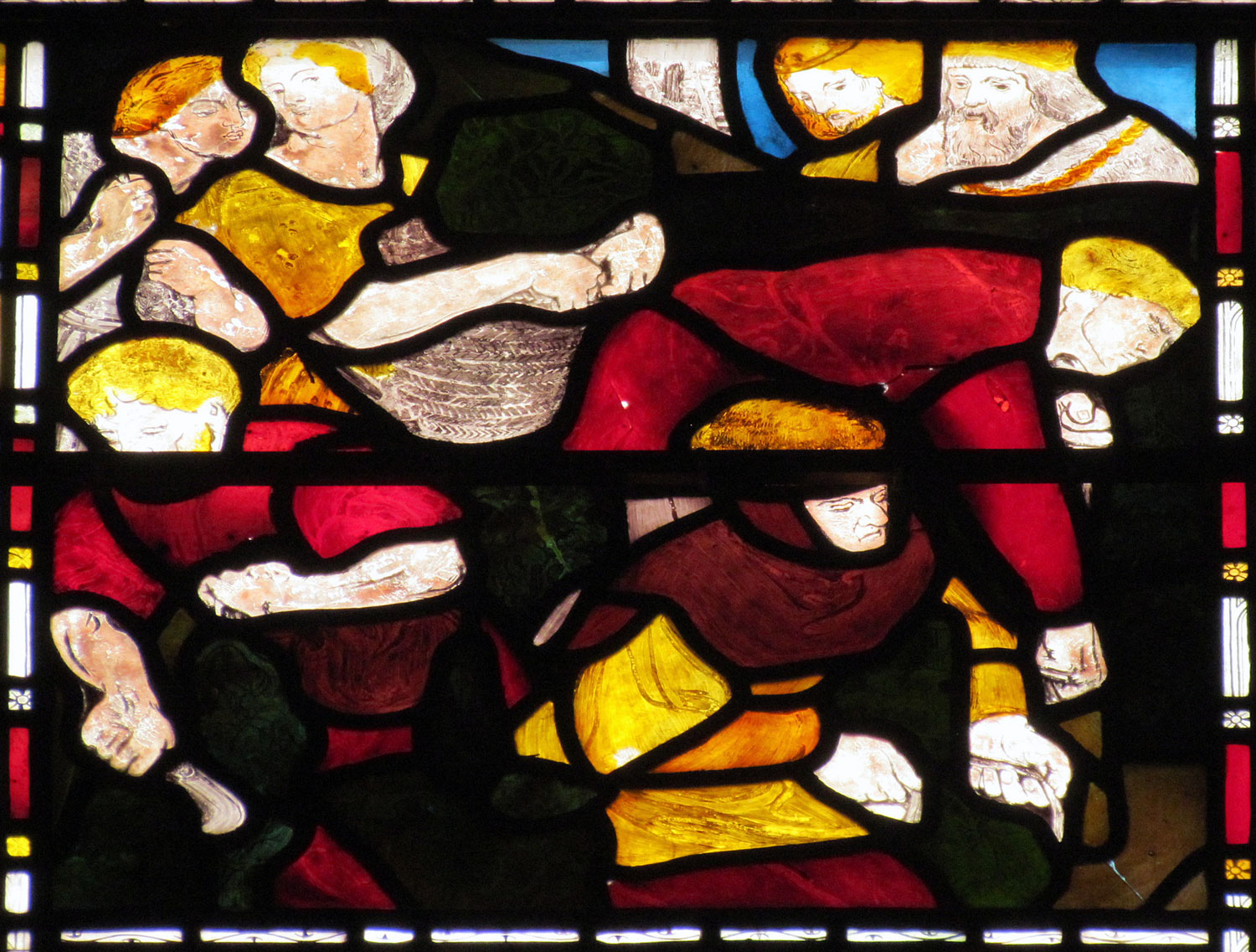
Scarborough E. windows: alteration Vine dressers:- Touch up wh. spots Lighter green leaves in basket.
Lighter green man fastening one to pole.
Captive - Turn brown hood-bright green.Turn orange sleeve bright red.
Death of Son - make saddle of king red, belt light yellow, armour deep stained orange. Better orange
dress to dead son. New yellow flag with crowns on. Arms of son red instead of green.
TRACERY: in circle surrounded by six smaller circles: Virgin and Child.
Philip Webb's Account Book notes 'Scarborough East Windows':
Scale drawings general arrangements 10s(shillings)
Pattern work with reduction of Virgin and Child, for tracery £2
The reduction was necessary because the Burne-Jones design was made for St. Michael's in Brighton,
and the space allotted to it in Scarborough was smaller.
St. Michael's
St. Martin's
13 : South aisle east window: The Mary Window – Mary the Virgin (centre) by Sir Edward Burne-Jones,Mary Magdalene (left) and Mary of Bethany (right) by William Morris
14 : South aisle centre window: (left to right) Saints Peter, Stephen and Paul by Sir Edward Burne-Jones
15 : South aisle west windows: St. Dorothea and St. Theophilus with an angel by Sir Edward Burne-Jones
16 : The pulpit front panels: upper - the four evangelists; lower - the four doctors of the church designed by William Morris and Ford Madox Brown, painted by George Campfield. Left side panel - The Annunciation by Rossetti
The Pulpit
Designs by Morris, Brown and Rossetti, and paintings by Campfield
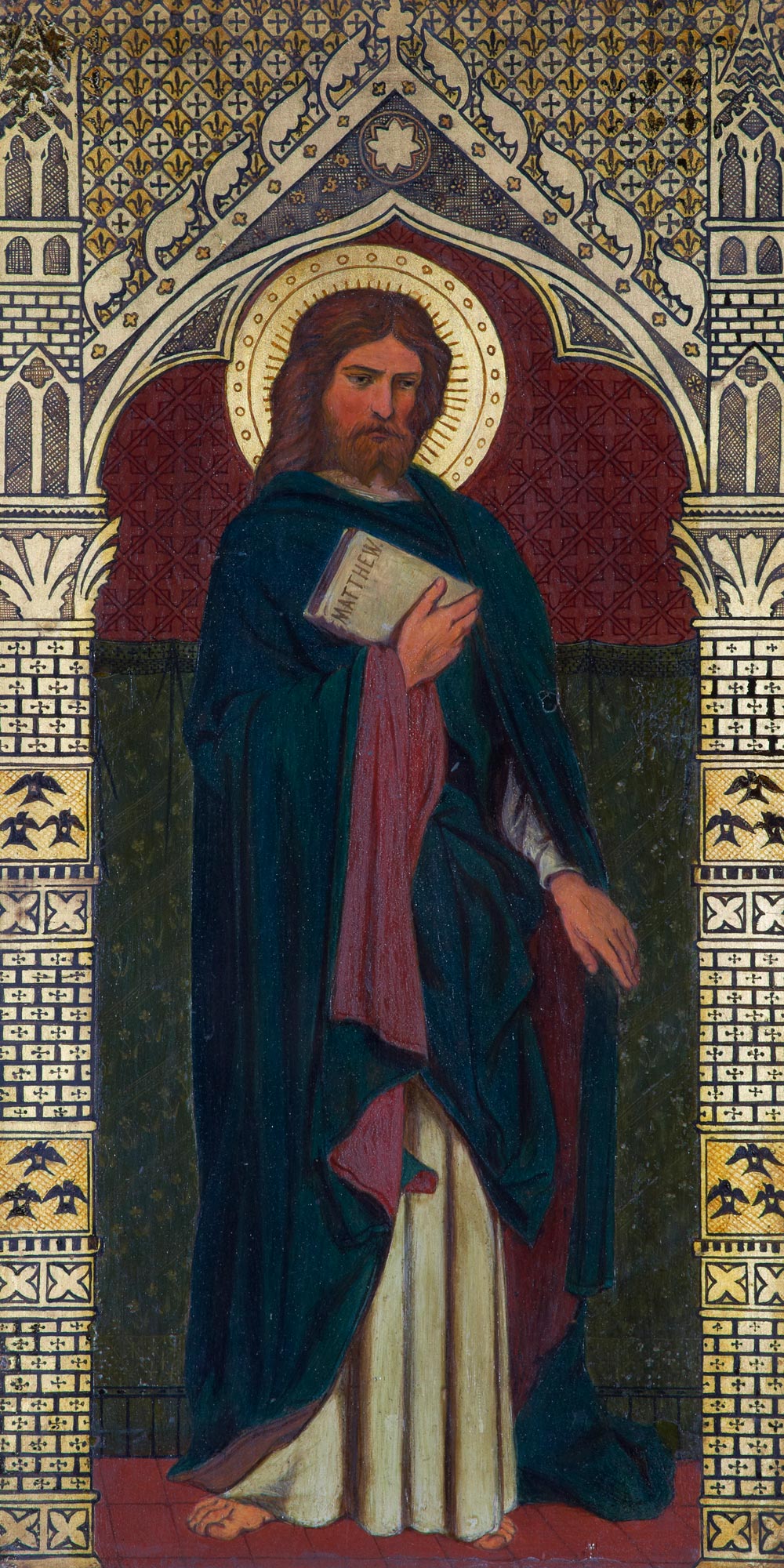
This simple pulpit is very elaborately decorated. The front panels were painted by George Campfield to designs by Ford Maddox Brown and William Morris.
The upper panels show the Four Evangelists (Matthew, Mark, Luke and John), and the lower panels the Four Doctors of the Western Church: Augustine of Hippo, Gregory, Jerome and Ambrose of Milan.
These are the characters generally portrayed on surviving examples of medieval pulpits.
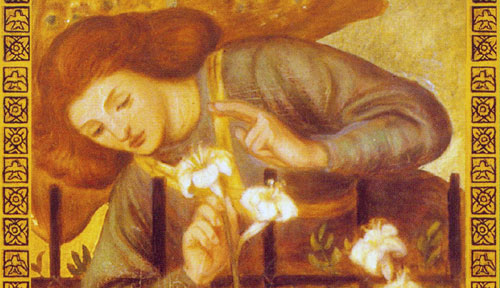
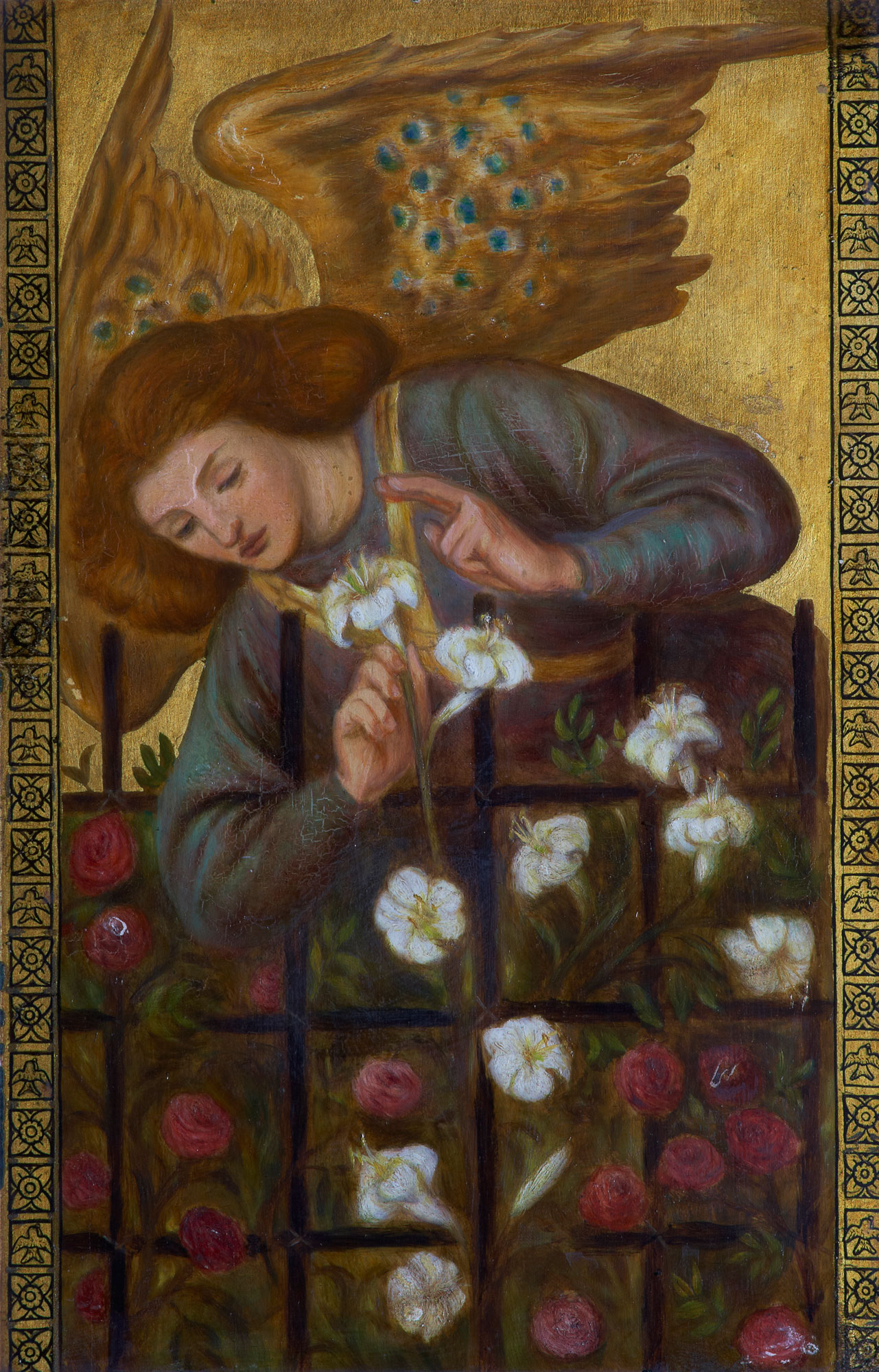
The North Side of the pulpit is very interesting because this was painted at a later date by Rossetti. The scene, in the two panels, is The Annunciation set in a medieval rose garden with Mary seated reading a devotional work. The angel is looking over the trellis in the upper panel, almost as if he were a lover in a medieval romance. The enclosed garden here is a symbol of Mary's virginity.
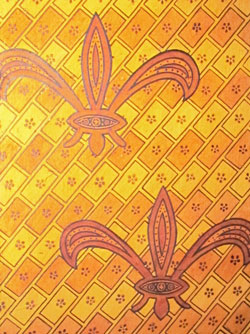
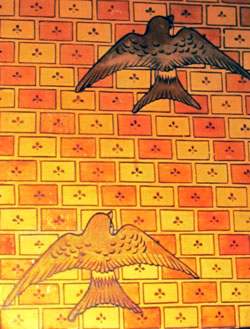
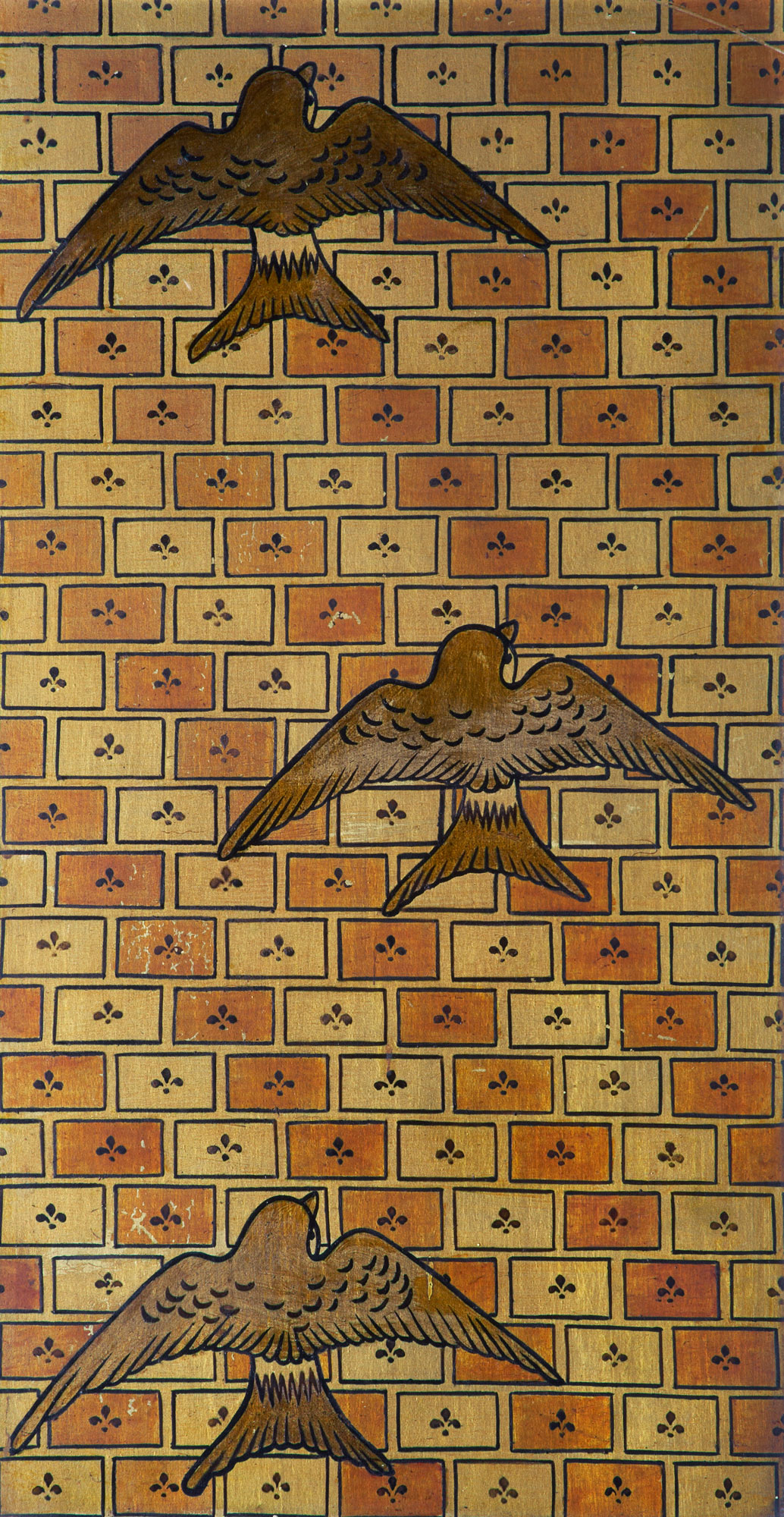
The composition is unusual and affecting. The framing is decorated by fleur-de-lis (iris flower) and birds. These are pre-Raphaelite puns; the birds are martins which is a reference to the name of the church, the fleur-de-lis refers to Mary the Virgin.
There are more fleur-de-lis and martins on the south side of the pulpit but they have been cleverly inverted so that they are in fact identical to the ones on the north side.
The pulpit was first commissioned in 1862, but the panels showing the four doctors were not included until 1873 because of the opposition of Archbishop Thompson, who thought that they were too popish.
Many thanks to David Chalmers for providing professional photographs giving detail of the figures depicted on the pulpit. Visit www.davidchalmersphotography.com

The Four Evangelists
Designs by Ford Madox Brown and William Morris, and paintings by George Campfield
In Christian tradition, the Four Evangelists are Matthew, Mark, Luke, and John, the authors attributed with the creation of the four Gospel accounts in the New Testament.
The gospels of Matthew, Mark, and Luke are known as the Synoptic Gospels, because they include many of the same stories, often in the same sequence. Convention has traditionally held the authors to have been two of the Twelve Apostles of Jesus, John and Matthew, and two "apostolic men” Mark and Luke:
Matthew – a former tax collector who was called by Jesus to be one of the Twelve Apostles,
Mark – a follower of Peter and so an "apostolic man",
Luke – a doctor who wrote what is now the book of Luke to a friend Theophilus. Also believed to have written the book of Acts (or Acts of the Apostles) and a close friend of Paul of Tarsus,
John – a disciple of Jesus and possibly the youngest of his Twelve Apostles.
They are called evangelists, a word meaning 'people who proclaim good news,' because their books aim to tell the "good news" ("gospel") of Jesus.
Matthew
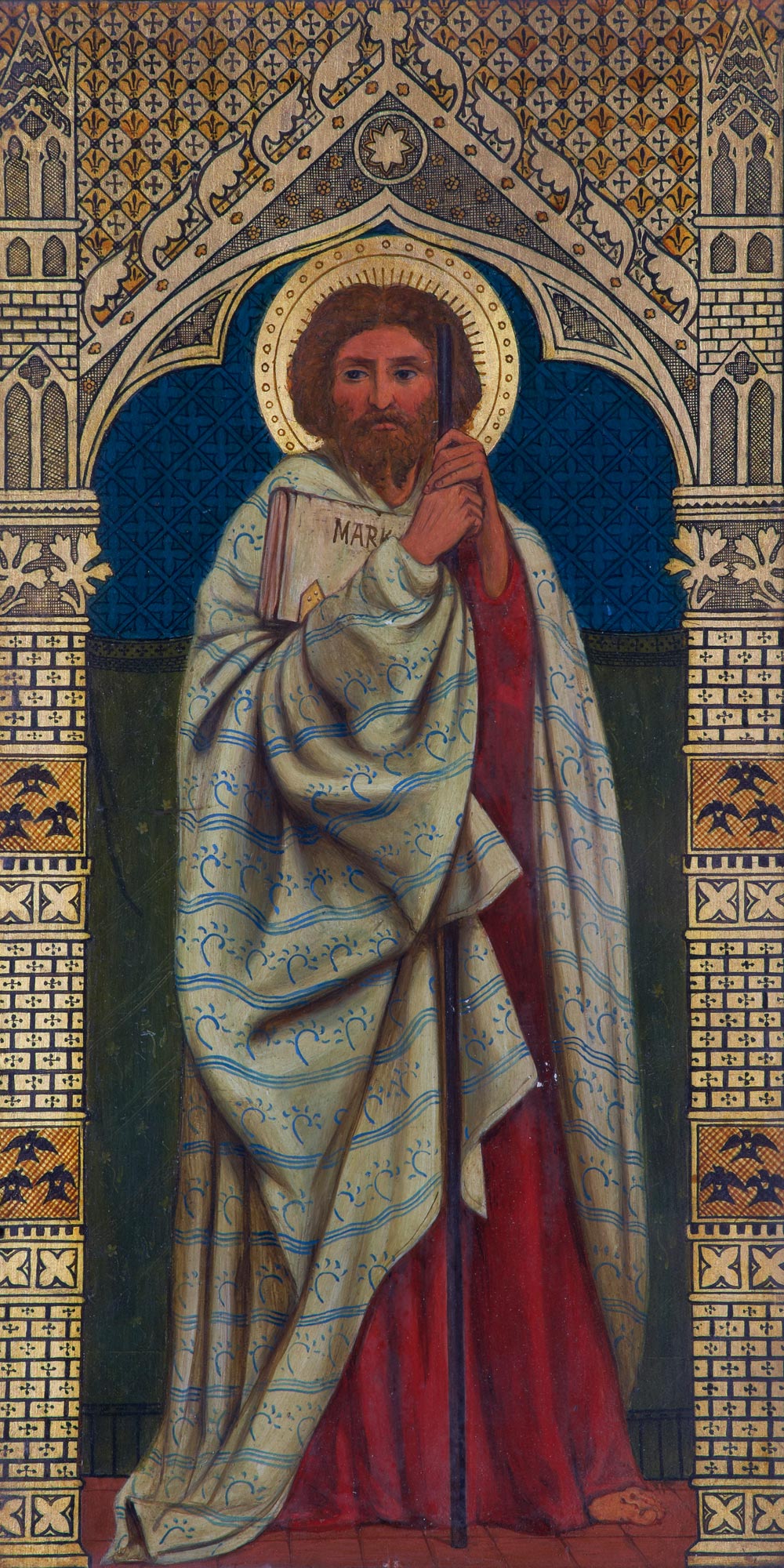
Mark
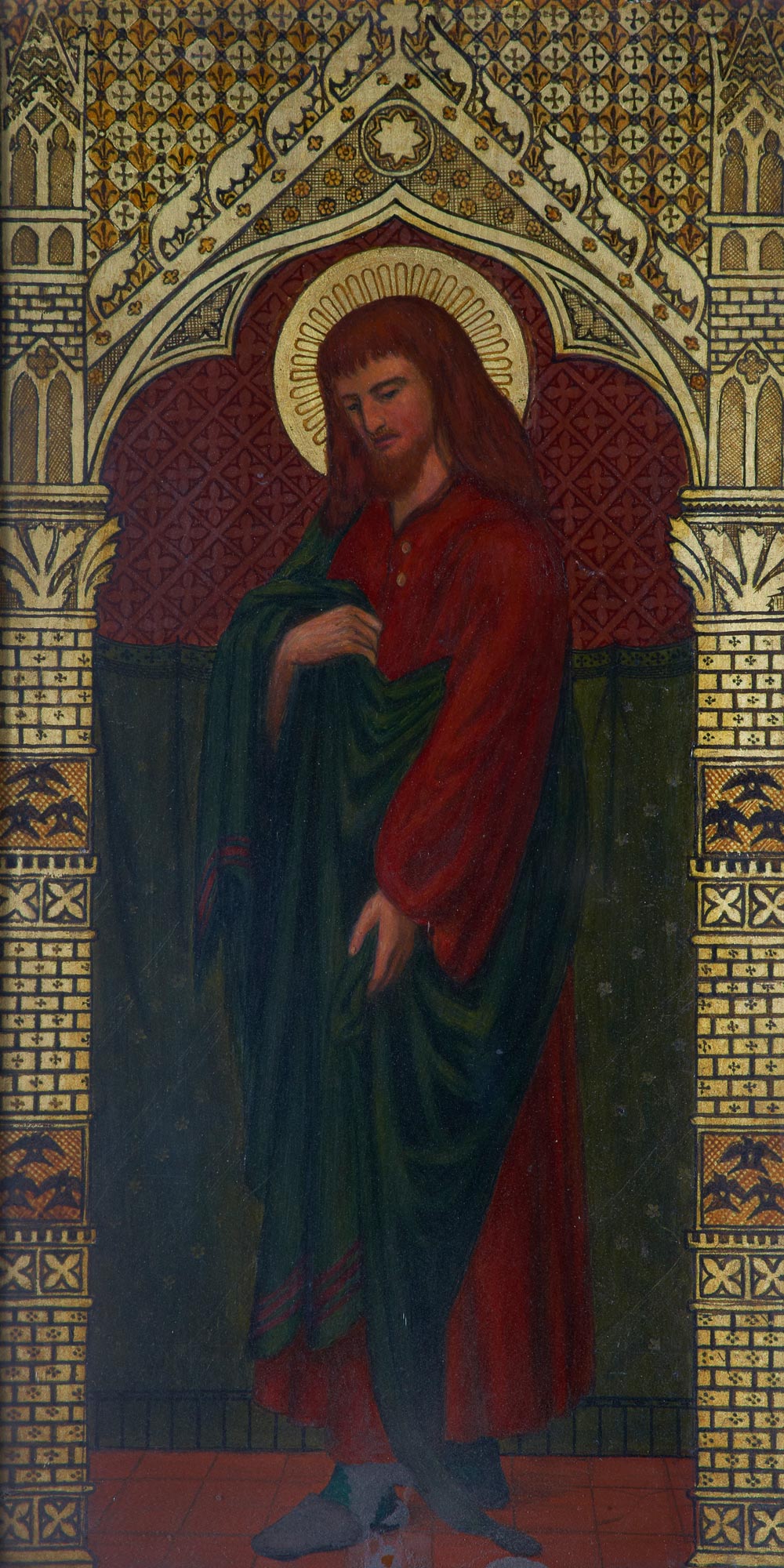
Luke
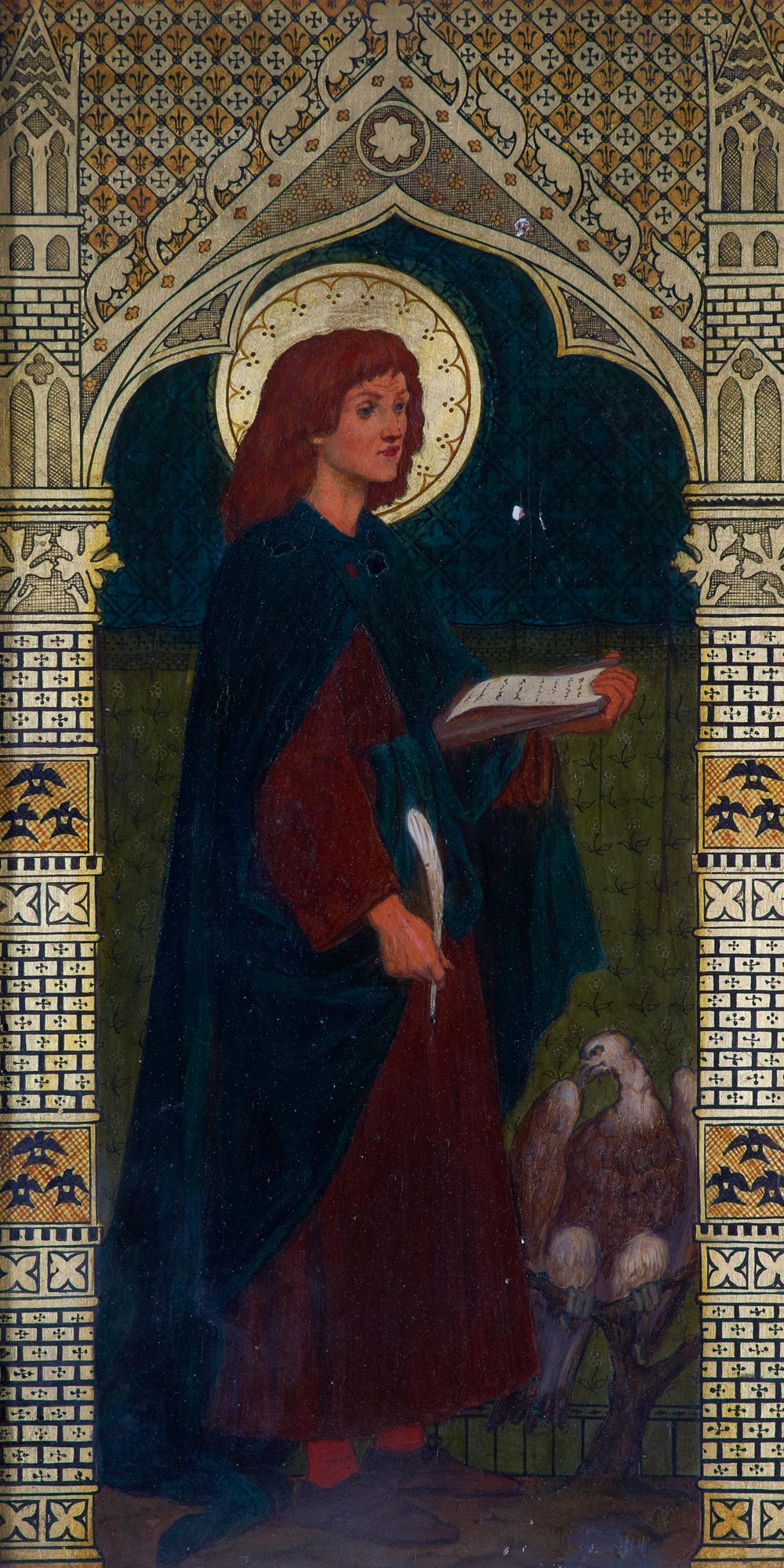
John
The Doctors of the Church
Designs by Ford Madox Brown and William Morris, and paintings by George Campfield
The feasts of the four original Doctors of the Church (from left to right) are celebrated during the second half of the year: St. Augustine on August 28, St. Gregory the Great on September 3, St. Jerome on September 30, and St. Ambrose on December 7.
The Doctors of the Church, in Latin Doctores Ecclesiae, are a special class of canonized saints that have distinguished themselves with lives of particular virtue and holiness; as theologians, they possess extraordinary intellect and insight that has enabled them to make monumental contributions to the understanding of the faith through their preaching or writing; and they have been designated as such by a Pope or an ecumenical council.
The four great doctors of the West are Augustine, Gregory the Great, Jerome, and Ambrose; while the four great doctors of the East are John Chrysostom, Basil the Great, Gregory Nazianzen, and Athanasius.
The Original Latin Doctors are considered the doctors par excellence:
St. Augustine of Hippo, 13 November 354 – 28 August 430, the Doctor of Grace, wrote Confessions, The City of God, a rule of life, Scripture commentaries, and numerous books on theological topics.
St. Gregory the Great, c. 540 – 12 March 604, was a fierce defender of the papacy and a liturgical reformer. He wrote Pastoral Care, a guidebook for bishops, The Dialogue, Moralia, and volumes of homilies and commentaries.
St. Jerome, c. 347 – 30 September 420, is the father of biblical studies, the translator of the Bible from Hebrew and Greek to Latin, the Vulgate.
St. Ambrose, c. 340 – 4 April 397, was a fierce defender of the faith against the Arian heresy, a charismatic preacher, a prolific writer, and the inspiration behind the Ambrosian liturgy.
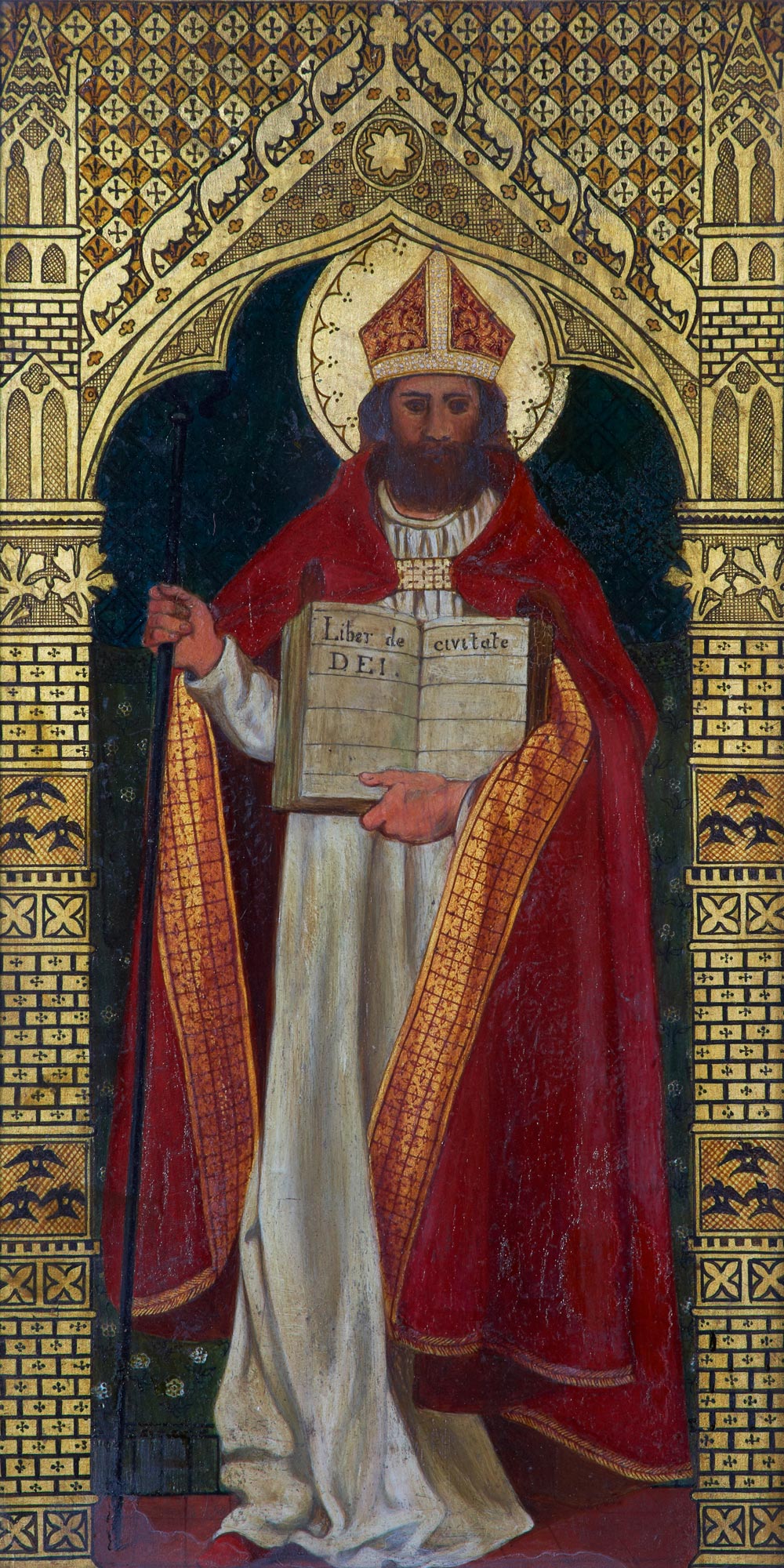
St. Augustine
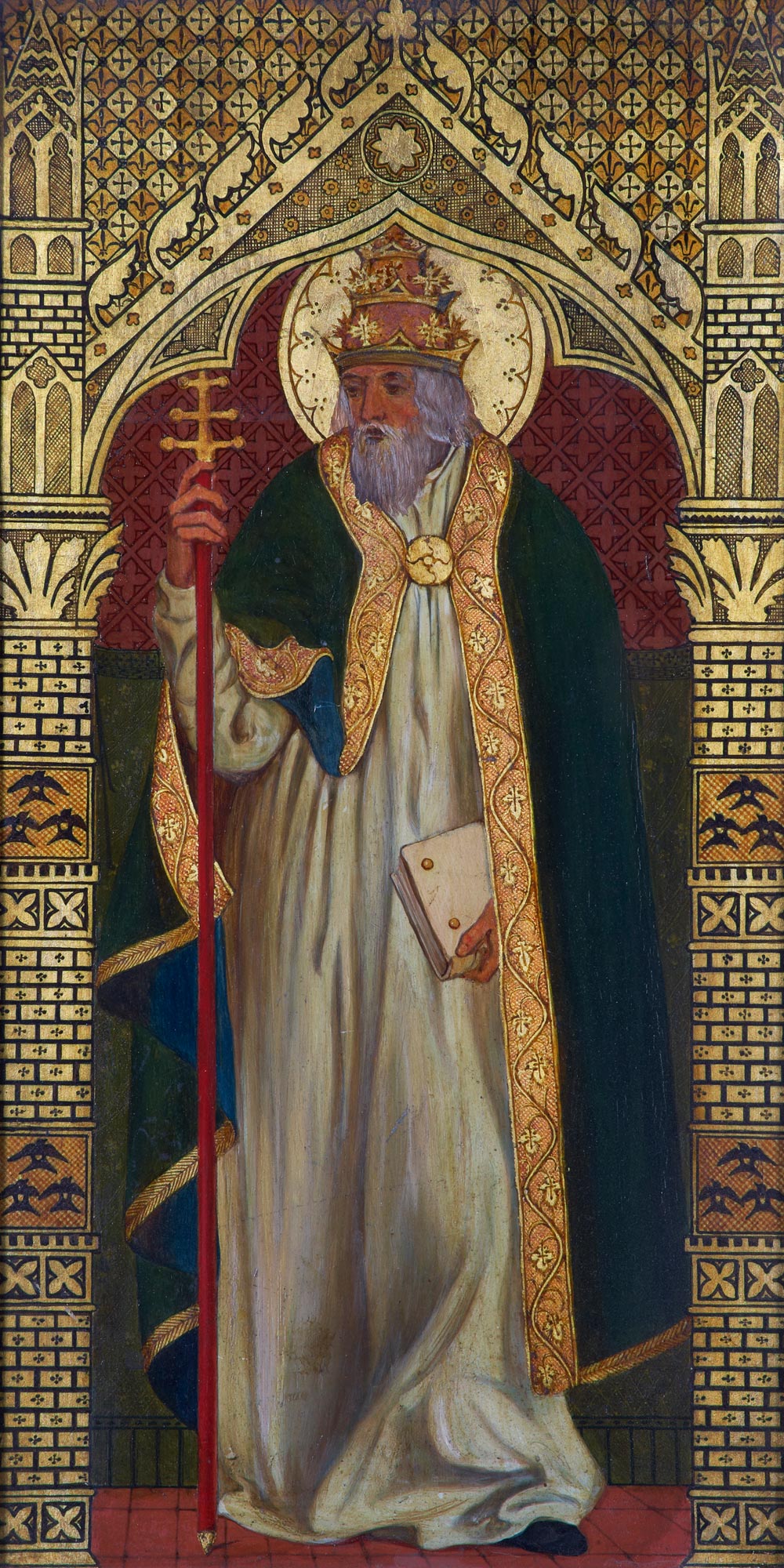
St. Gregory the Great
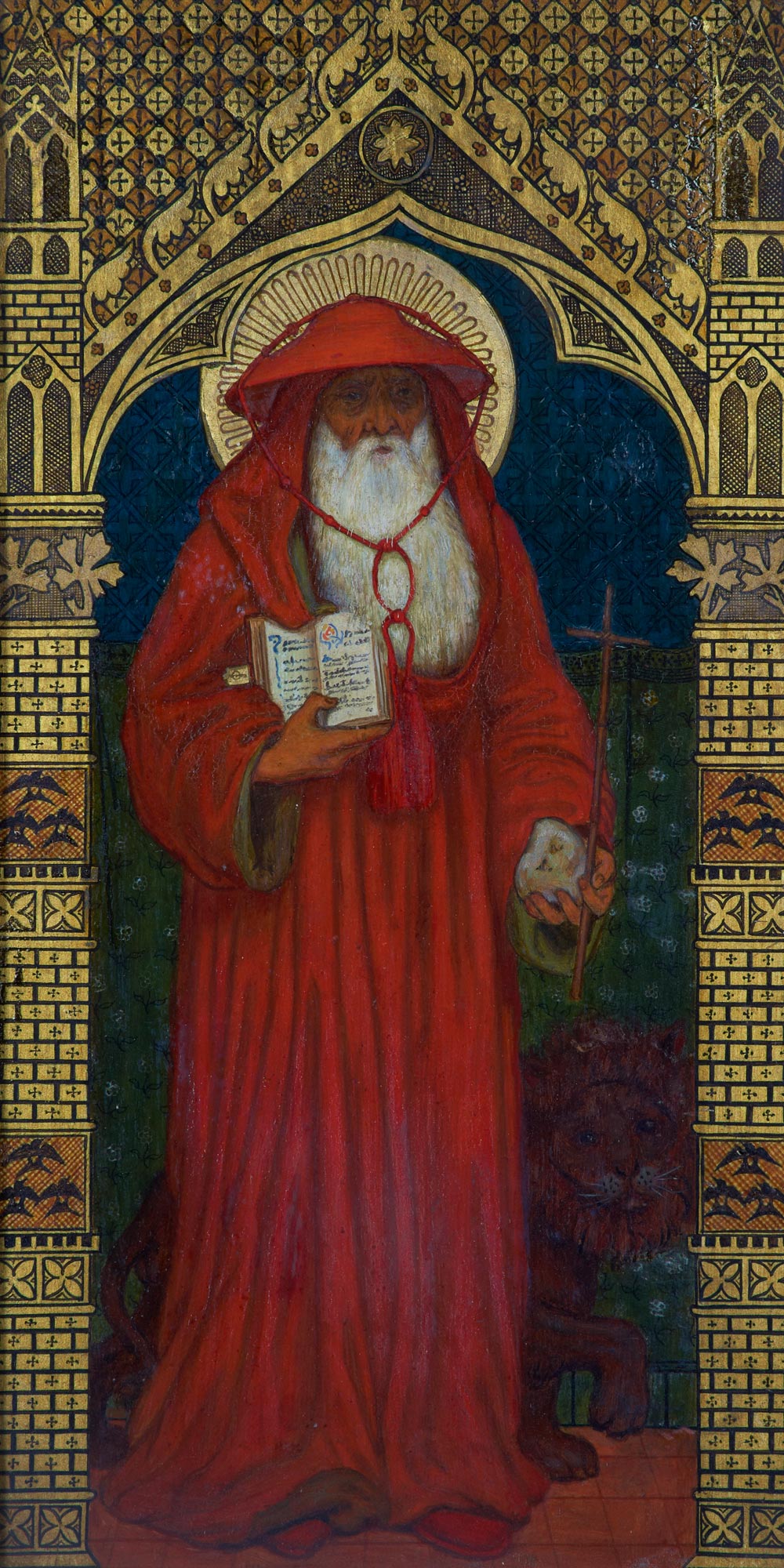
St. Jerome
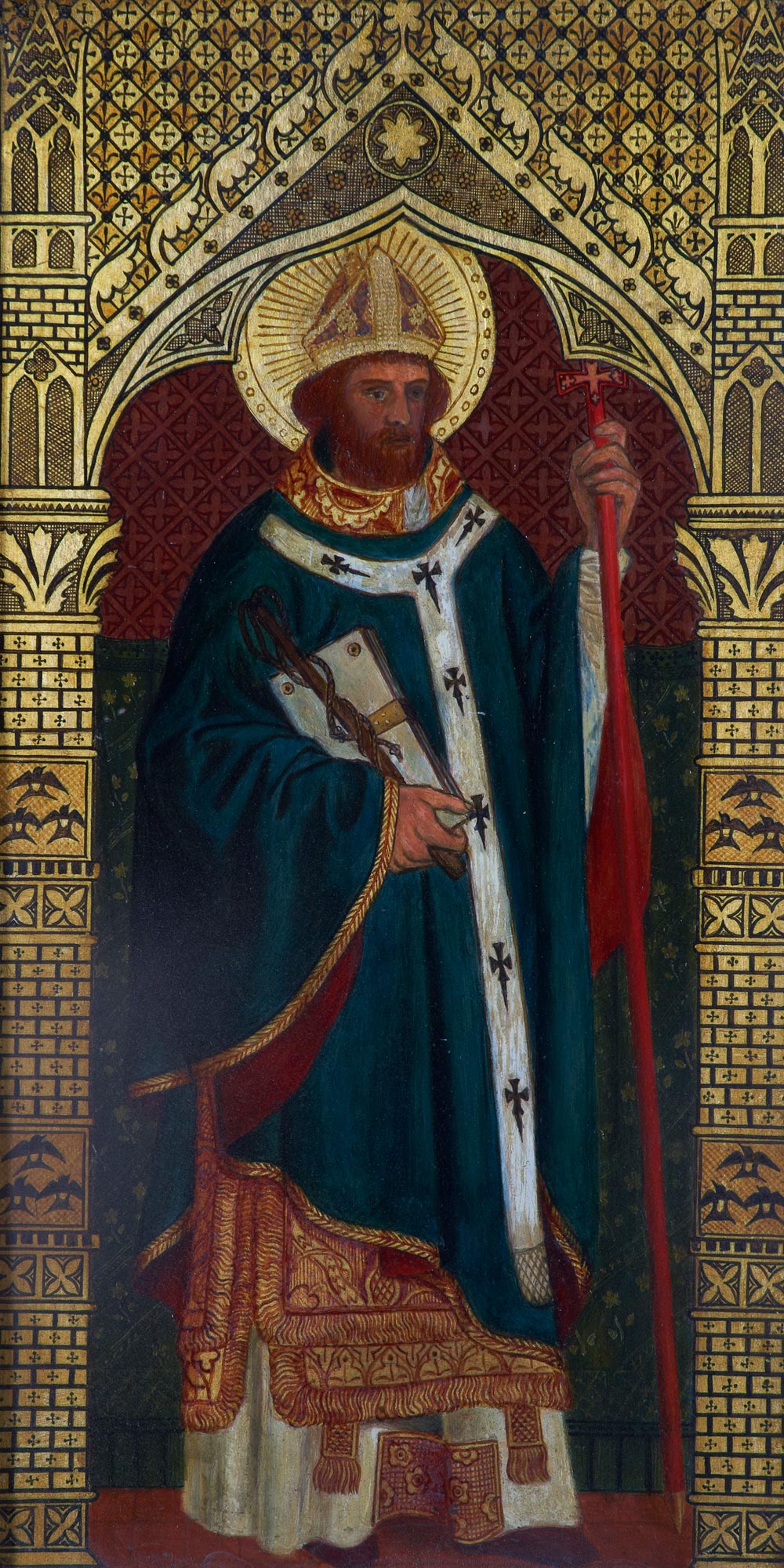
St. Ambrose
The Annunciation by Dante Gabriel Rossetti
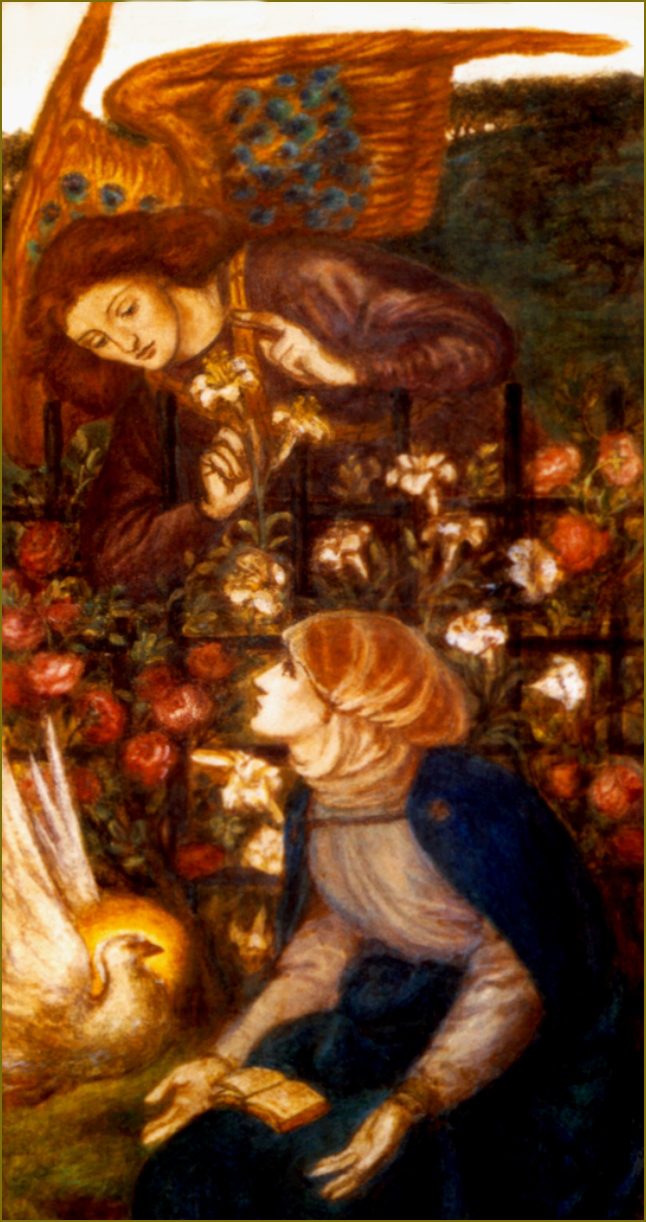
The scene on the south side of the pulpit in two panels is The Annunciation, set in a medieval garden' with Mary seated reading a devotional work. In the original painting (left) there is also a large haloed dove perched near her knee, representing Mary receiving the holy spirit. Due to space constraints this feature was not included in the St. Martin's version (right). Mary's hands, with long, elegant fingers, are palm up as if in prayer. To see an enlarged version of the The Annunciation click on the image left.
The flowers in the garden, red roses and white lilies, symbolise both the sacrifice of Christ and the purity of Mary. (Medieval Christians identified the five petals of the rose with the five wounds of Christ. Roses also later came to be associated with the Virgin Mary. The red rose was eventually adopted as a symbol of the blood of the Christian martyrs.) The enclosed garden here is a symbol of Mary's virginity.
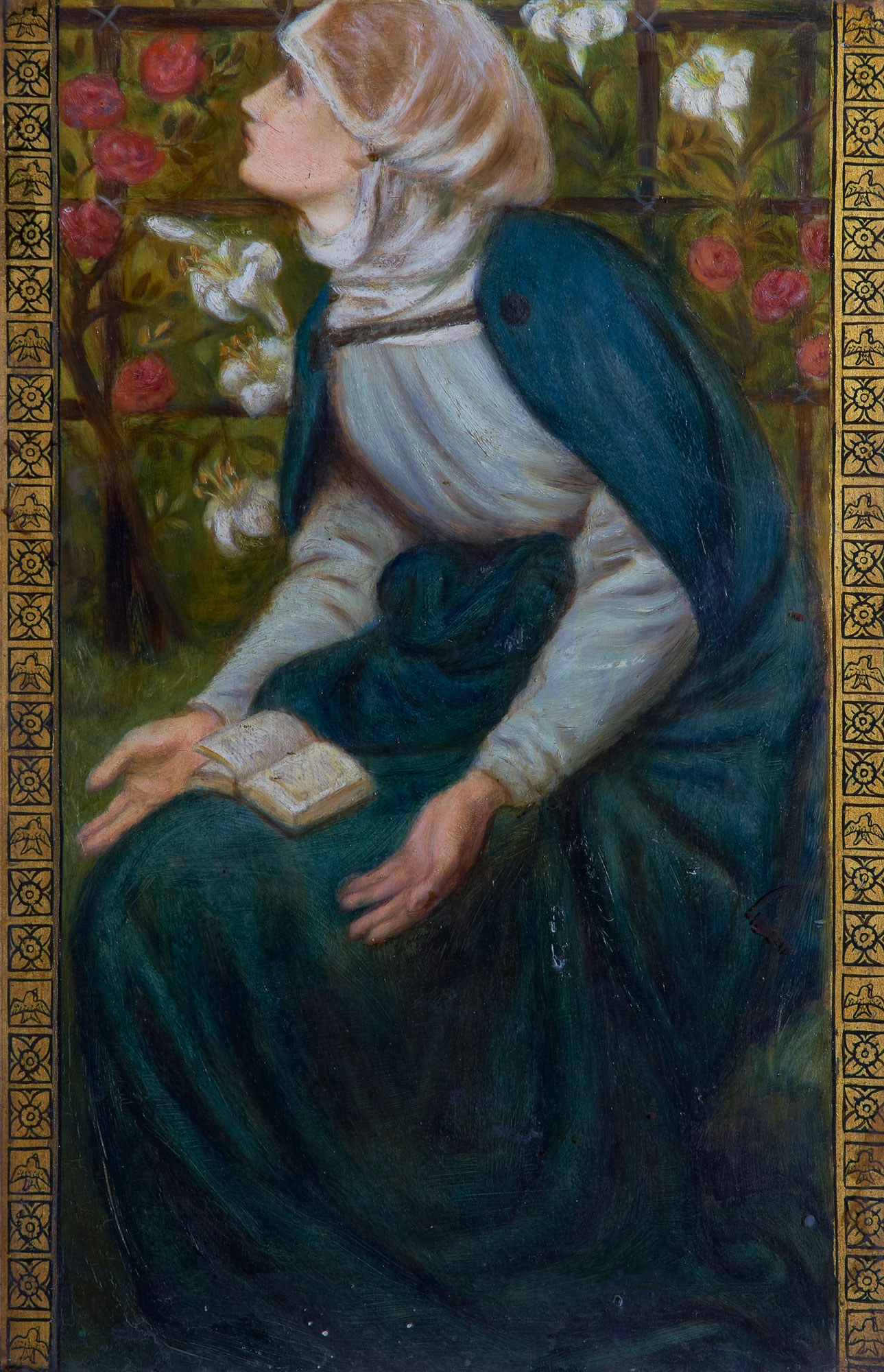
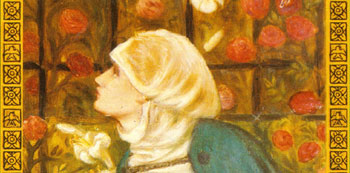
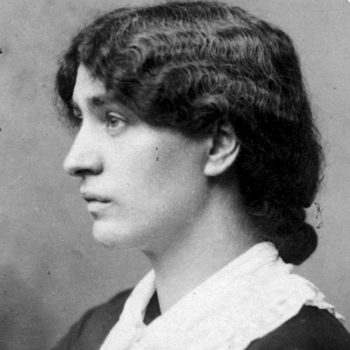
The model for Mary is thought to be Jane (Burden) Morris.
Note that the luxuriant hair of Mary is only thinly disguised by her head covering.
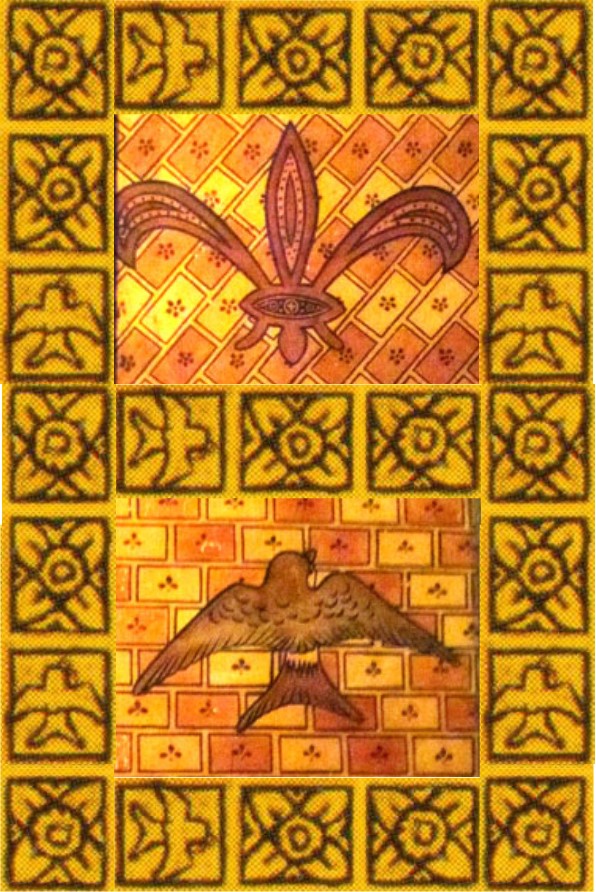
The framing is decorated by fleur-de-lis (iris flowers) and birds. These are pre-Raphaelite puns; the birds are martins which is a reference to the name of the church, the fleur-de-lis refers to Mary the Virgin.
There are more fleur-de-lis and martins on the south side of the pulpit (below) but they have been cleverly inverted so that they are in fact identical to the ones on the north side. Click on the images to the right for greater detail.
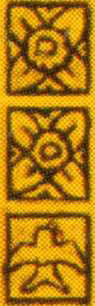
In the image to the right (artificially constructed) allows you to compare the larger central images of the fleur-de-lis and the martin that appear on the north side of the pulpit with the border framing the Rossetti painting on the south side of the pulpit..

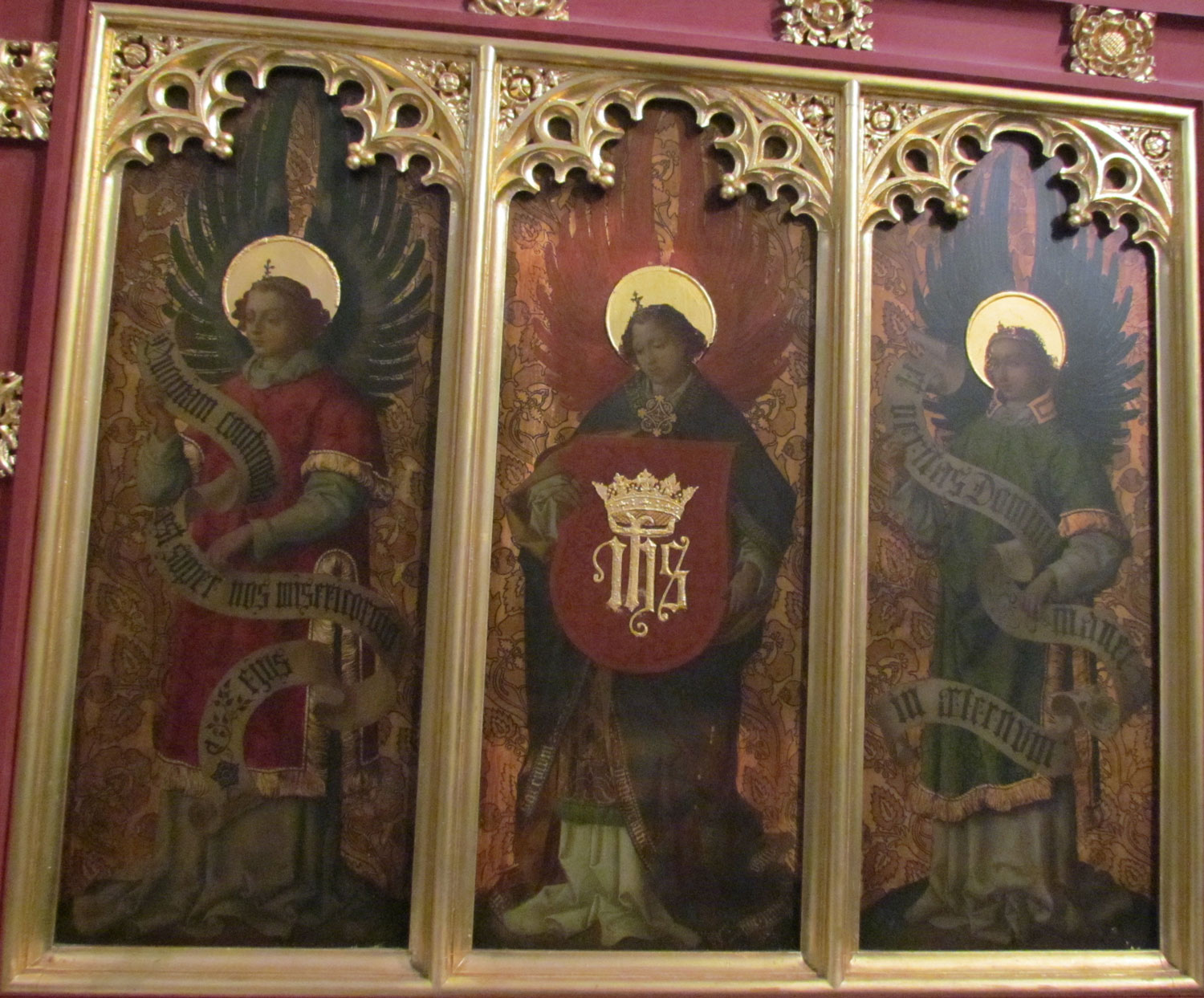
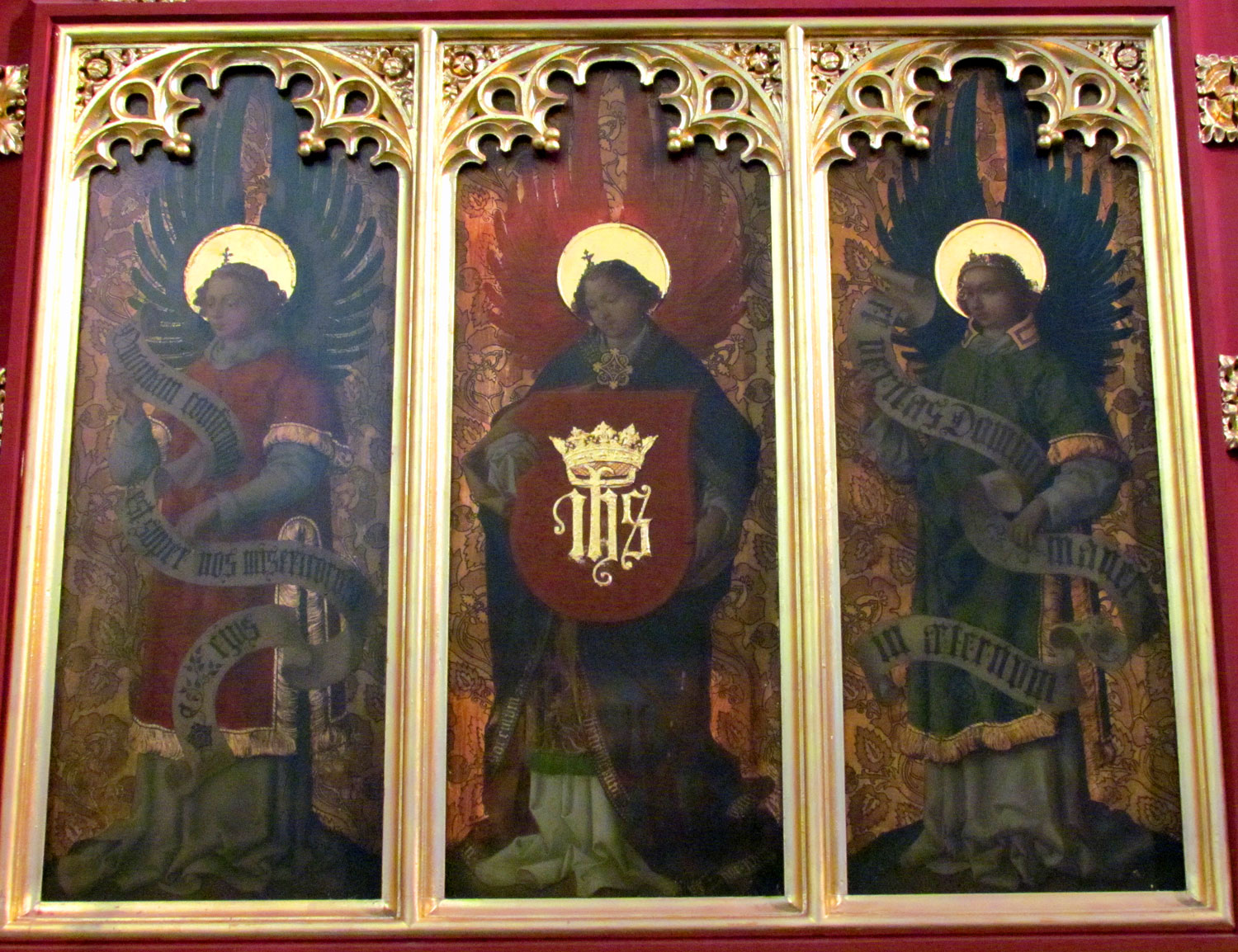
17 : The organ screen: designed by Bodley with four angels painted by R. Spencer Stanhope, friend of William Morris
The Organ Screen
Designed by Bodley with Angels by R. Spencer Stanhope
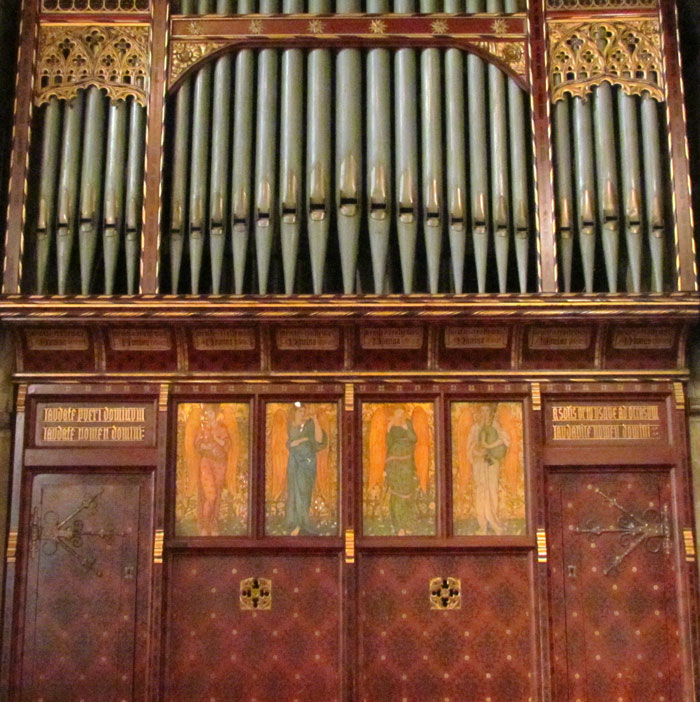
The screen faces into the south isle and features four angels painted by R. Spencer Stanhope, a friend of William Morris. The screen and case were designed by Bodley for the church's second organ.
The first organ was a small Willis which was replaced by an over-ambitious instrument from Harrisons of Durham (then in the early days of the firm).
The four-manual organ was simply too large for the case in which it was set. It was removed in 1890 and replaced by the present, noble three-manual "Father" Willis. The Harrison organ is now in a church in Wallingford, Berkshire.

Psalm 113 - Who is like the Lord out God?
This short hymn celebrates the way in which the great God who rules over all takes notice of the lowly. Such a God is indeed worthy to be praised by all mankind. Psalms 113 – 118 have been used in connection with Passover, and probably provided the hymn that Jesus and his disciples sang after the Passover supper.
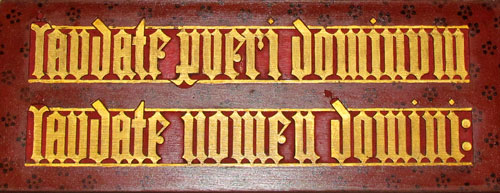
Texts that appear from this psalm on the screen are as follows: 113: 1
laudate, pueri, dominum; laudate nomen domini
Praise, O ye servants of the Lord, praise the name of the Lord.
Psalm 113:3
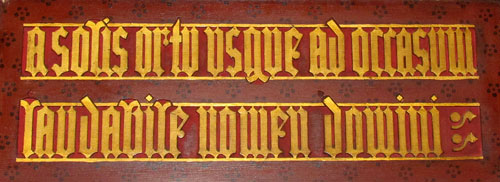
A solis ortu usque ad occasum laudibate nomen domini
From the rising of the sun unto the going down of the same, the Lord’s name is to be praised.
Psalm 95 - Let us sing songs of praise.
The first part of this psalm is a celebration of God’s kingship and the privileges his people enjoy as they worship him.
The text on the organ screen from this psalm is:
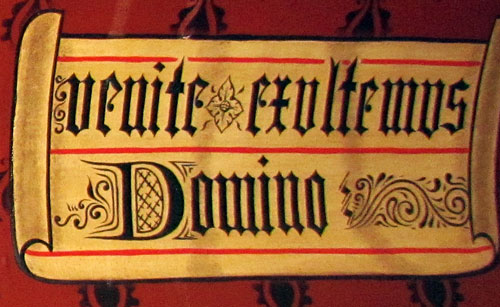
Psalm 95: 1 Venite, exultemus Domino
O come, let us sing unto the Lord.
18 : The chancel clerestory lights with the symbols of the four evangelists by Philip Webb
The Chancel Clerestory Lights showing the Symbols of the Evangelists
These were commissioned by Miss Mary Craven in 1871, and are a thanks offering for the recovery from illness of the Rev'd R Henning Parr and George Frederick Bodley.
The fourth window, St Matthew,is totally obscured by organ pipes. Below are the cartoons and images of the three windows, which may be clicked for greater detail.
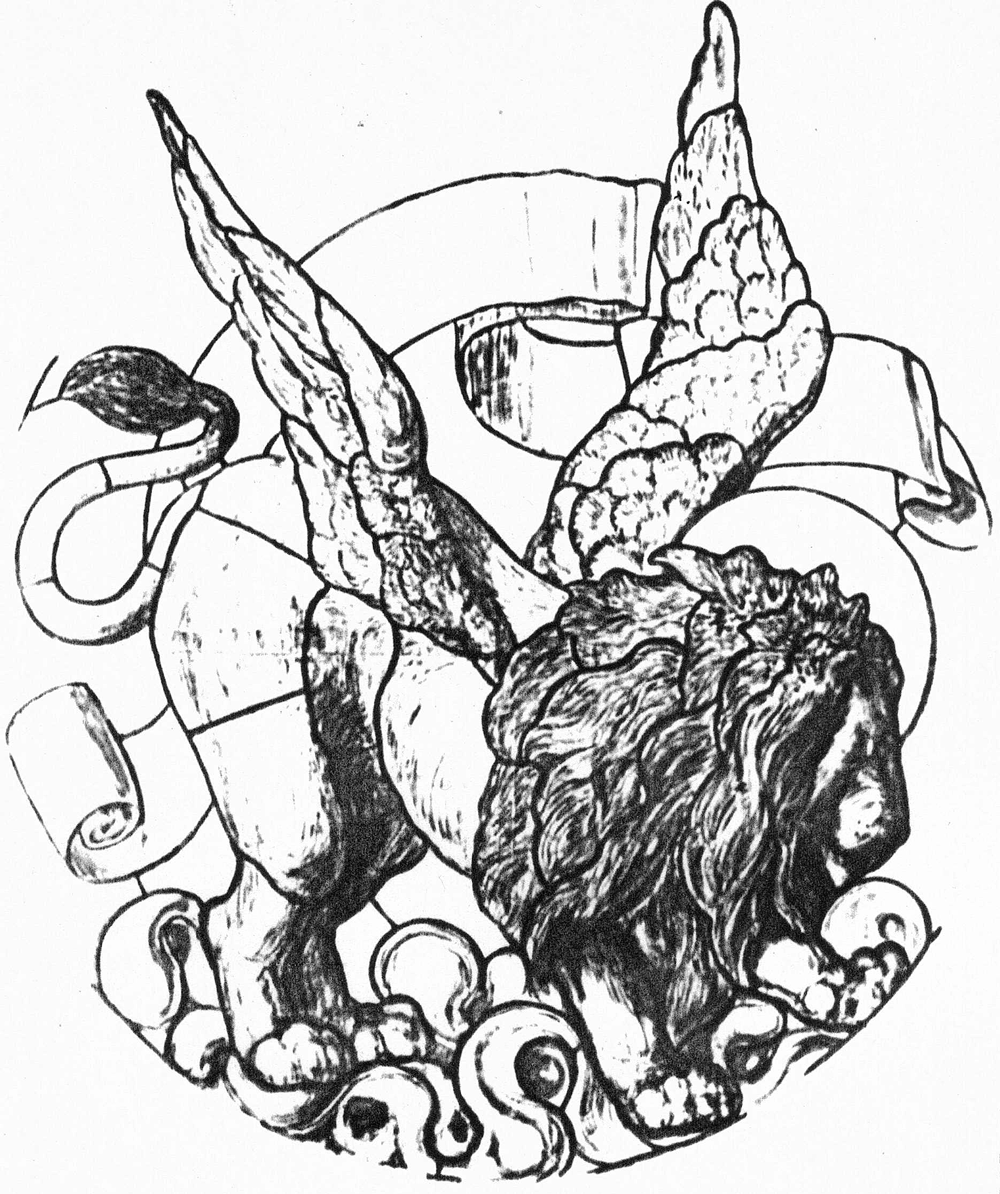
St Mark
Symbolized by a winged lion – a figure of courage and monarchy. Mark has John the Baptist preaching "like a lion roaring" at the beginning of his Gospel. It also represents Jesus' Resurrection (because lions were believed to sleep with open eyes, a comparison with Christ in the tomb), and Christ as king. This signifies that Christians should be courageous on the path of salvation.
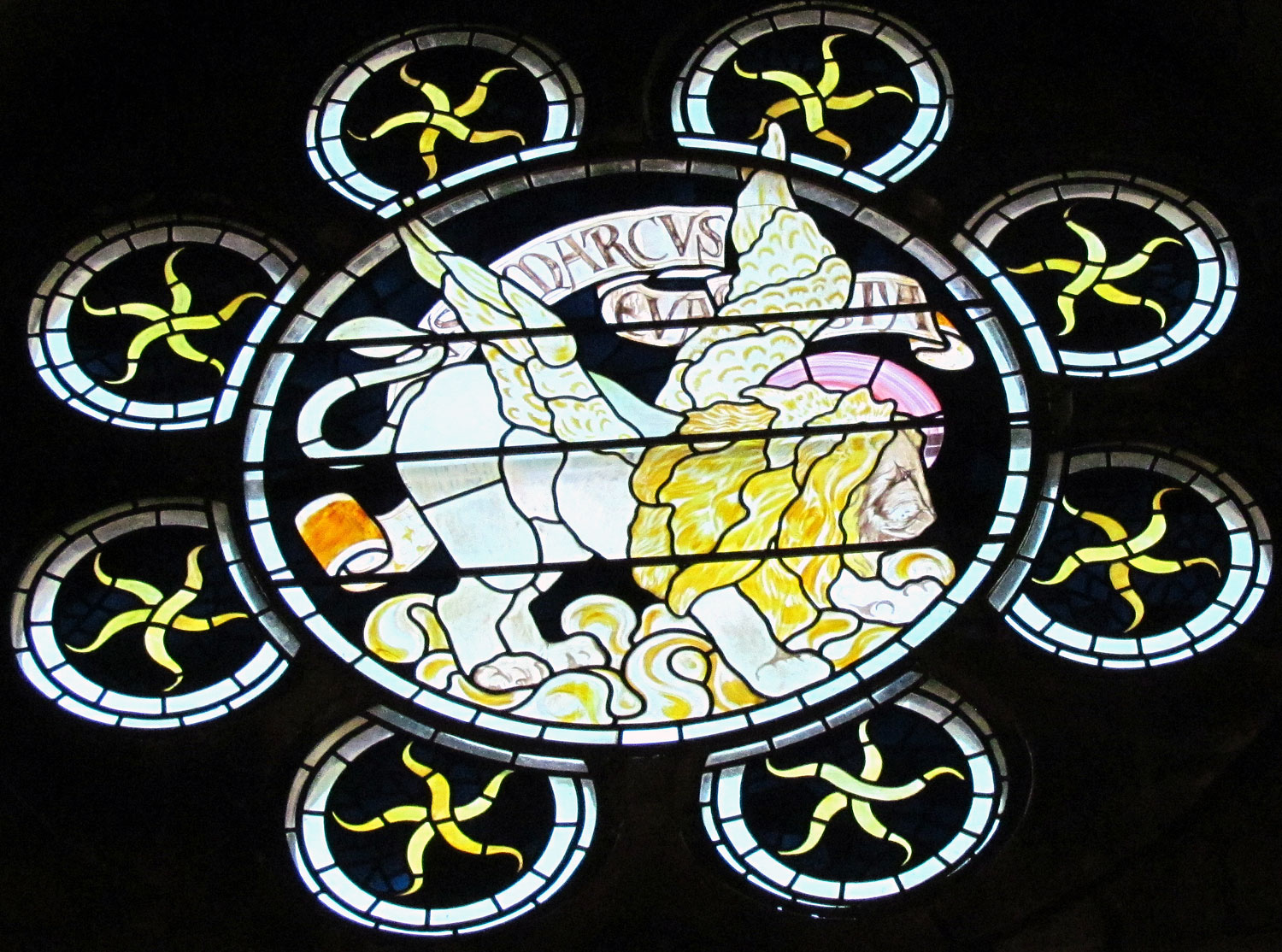
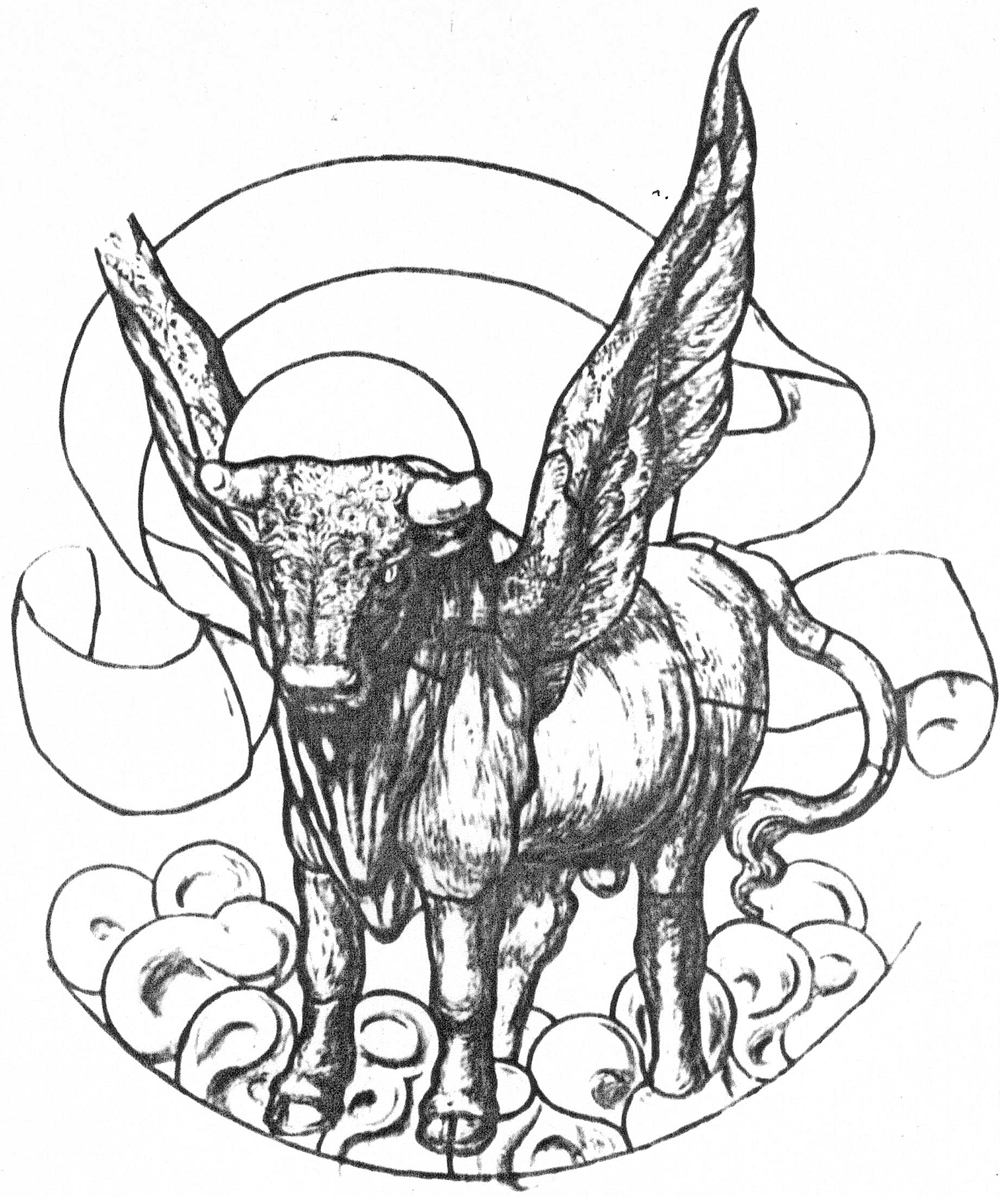
St Luke
Symbolized by a winged ox or bull – a figure of sacrifice, service and strength. Luke's account begins with the duties of Zacharias in the temple; it represents Jesus' sacrifice in His Passion and Crucifixion, as well as Christ being High priest (this also represents Mary's obedience). The ox signifies that Christians should be prepared to sacrifice themselves in following Christ.
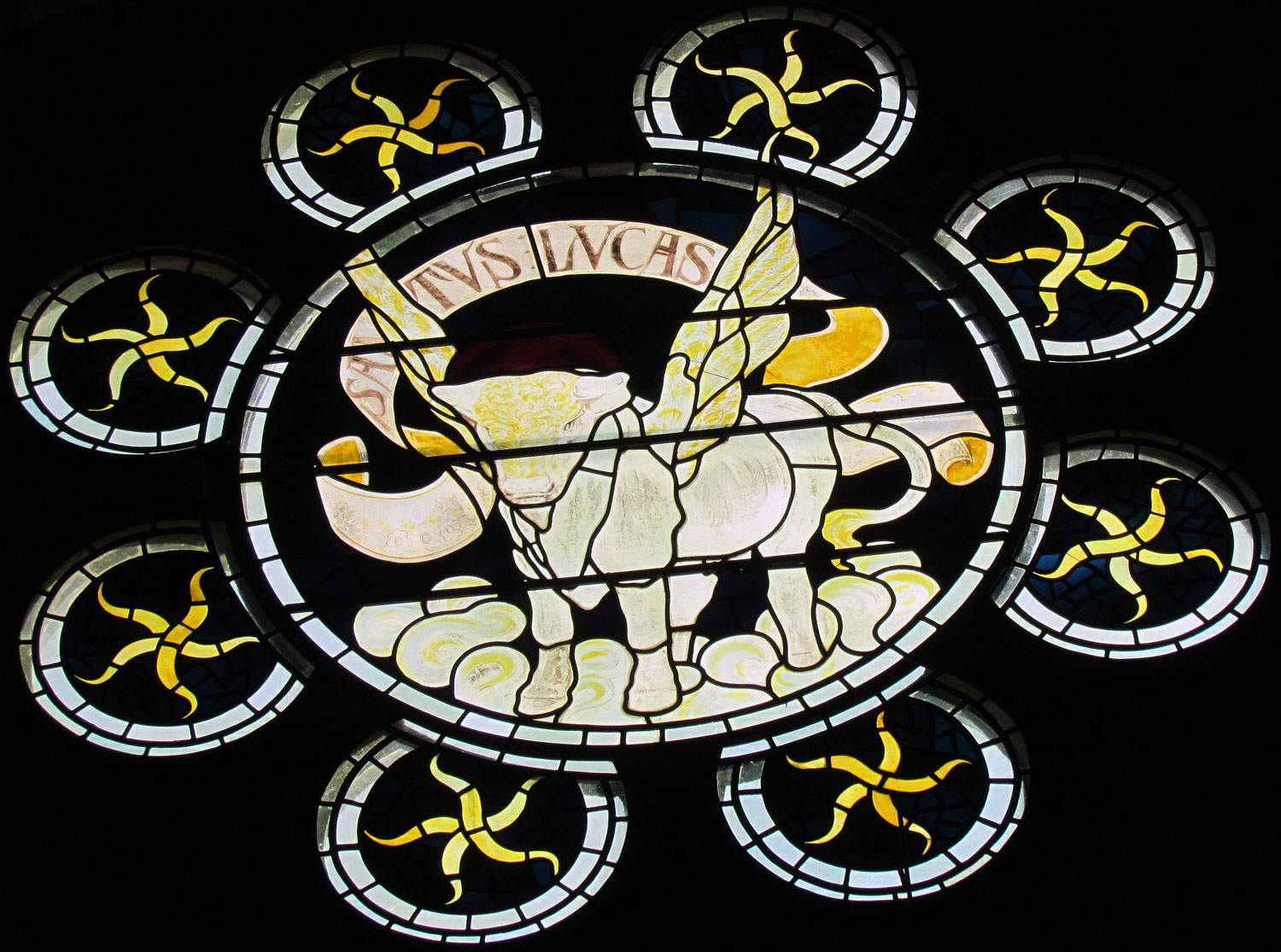
St. John
Symbolized by an eagle – a figure of the sky, and believed to be able to look straight into the sun. John starts with an eternal overview of Jesus the Logos and goes on to describe many things with a "higher" level than the other three (synoptic) gospels; it represents Jesus' Ascension, and Christ's divine nature. This represents that Christians should look on eternity without flinching as they journey towards their goal of union with God.
St Matthew
Symbolized by a winged man, or angel. Matthew's gospel starts with Jesus' genealogy from Abraham; it represents Jesus' Incarnation, and so Christ's human nature.
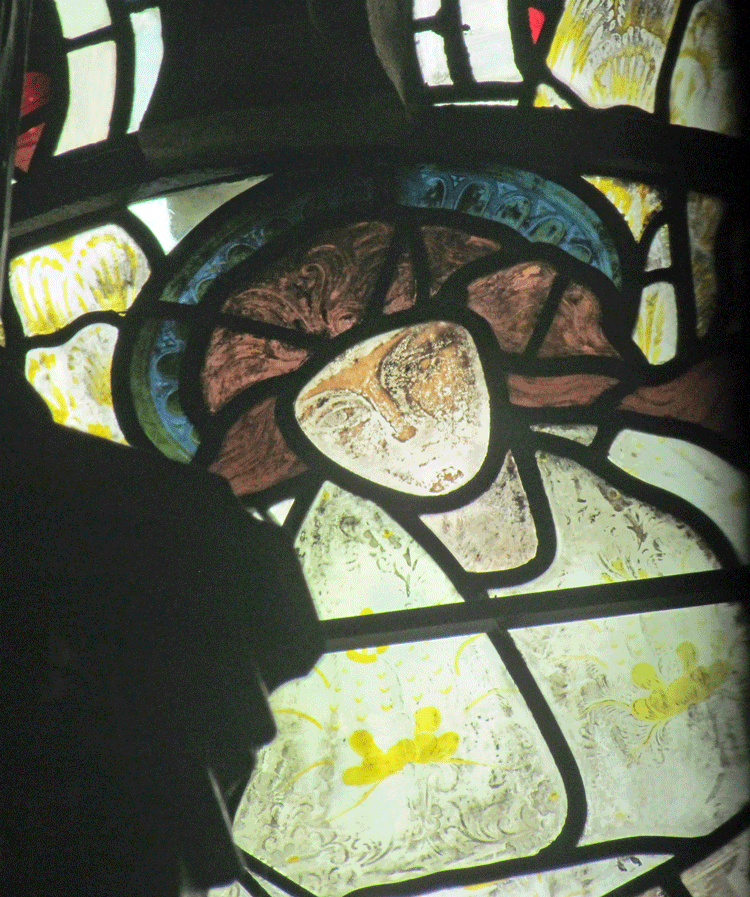
Although all the chancel windows were restored in 2005, the St. Matthew symbol window in the chancel was not because it is mostly hidden from view by the organ. The photos of it appearing here were taken from the scaffolding erected around the east window during the restoration. Unfortunately we do not have a copy of Webb's cartoon for St. Matthew's symbol, and have not been able to trace one so far.
Nevertheless, our research has led to the discovery of a very similar window, again designed by Webb, which also give some insight into how the pre-Raphaelite artists recycled their designs.
Morris, Marshall, Faulkner & Company, founded in April 1861, made a spectacular beginning with three major schemes for stained glass in new churches by the architect George Frederick Bodley, including St. Michael's, Brighton, At All Saints, Selsley, near Stroud in Gloucestershire (1862) and St. Martin's, Scarborough in 1863.
A search of the internet has led us to a church in Cornwall with a very similar window designed by Webb.

19 : The chancel canopy of honour painted by Philip Webb
The Canopy of Honour painted by Philip Webb
A canopy of honour is a decorative ceiling, especially over the chancel, in medieval church architecture or derivatives. Similar canopies may also appear above altars or crucifixes.
The painted canopy of honour above the altar in St. Martin's was the work of Philip Webb, who was paid £2 a day for this work. Because it is usually in the dark people actually forgot that this work was there until a BBC film crew were working in the church making a documentary film about Fredrick Delius. Their bright lights lit up the canopy and it was found to be in pristine condition. It is now floodlit.
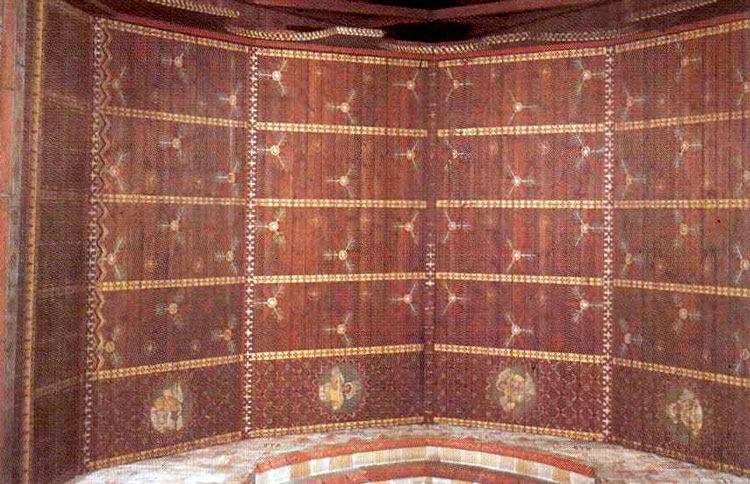
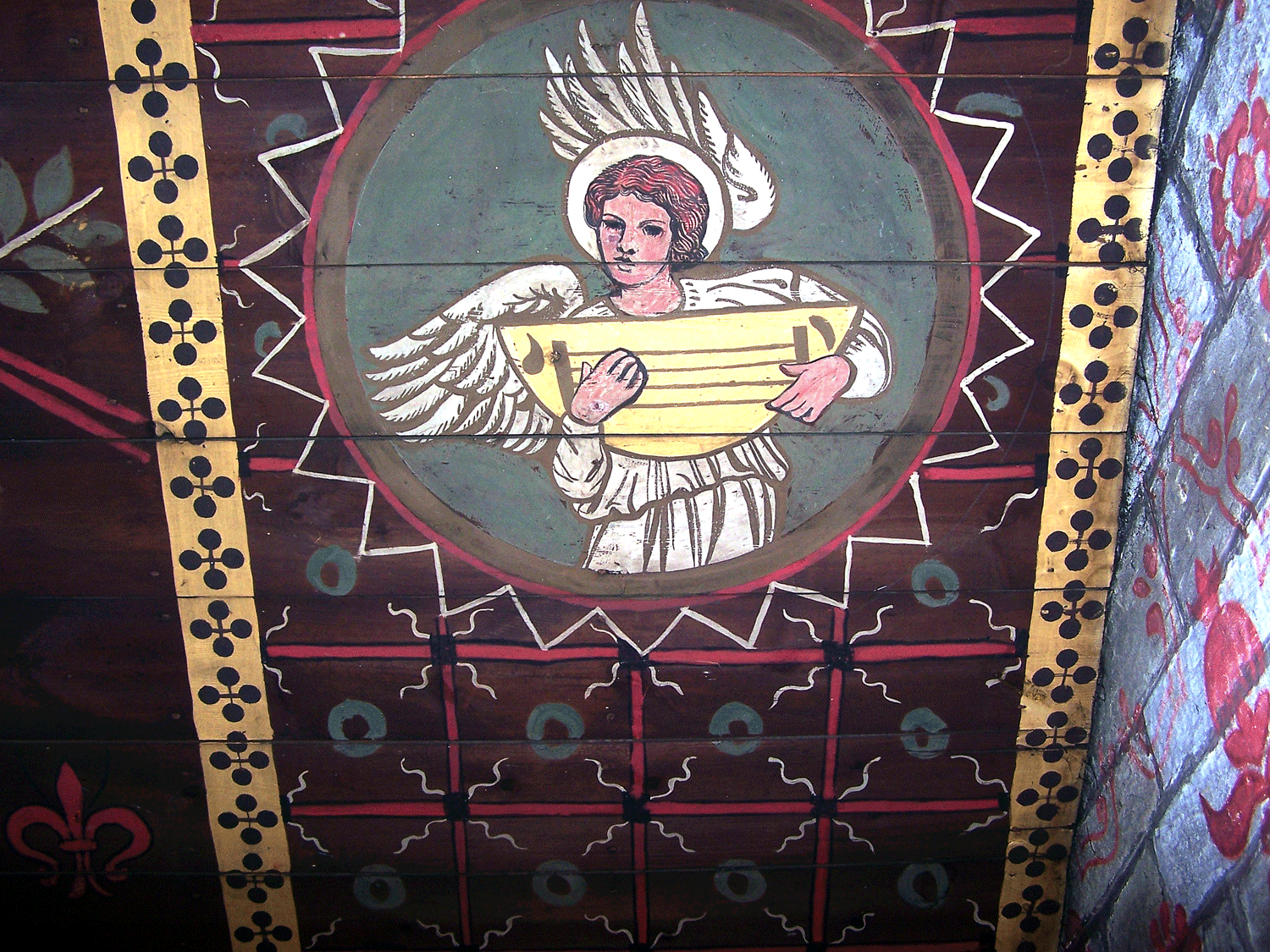
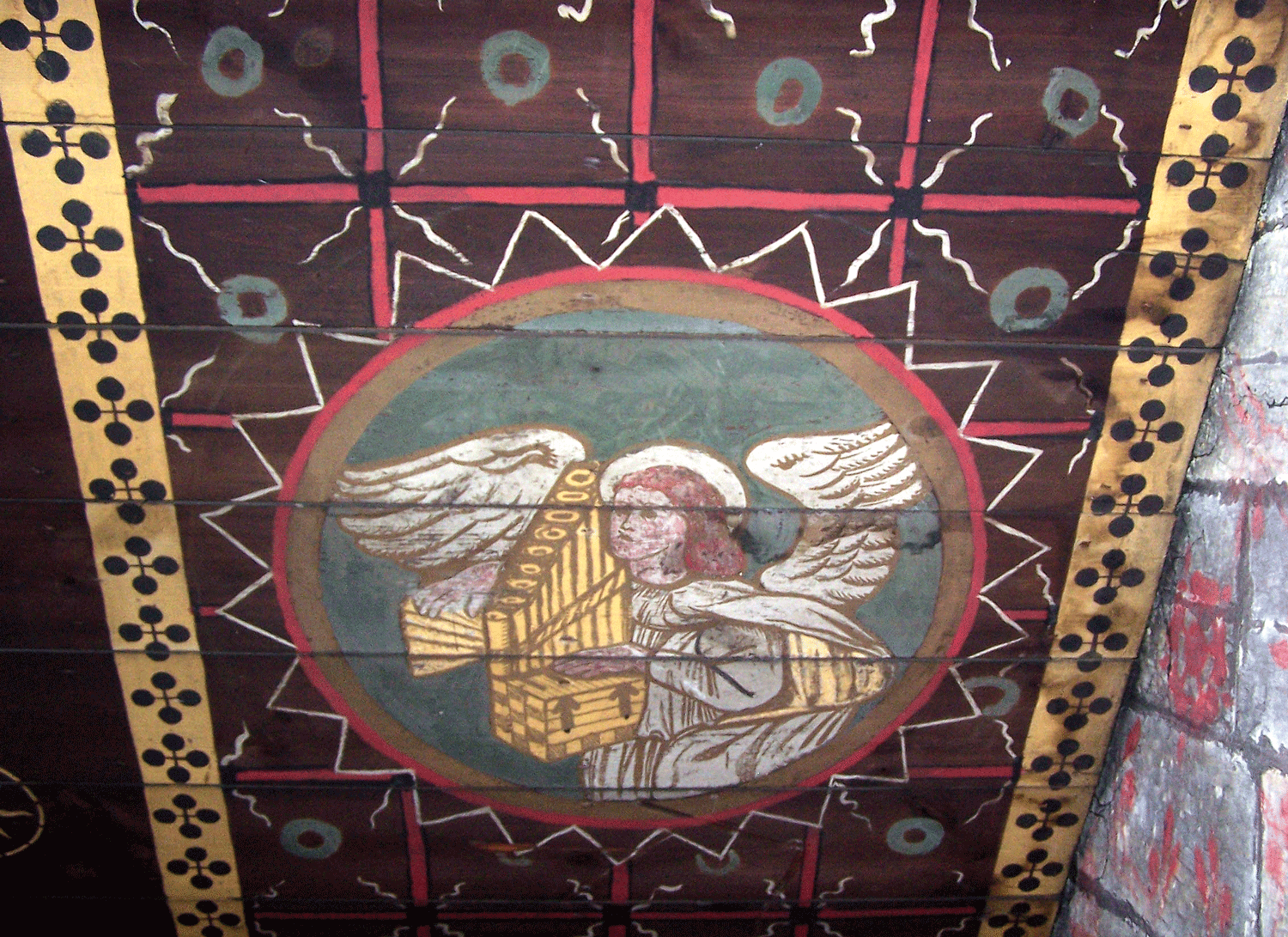
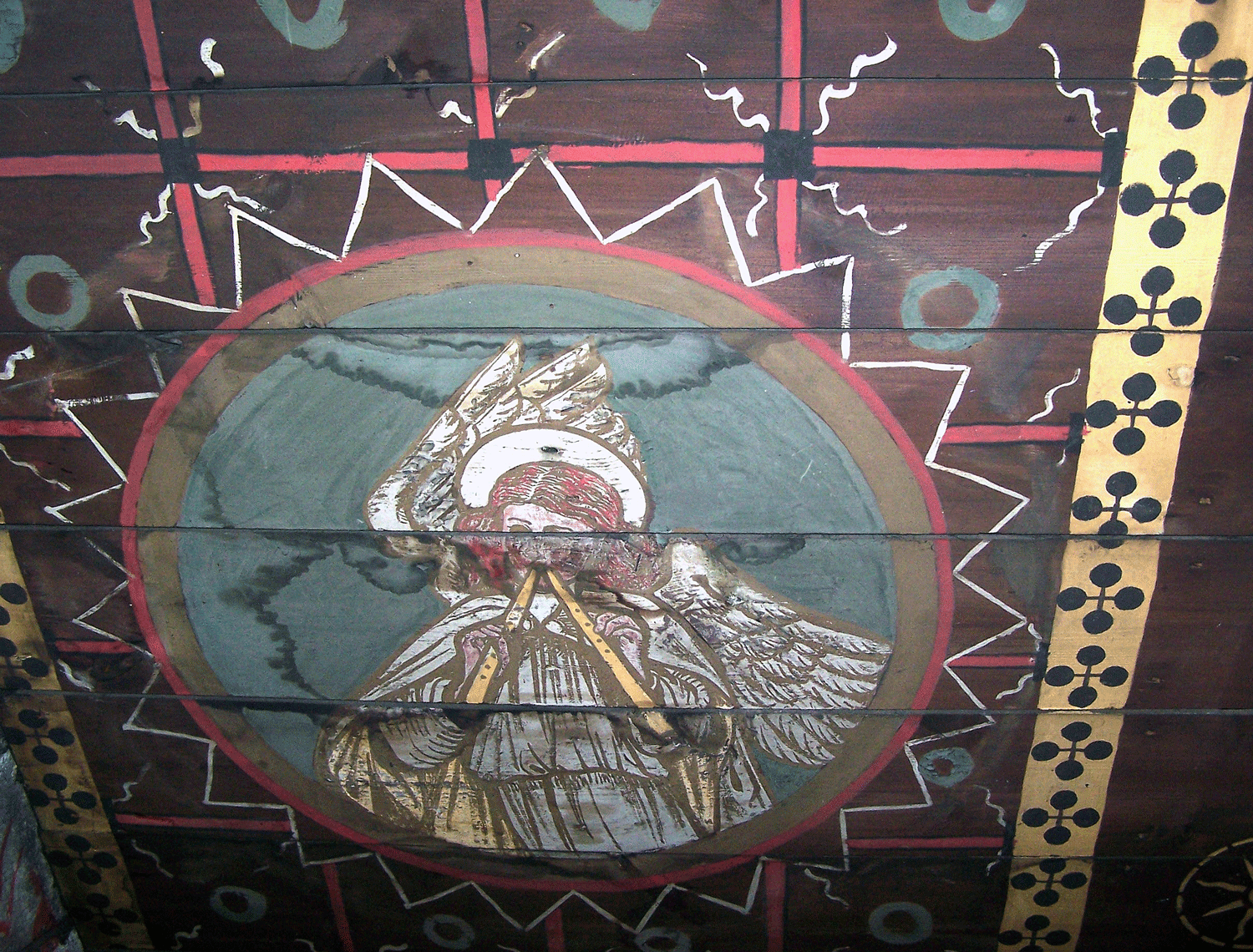
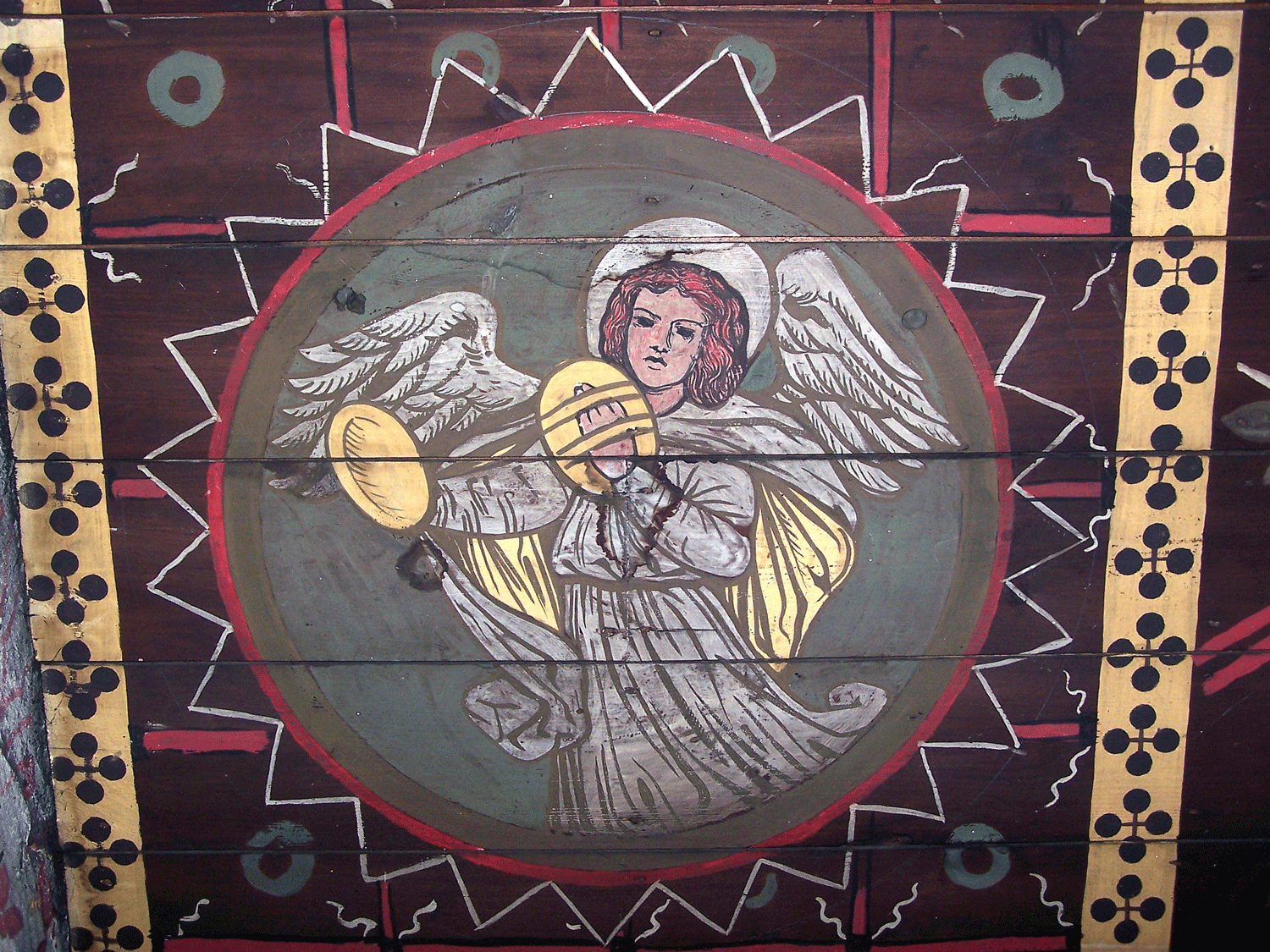
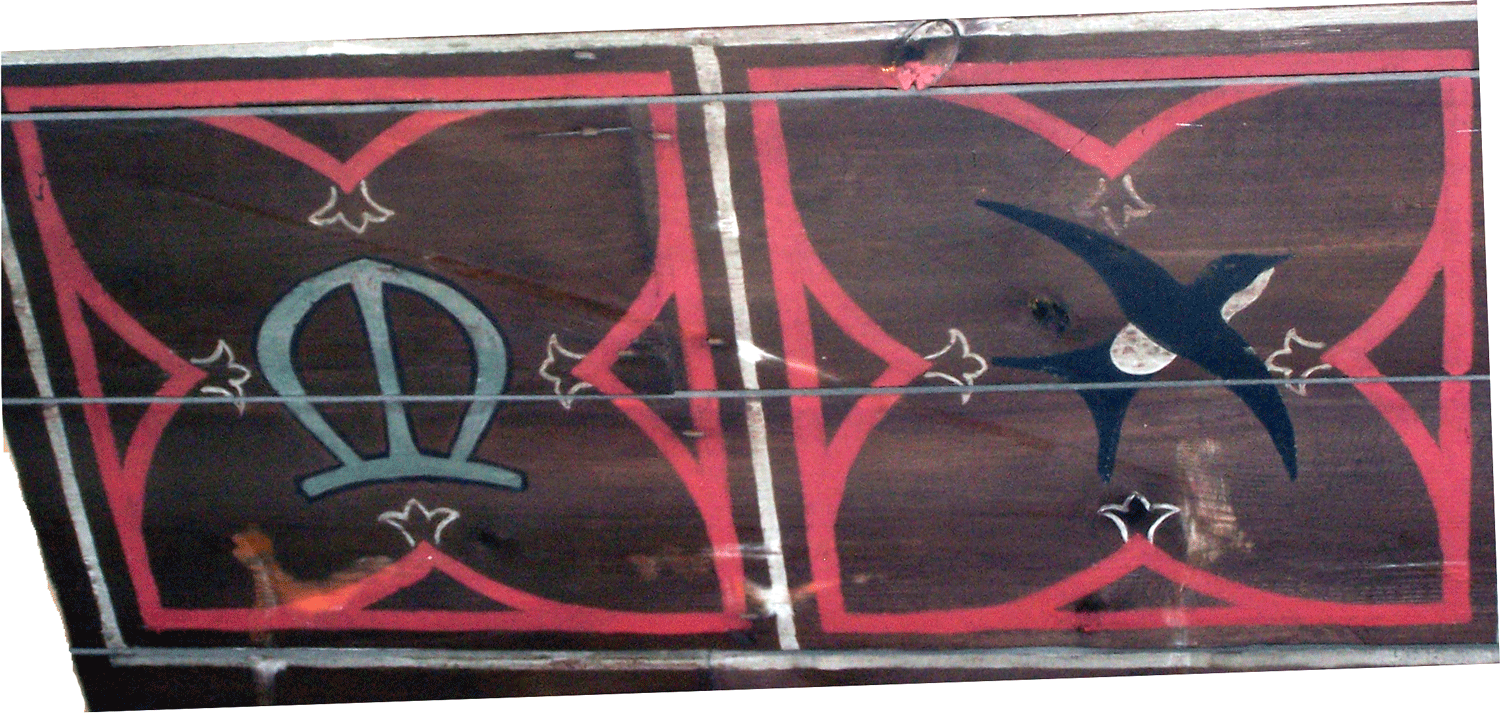

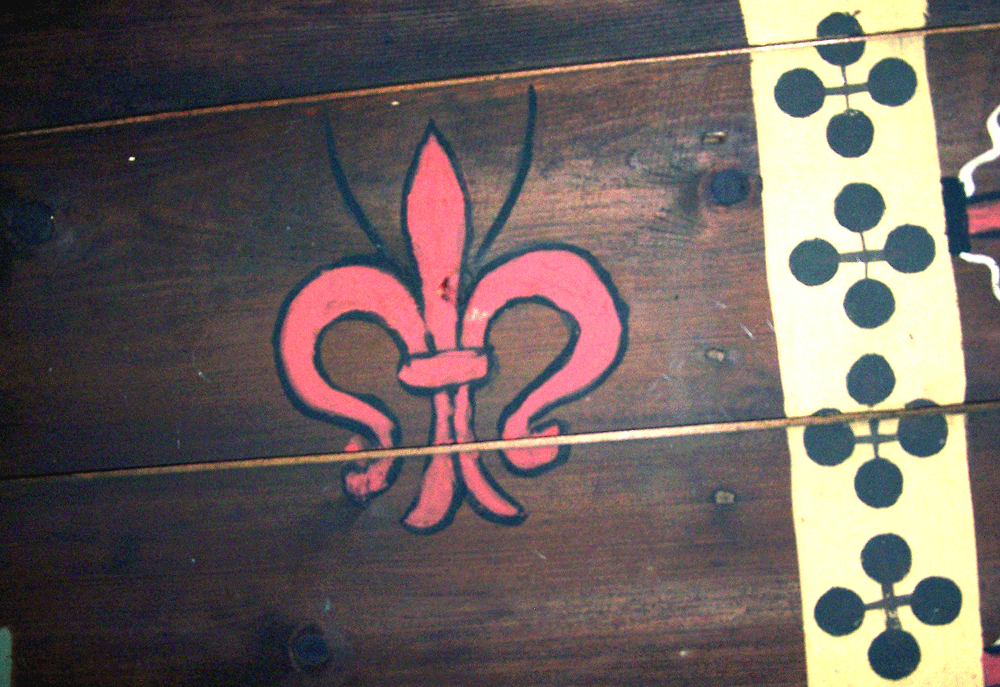
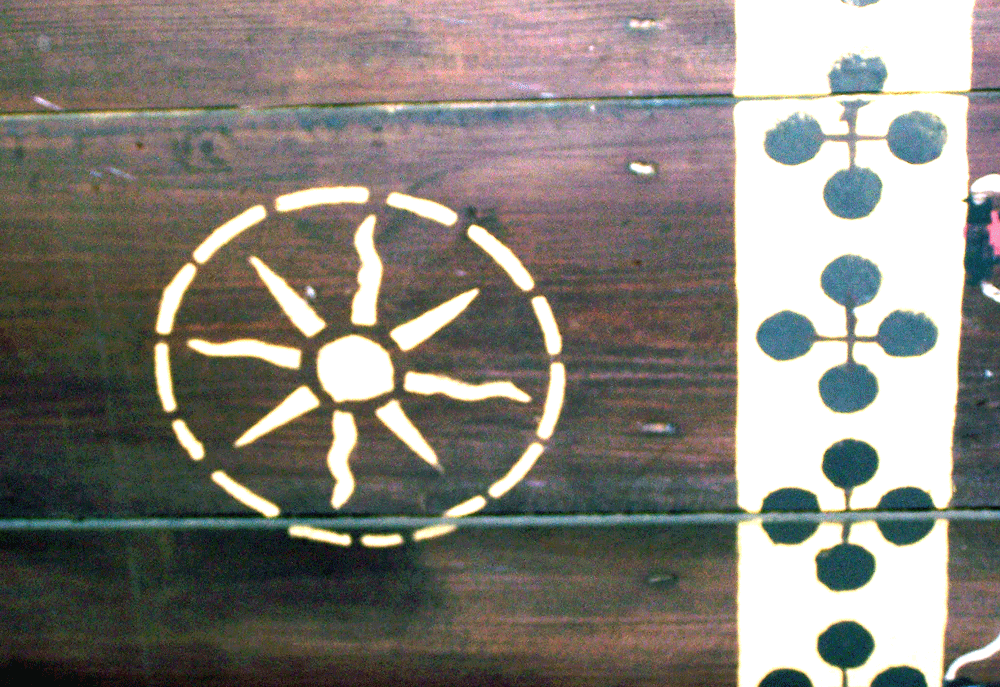
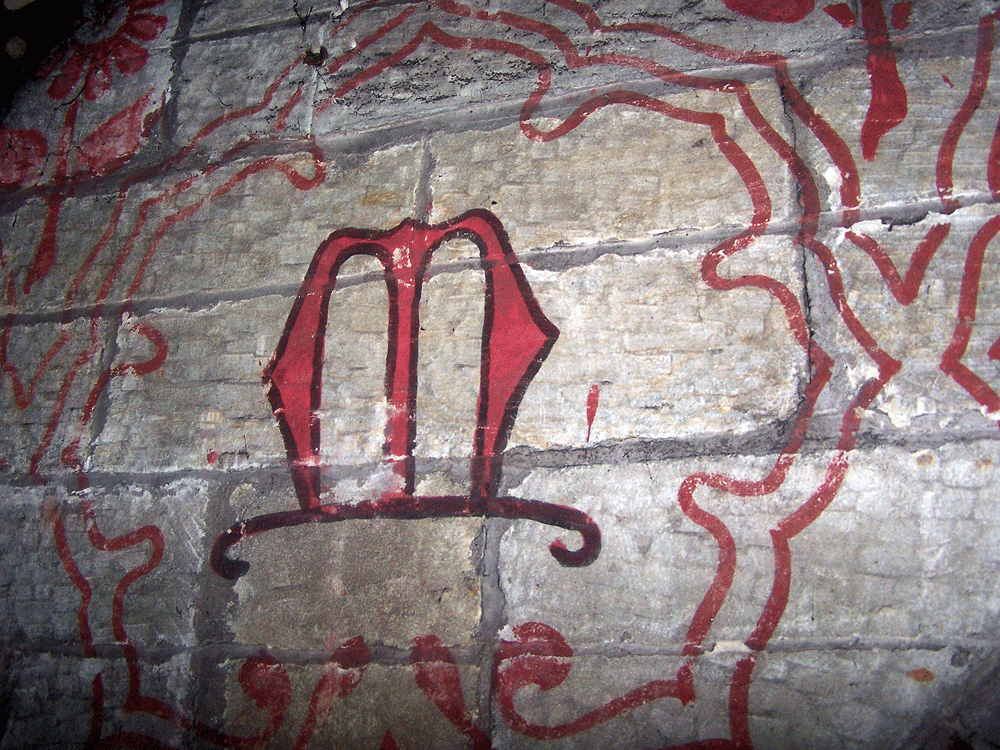
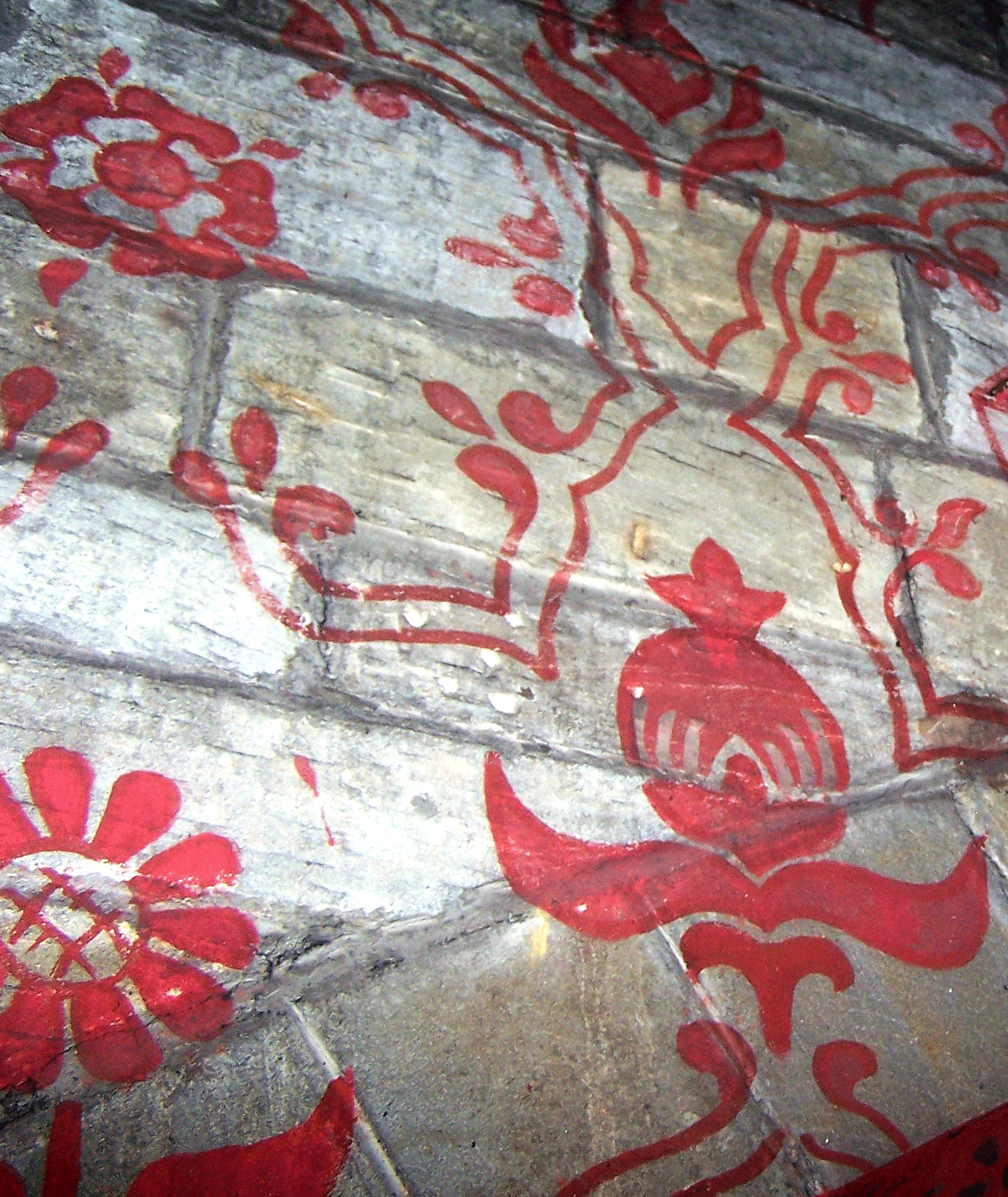
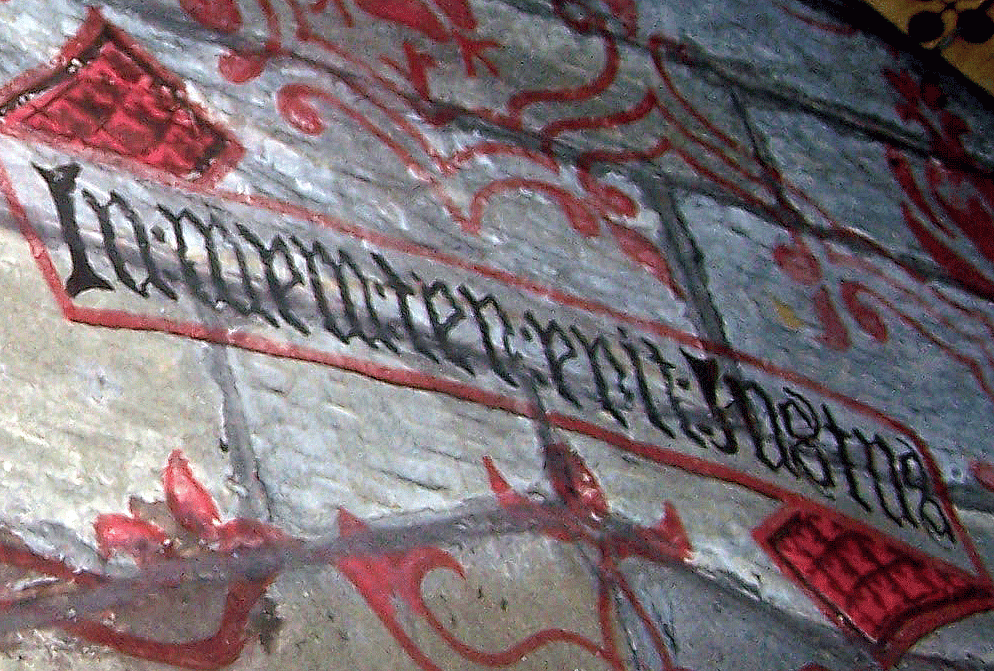
Here we see the monogram for Martin/Mary, a range of floral symbols, including the sunflower, rose and pomegranate, and an abrievated Latin scroll " in memoria aeterna erit justus" from the latin text of a requium mass:
Requiem aeternam dona eis, Domine
et lux perpetua luceat eis.
In memoria aeterna erit iustus,
ab auditione mala non timebit.
Eternal rest give unto them, O Lord
and let perpetual light shine upon them.
He shall be justified in everlasting memory,
and shall not fear evil reports.
20 : The east wall, reredos and altar, originally designed by Bodley, with paintings by George Campfield to designs by Morris and Burne-Jones
The East Wall
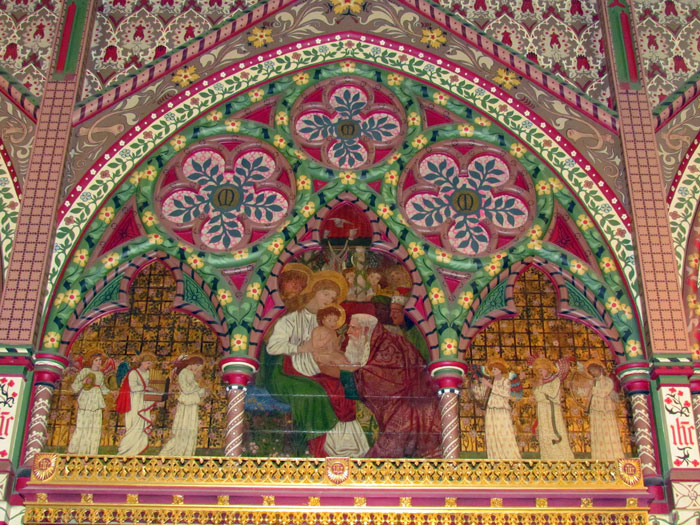
The original design of the East Wall was by Bodley, and it was paid for by Miss Mary Craven. The blank tracery is early English Decorated in inspiration, but not modelled on the tracery of Kirkham Priory (Yorkshire) as has been suggested.
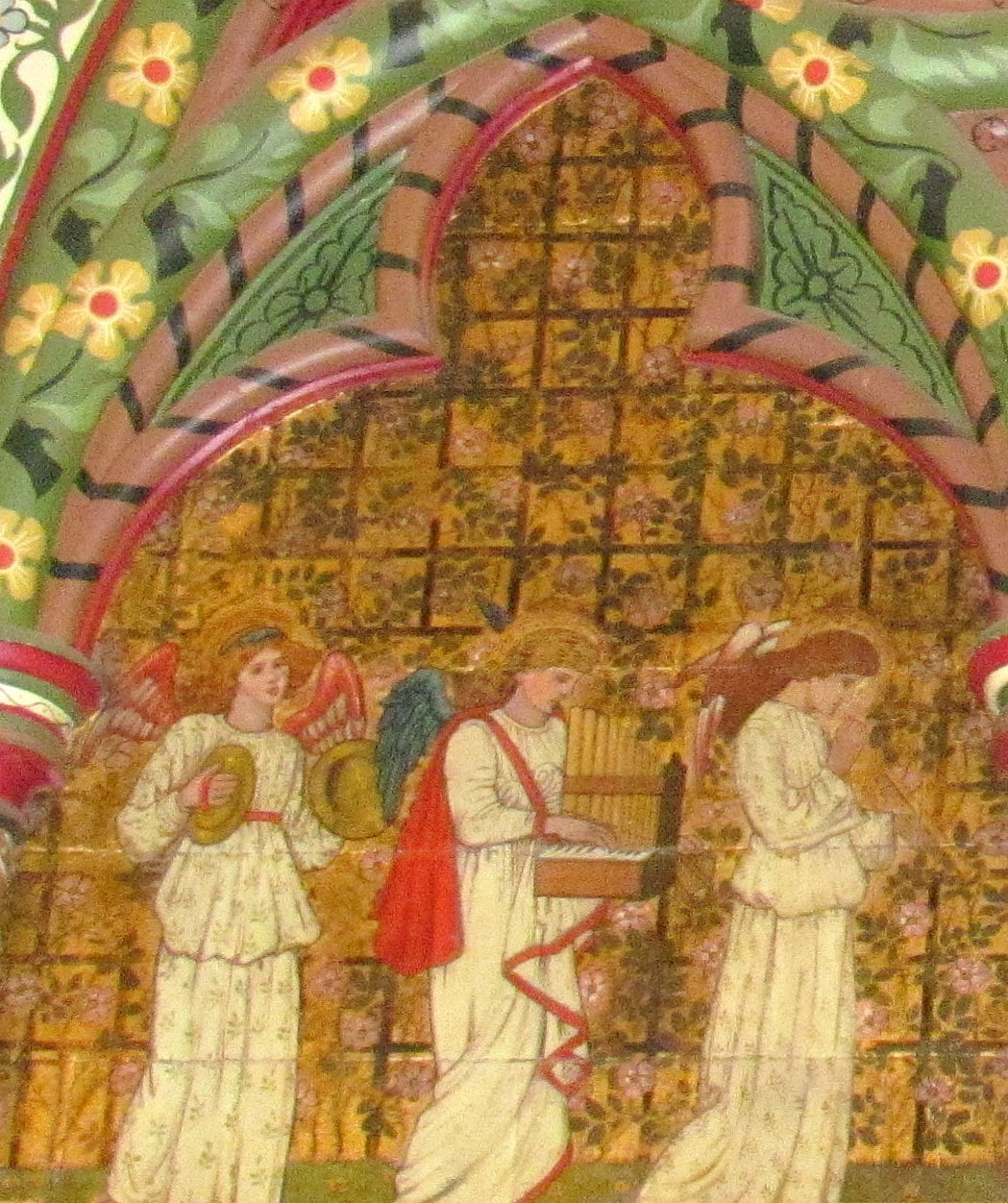
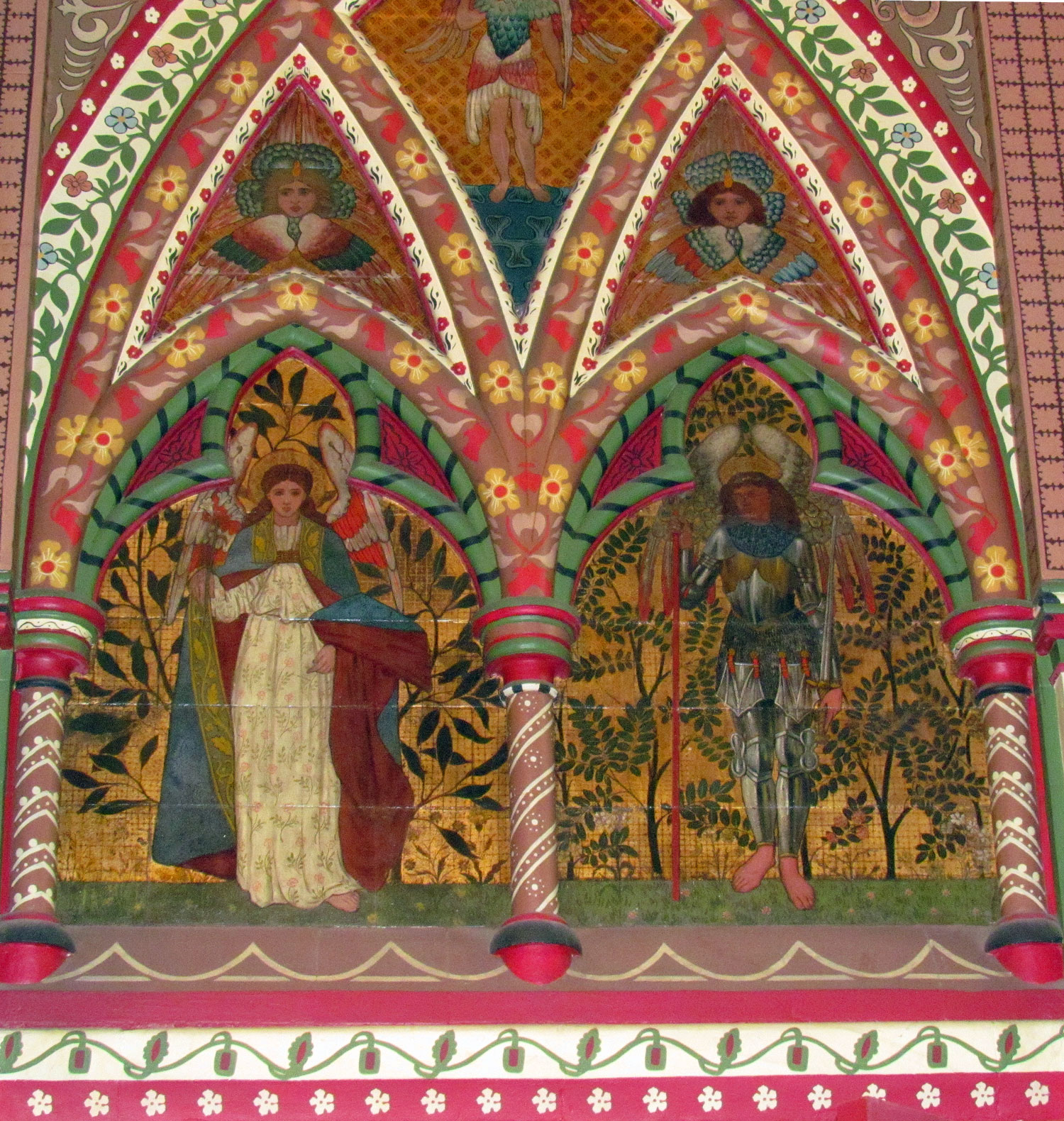
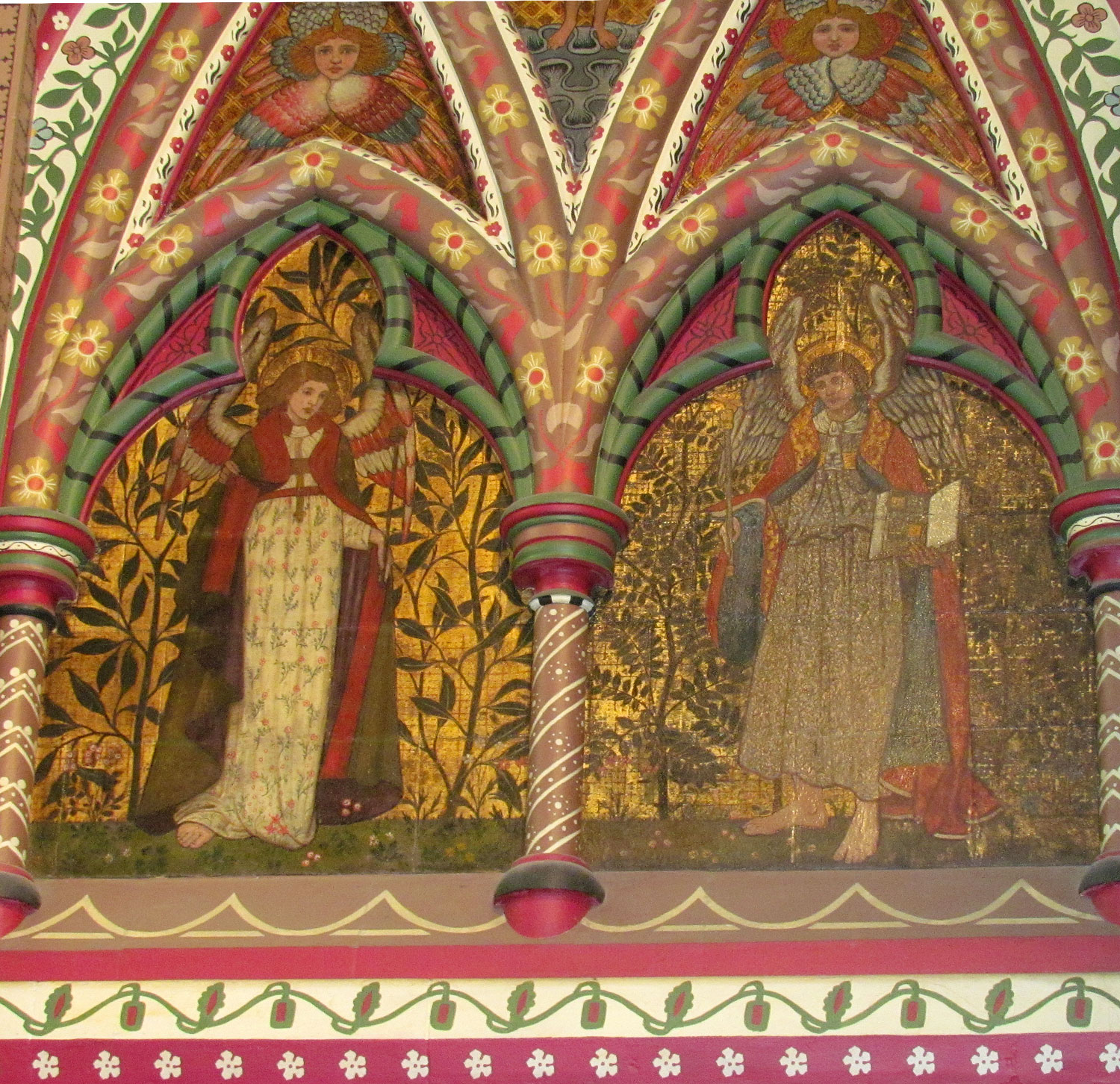
The four archangels in the north and south panels and the angels in the central panels were painted by George Campfield to designs by William Morris.
The central panel of the Adoration of the Magi was also painted by George Campfield, but this time to designs by Burne-Jones.
The work was painted and repainted between 1863 and 1865, but had so far deteriorated by 1889 as to need restoration by Thomas Farren. The tracery was again retored in 1973.
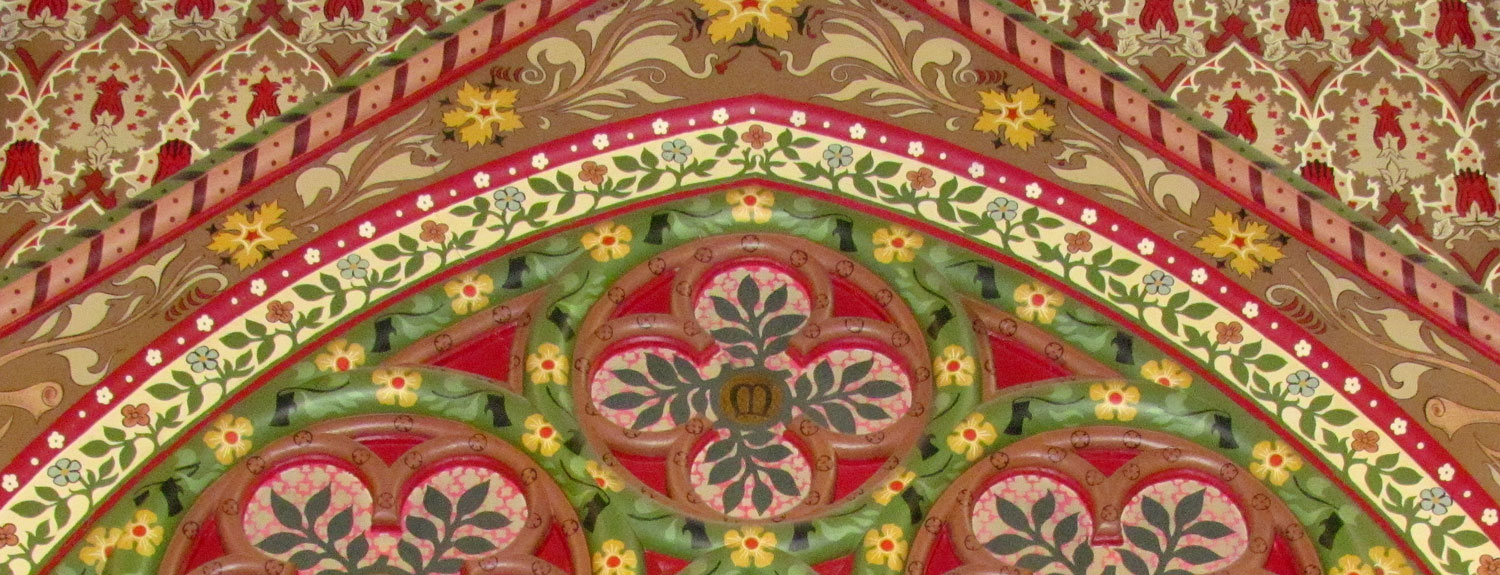
The wall possesses a rich symbolism with red pomegranate flowers and yellow narcissi both symbolising the resurrection, and the pelican on the central gable (seen "in its piety" feeding its young with its own blood) representing the sacrifice of Christ.
The whole east wall and window proclaims redemption through Christ's incarnation and blood, and it answers the theme of the west windows, which depict Adam and Eve, whose fall made redemption necessary, and the promise represented by the Annunciation.
Designed by Bodley with designs by Morris and Burne-Jones, painted by George Campfield.
The central section contains the painting of The Adoration of the Magi designed by Burne-Jones.
Flanking the central image of the Magi are the four archangels designed by William Morris.
Click on individual images below to enlarge.


The Reredos and Altar
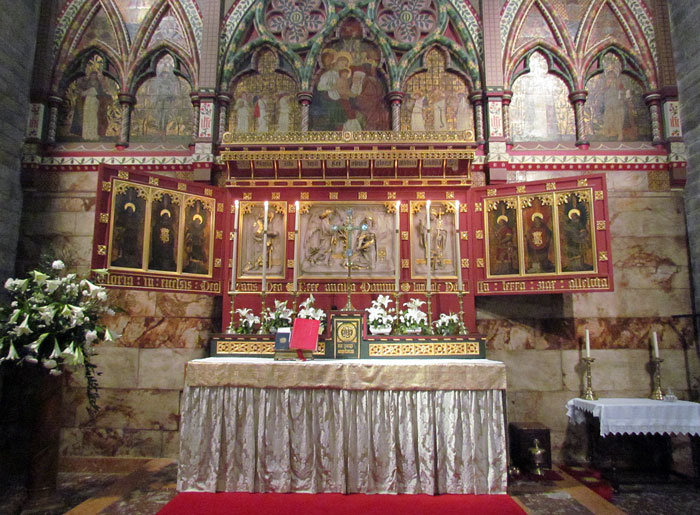
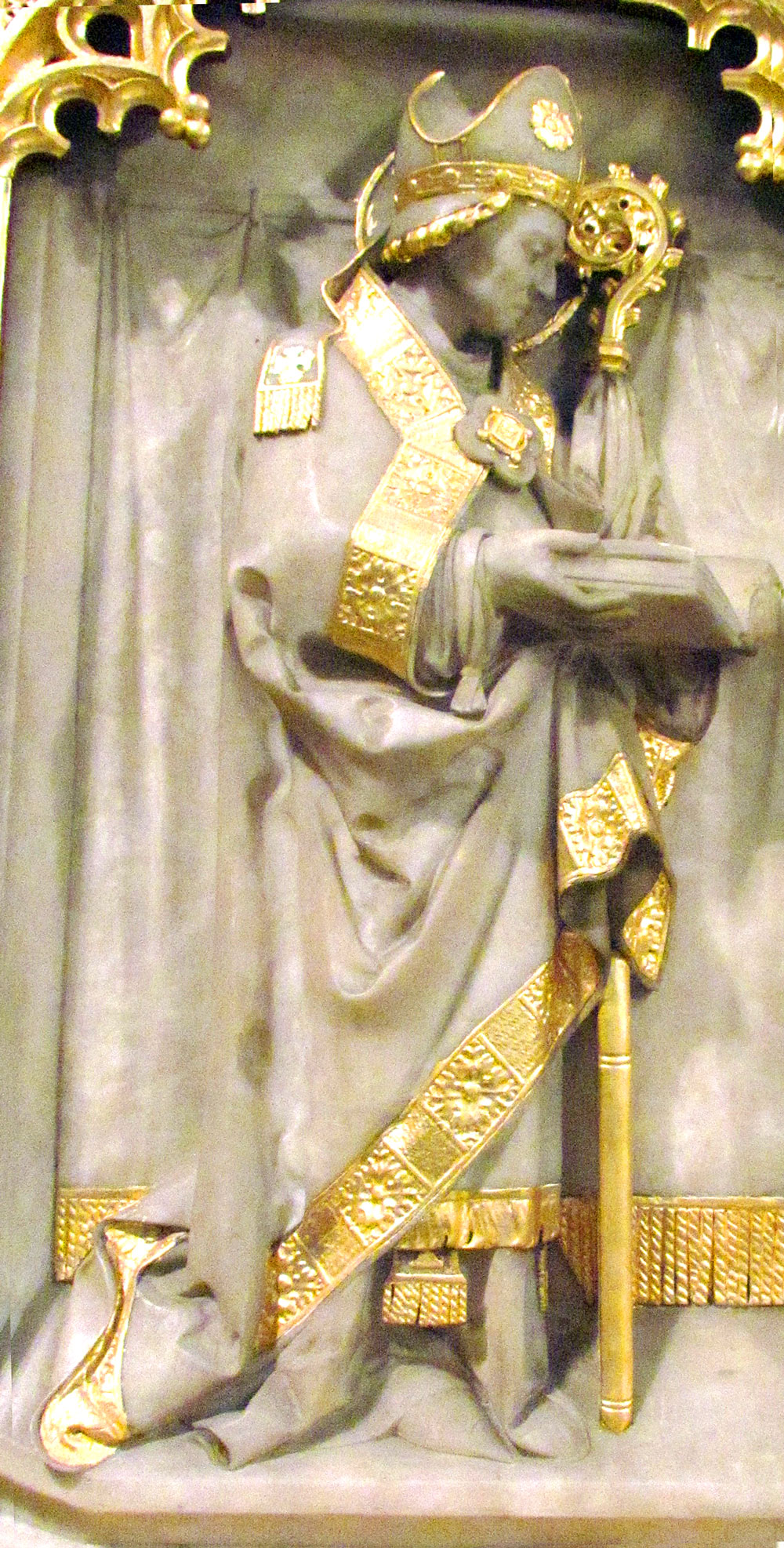
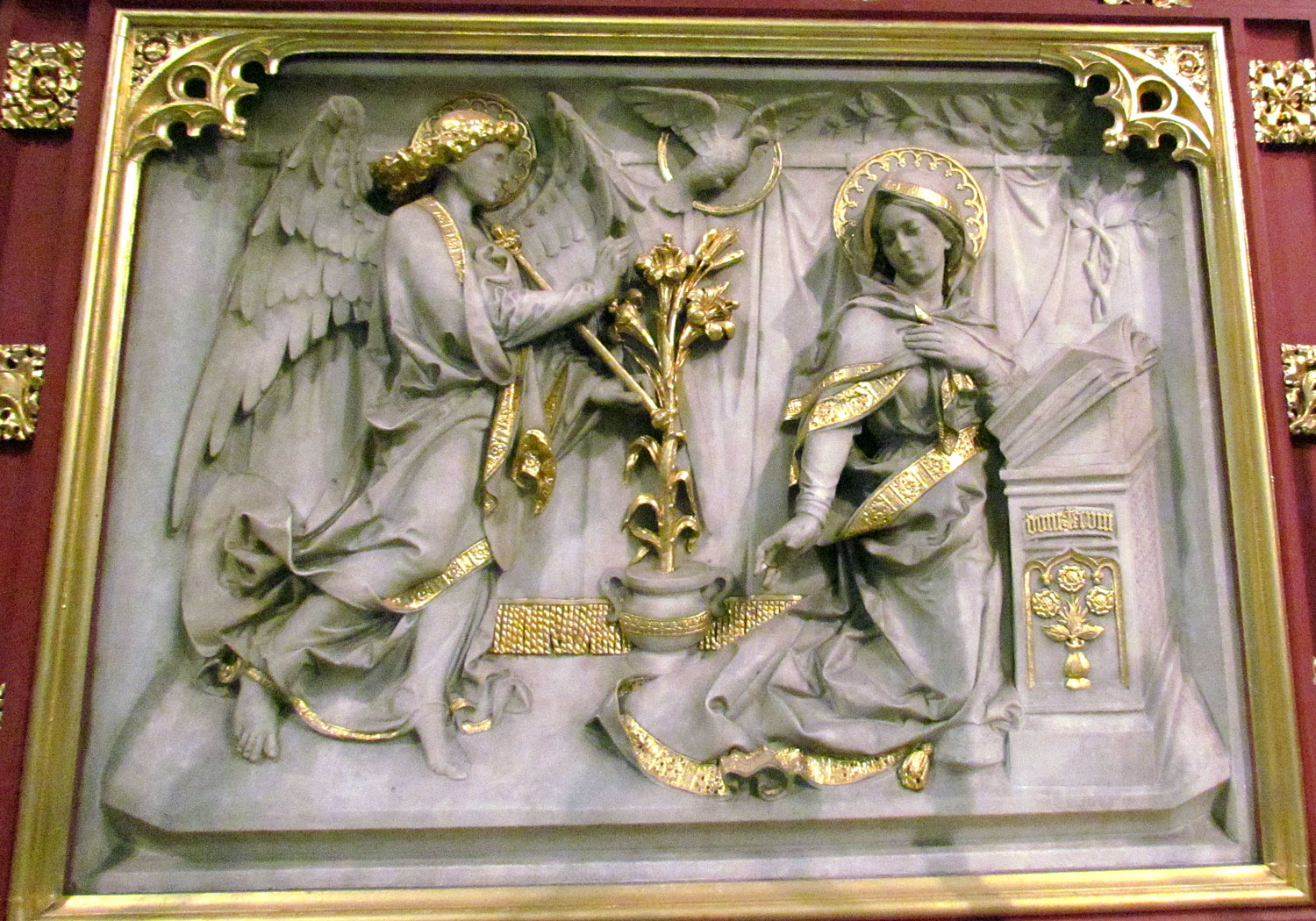
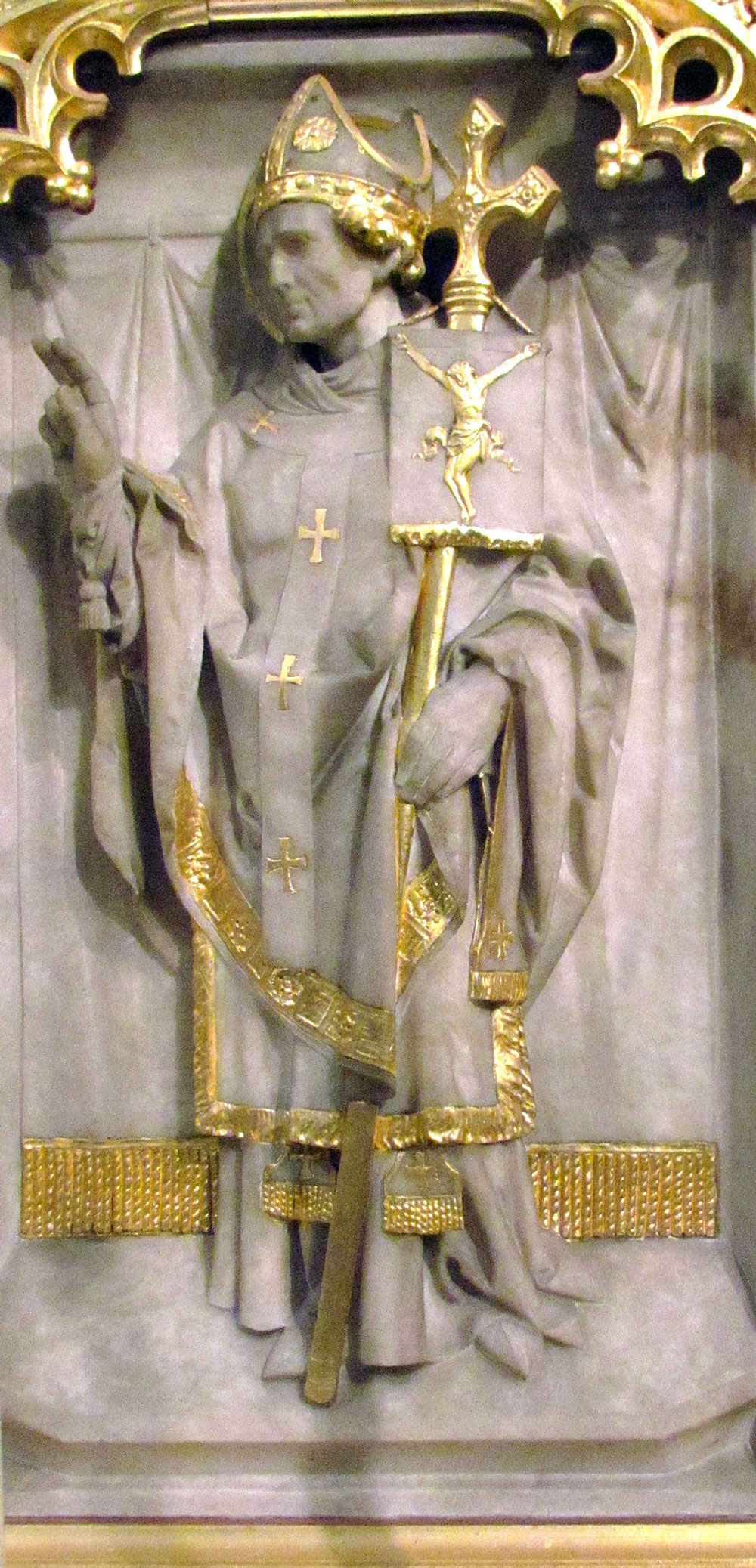
A reredos is an ornamental screen covering the wall at the back of the altar, and this was added in 1890 to a design by Bodley. The central panels are in bas relief and were executed by the firm of Farrer and Brindley. The central Annunciation is flanked by two early bishops of York, Wilfred (left) and Paulinus (right). Winged panels feature six archangels and give it the air of a triptych.
This, together with the classical altar, replaced an earlier plain altar table which is now in the church of St. Michael at Wheatcroft, at the south end of the parish.
St. Martin's has a rich collection of altar frontals; the most famous of them, the "red frontal" is thought to be the work of William Morris's wife, Jane.
21 : The screen (designed by Bodley) and chancel arch (decorated by Bodley)
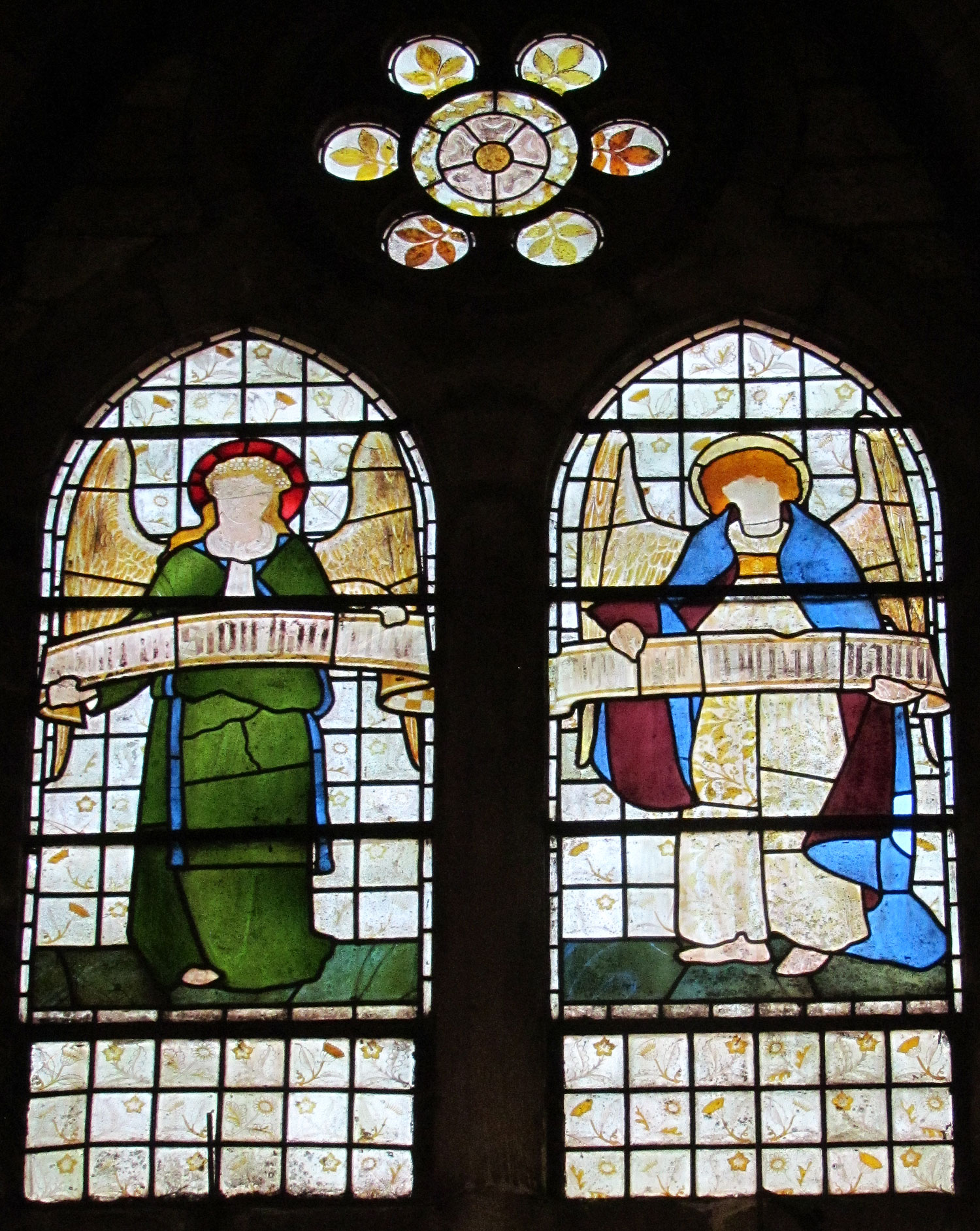
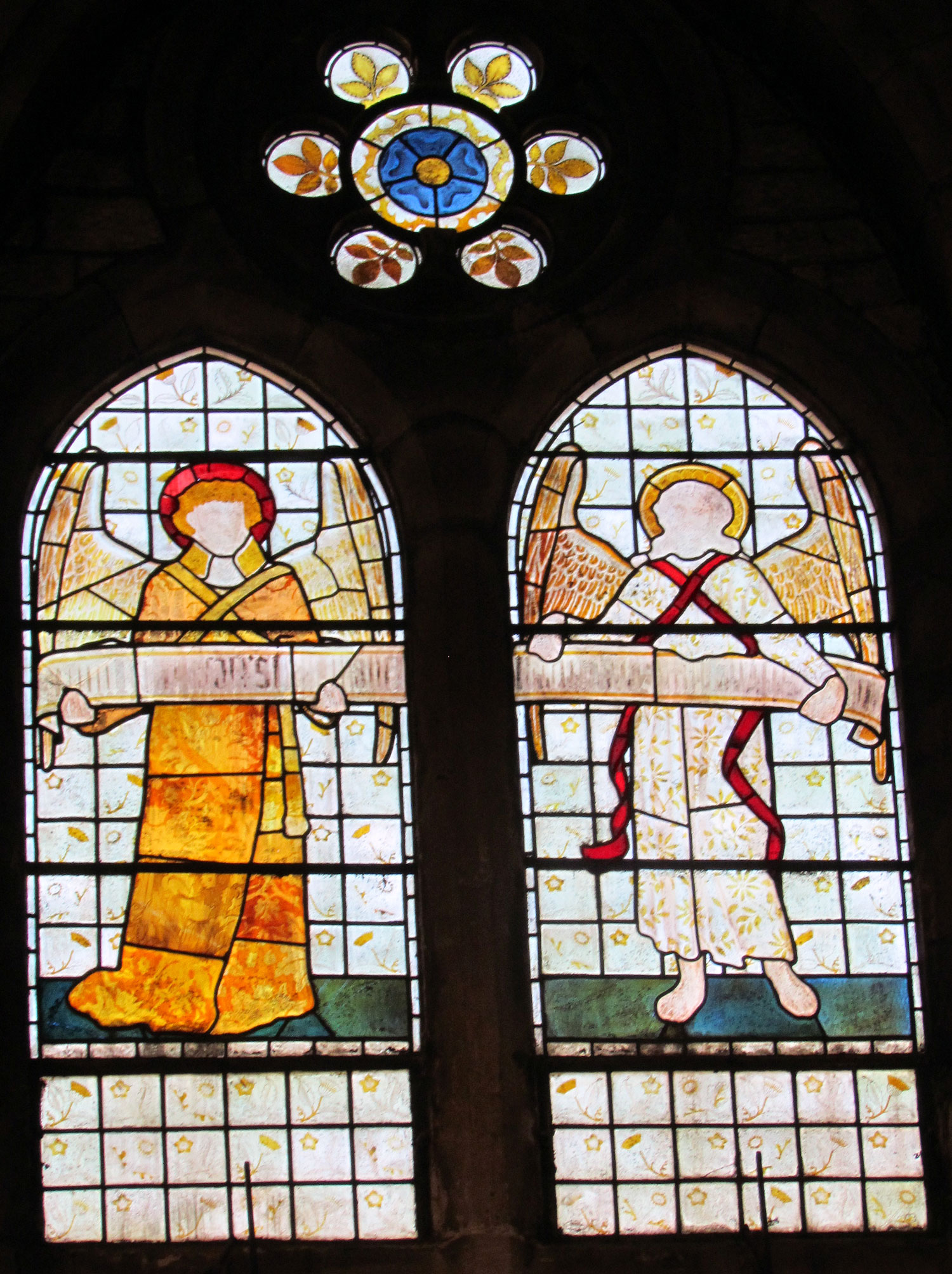
22 : Clerestory windows in the body of the nave by Morris and Co.
The Clerestory Windows in the Nave
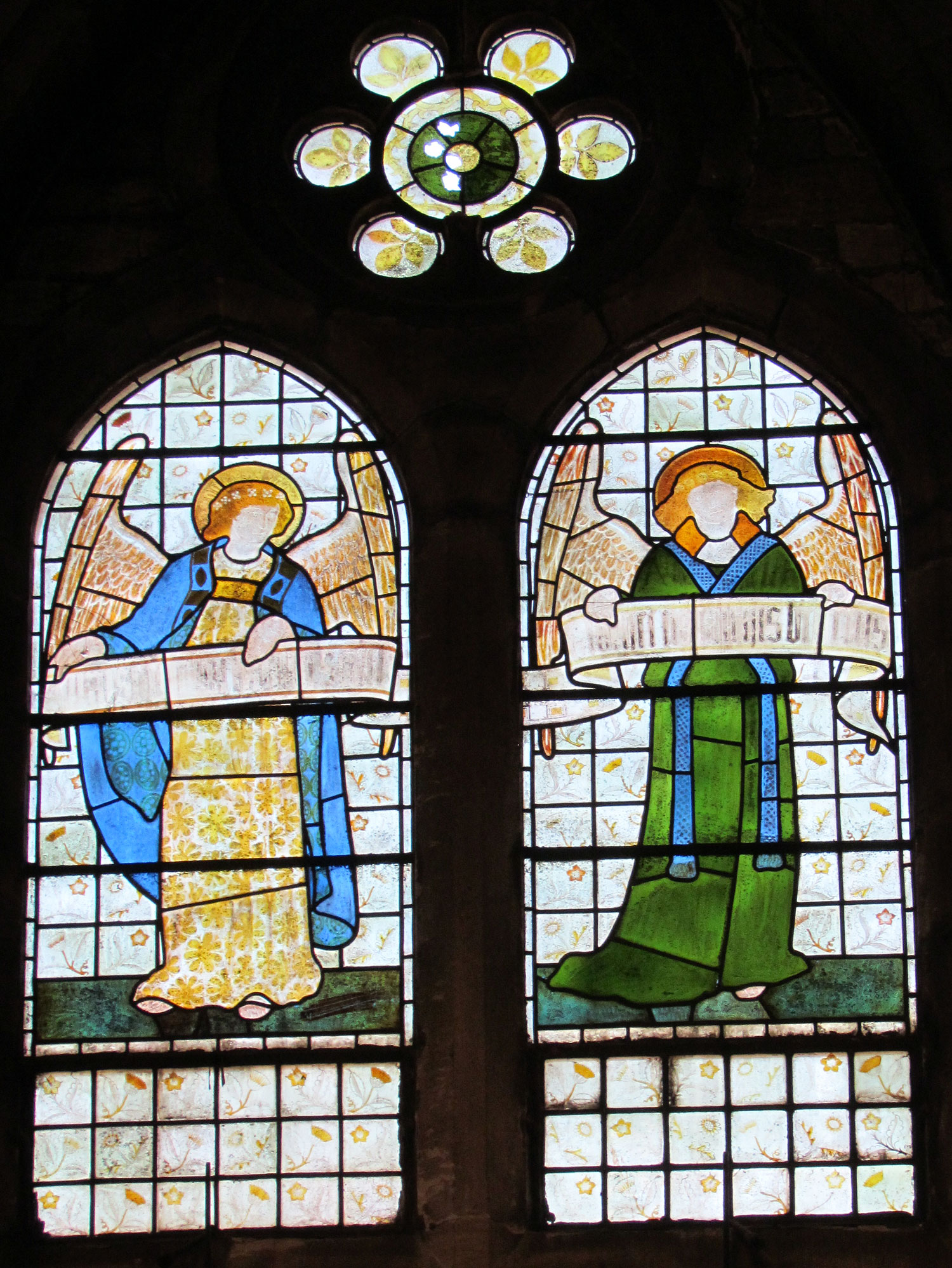
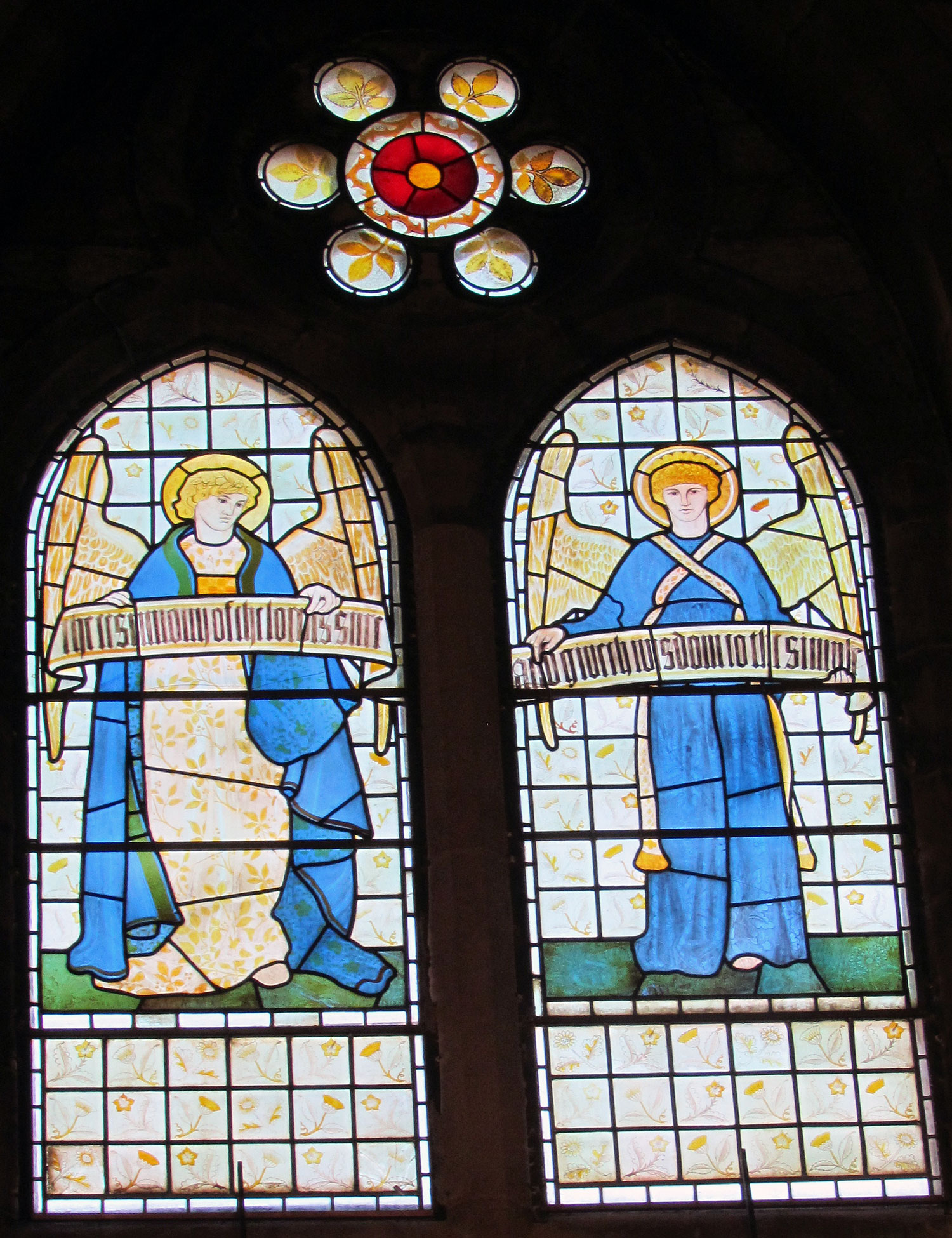
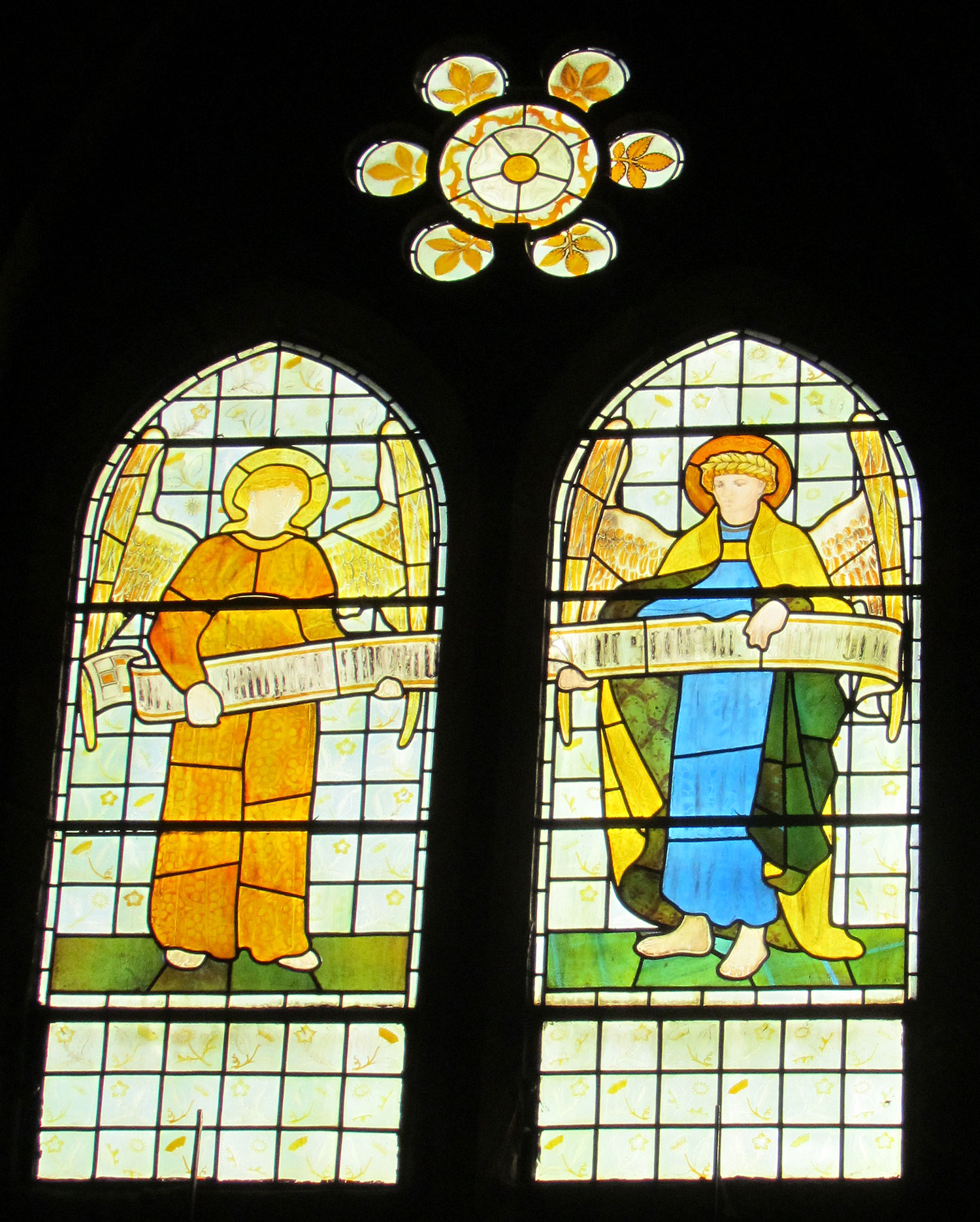
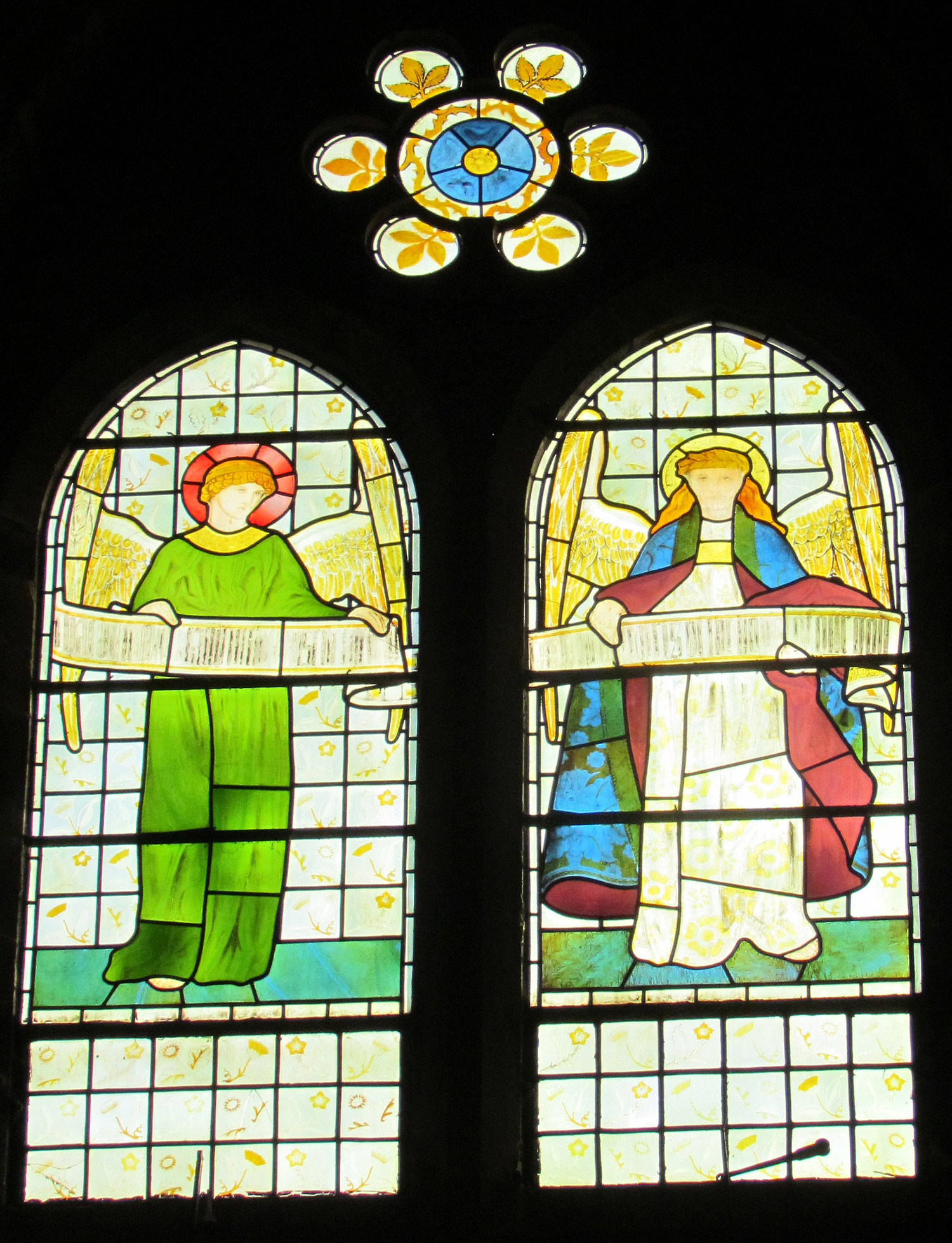
The eight clerestory windows in the Nave represent a variety of angels. They are all by Morris and Co. and were made from designs originally intended for the roof of the chapel of Jesus College, Cambridge. The angels are set against a background of quarrries (square panels of clear glass painted with foliage). The result is a series of windows that allow the maximum of light into the upper church.
The single window above the fifth bay of the nave represents St. John the Baptist. It is also by Morris and Co. and was the gift of Agnes Marshall to commemorate the birth of her first grandchild.
Originally the font stood in the bay beneath this window, which is why St. John the Baptist is depicted in it. Before the building of the Baptistry the main entrance was through the north door from Albion Road.
North Wall West
North Wall Centre West
North Wall Centre East
North Wall East
The north wall east clerestory window is the only one to have been restored when the east and west wall windows were restored to their original glory in 2006. By clicking on the individual windows for an enlargement you can easily compare the difference restoration makes.
South Wall East
South Wall Centre East
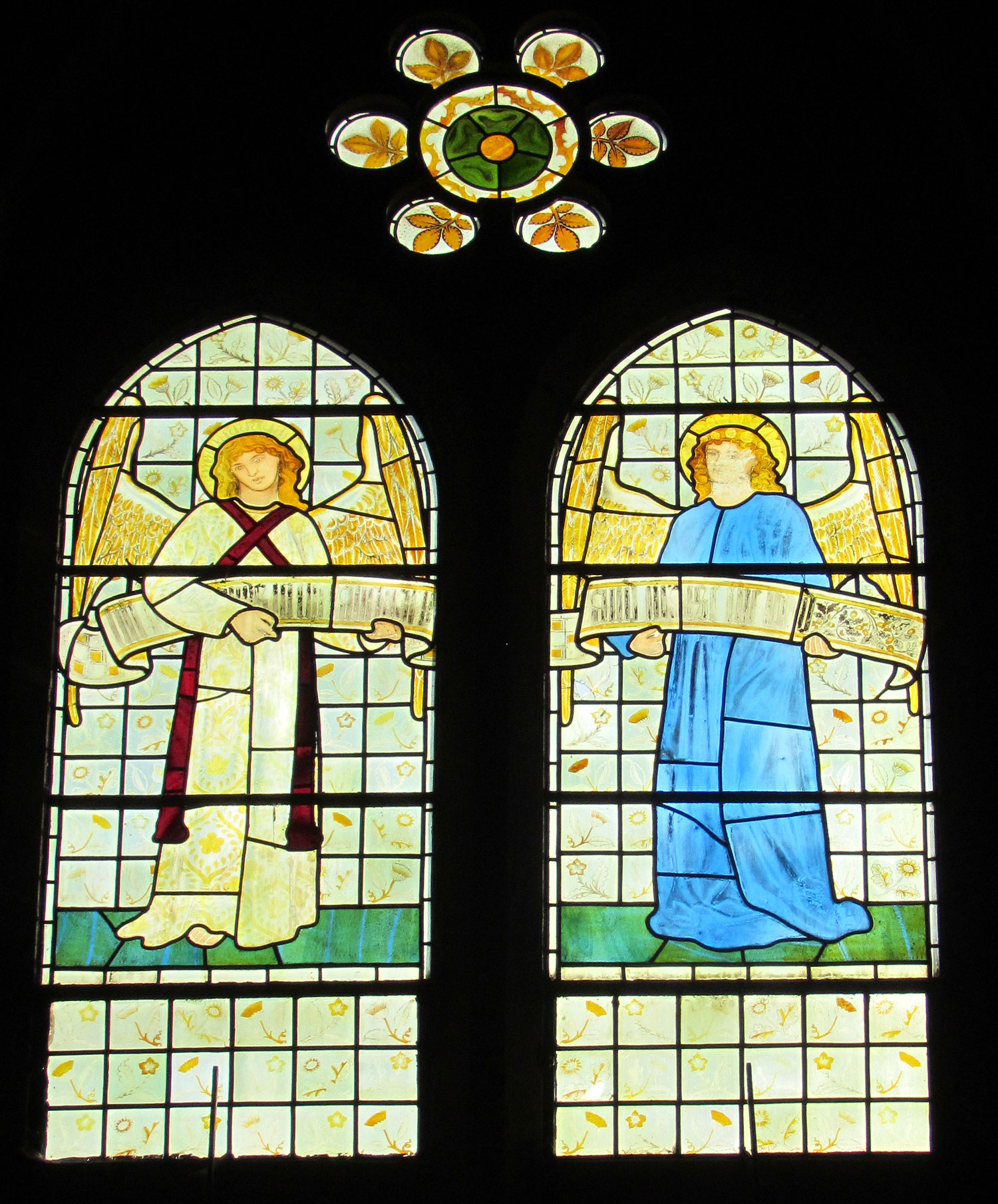
South Wall Centre West
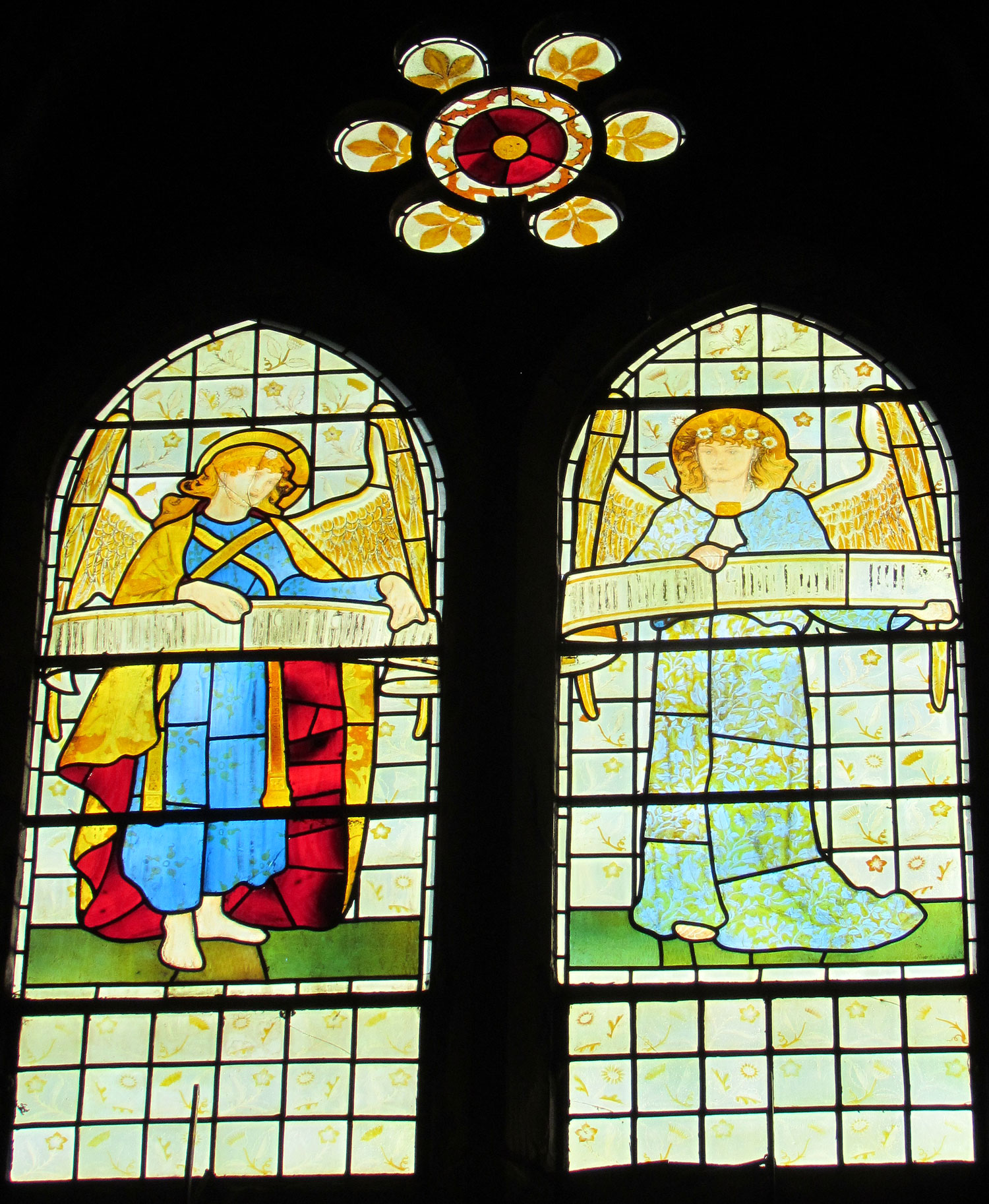
South Wall West
The text held by the angels in the restored window reads:
"The testimony of the Lord is sure, and giveth wisdom to the simple." Psalm 19 v.7. The other windows are unfortunately undecipherable.
However, a recently discovered hand-written note dated Whitsuntide 1870 by the first vicar, R. Henning Parr, gives us information about the texts of the other three northern clerestory lights.
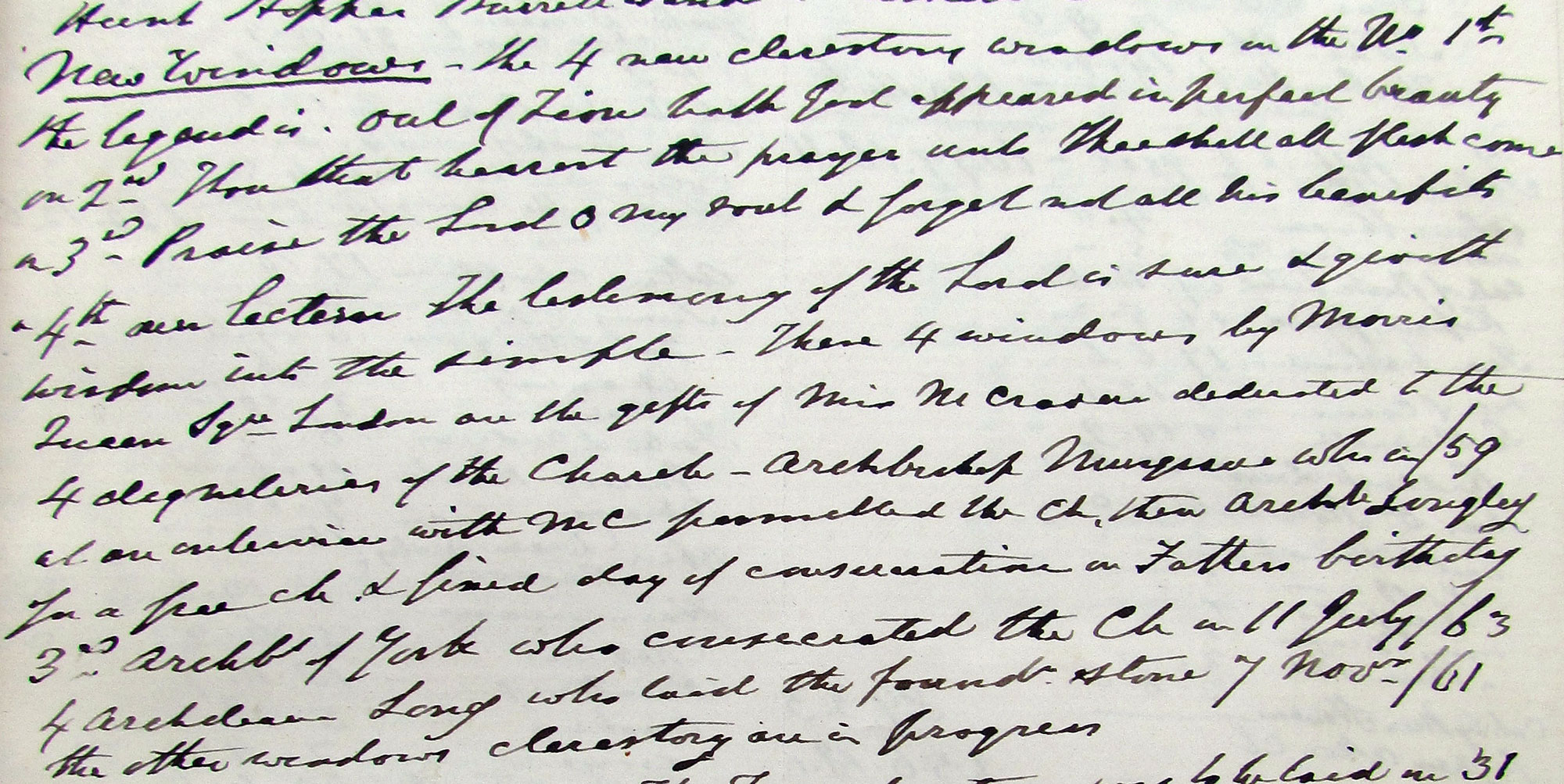
Click to enlarge.
A transcript of the above:
New windows The four new clerestory windows on the North
1st the legend is Out of Zion hath God appeared in perfect beauty (Psalm 50 v.2)
On 2nd Thou that hearest the prayer unto thee shall flesh come (Psalm 65 v2)
On 3rd Praise the Lord O my soul and forget not all his benefits (Psalm103 v 2)
On 4th over lectern "The testimony of the Lord is sure, and giveth wisdom to the simple." (Psalm 19 v.7)
The four windows by Morris, Queen's Square, London, are the gift of Miss M Craven dedicated to the dignitaries of the Church - Archbishop Musgrave who in (18)59 at an interview with MC (Mary Craven) formulated the Ch(urch), then Archdeacon Langley for a free church & fixed day of consecration on Father's birthday (Robert Martin Craven the father of Mary), 3rd Archbishop of York who consecrated the Church on 11th July (18)63
4 Archbishop Long who laid the foundation Stone 7th Nov (18)61
The other windows clerestory are in progress.
Unfortunately no further note has yet been found to help us identify the texts held by the angels on the south clerestory lights.
Burlison and Grylls
Please note this section of the website is still under construction and links below are not yet available.
With the extension of the Church to the west for the Narthex in 1879 new windows were inserted by the firm of Burlison and Grylls in the Parish Office, Narthex and Baptistry. The company was founded by Bodley’s partner, Thomas Garner.
Thomas Garner was born on 12 August 1839, trained in the office of Sir George Gilbert Scott and entered into partnership with George Frederick Bodley in 1869 which lasted until c1897. He was an able but reticent exponent of the late Gothic Revival in England. He died on 30 April 1906.
You may explore the Burlison and Grylls glass either by selecting the letters A – G on the plan or from the list below.
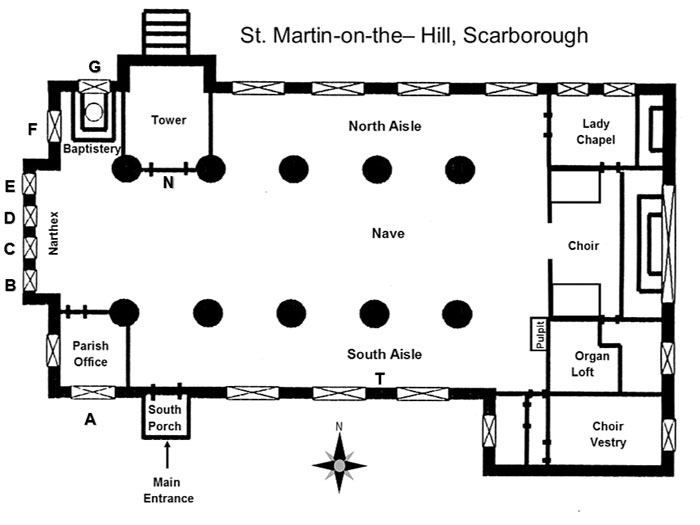
A : The Parish Office (until 1987 it was The Chapel of St. George used as a requiem chapel for the overnight reception of biers). The windows depict Saints Augustus, Monic and George.
B : The Narthex South Window
C : The Narthex Centre-South Window
D : The Narthex Centre-North Window
E : The Narthex North Window
F : The Baptistry West Window
G : The Baptistry North Window depicting Saints Martin, John and Paulinus, and the Nativity
Other features that may be explored from this section include:
N : The North Cross
T : The Titanic Connection – James Moody
The Lady Chapel
St John the Baptist